


 English
 French
A powder mixing system involves more than selecting a suitable mixer. For food additive manufacturers, the way powder enters the system and moves between equipment can also affect workshop cleanliness, material handling efficiency, and daily operation.
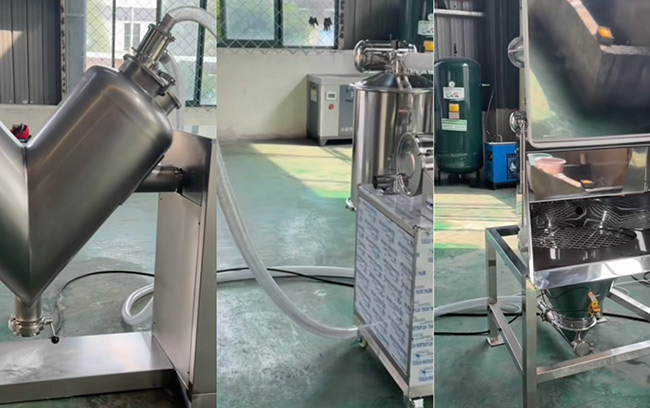
In this project, Salinovate connected three units: a dust-free feeding station, a vacuum conveyor, and an SLV-300 V-type mixer. The system was designed around a practical production requirement: feeding food additive powders into the mixer while reducing dust generated during manual loading and minimizing unnecessary open handling. The mixer has a vessel design volume of 300 L and a loading volume of 150 L. Based on the powder’s approximate bulk density of 0.6 kg/L, the calculated batch load is around 90 kg.
This project illustrates an important principle in powder processing: the feeding equipment, conveying method, and mixer should be considered as one connected material-handling system, rather than three independent machines.

I. Why Powder Mixing Requires More Than a Mixer
Choosing a powder mixer based only on its vessel volume may overlook important parts of the production process. Before mixing can begin, the powder must be introduced into the system and transferred to the mixing vessel.
For food additive powders, this stage deserves particular attention. Opening bags and manually charging powder can release dust into the surrounding area, while repeated manual handling may add labor and make the feeding process less convenient.
A connected feeding and mixing arrangement addresses these challenges at different stages:
• Feeding: A dust-free feeding station provides a designated point for introducing powder into the system and helps control dust generated during loading.
• Conveying: A vacuum conveyor transfers the powder from the feeding station toward the mixer, reducing the need for repeated manual movement.
• Mixing: The SLV-300 V-type mixer provides the vessel in which the batch is mixed.
Each unit serves a different purpose, but the benefit comes from coordinating them into a continuous material route.
For manufacturers planning a powder mixing upgrade, the key question is therefore not simply which mixer to buy. It is how to move material from the loading point to the mixing vessel in a way that suits the product, operating environment, and production requirements.
II. System Configuration: Three Units with Different Functions
This dust-free powder mixing system combines a dust-free feeding station, a vacuum conveyor, and an SLV-300 V-type mixer. Their functions are complementary, and the connection between them determines how the powder moves through the process.
2.1 Dust-Free Feeding Station: Managing Powder at the Loading Point
The feeding station is the starting point of the material route. Operators introduce the food additive powder here rather than handling the mixer as the primary loading point.
This arrangement creates a designated area for bag opening and powder feeding. It is intended to help capture dust generated during loading and reduce the spread of airborne powder around the workshop. The actual dust-control performance depends on the feeding station’s configuration, the powder’s properties, and how the equipment is operated. The objective is to improve control at the point where powder enters the system, rather than assume that dust can be eliminated completely.
2.2 Vacuum Conveyor: Transferring Powder to the Mixer
After the powder enters the feeding system, the vacuum conveyor moves it toward the V-type mixer. Vacuum conveying can reduce the need for operators to manually carry and pour powder between separate machines. It also helps establish a more organized material route between the feeding point and the mixing vessel.
When planning this connection, manufacturers should confirm the conveying distance, powder characteristics, required transfer rate, and available installation space. These factors influence the suitability and configuration of the conveying equipment.
2.3 SLV-300 V-Type Mixer: Mixing the Required Batch
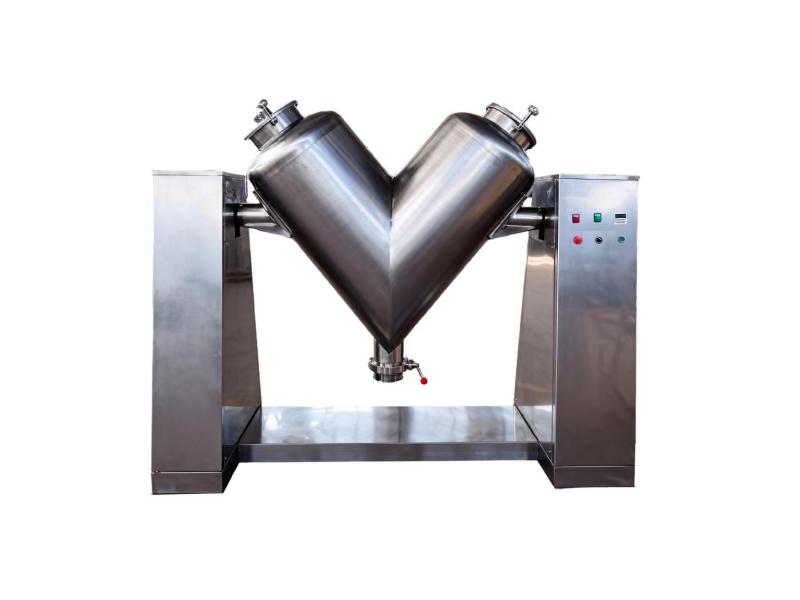
The SLV-300 V-type mixer is the mixing unit in this system. Its design vessel volume is 300 L, with a loading volume of 150 L for the project.
The V-type configuration is used for batch powder blending. For food additive applications, the appropriate mixing arrangement should be evaluated against the formulation, particle characteristics, required blend uniformity, and production procedure.
In this project, the mixer is not treated as an isolated machine. It forms the final stage of the connected feeding-and-conveying route, receiving powder transferred from the upstream equipment.
III. How the Integrated Powder Handling Process Works
The system follows a straightforward material route: powder feeding, vacuum conveying, and batch mixing.
Step 1: Introduce the powder at the feeding station.
The operator loads the food additive powder at the designated feeding point. The feeding station is intended to help manage dust generated during bag opening and loading.
Step 2: Transfer the powder through the vacuum conveying system.
The vacuum conveyor draws and transfers the powder toward the mixer. This reduces the need for repeated manual transfer between the feeding station and the mixing vessel.
Step 3: Deliver the powder to the SLV-300 V-type mixer.
The conveyed material enters the mixing vessel according to the system’s configured connection and operating procedure.
Step 4: Carry out batch mixing.
Once the required material has been loaded, the SLV-300 V-type mixer performs the mixing operation. The batch size and operating parameters should be confirmed according to the actual powder and process requirements.
The integration focuses on coordinating the material route before mixing begins. You can watch the following video to clearly see the connections of the three devices in this food additive powder mixing project. What’s more, it should not be assumed to include automatic weighing, recipe control, or automatic discharge unless those functions are specifically included in the system configuration.
IV. Matching Mixer Volume to the Required Batch Size
Mixer selection should consider both vessel volume and the amount of material loaded per batch. Bulk density is useful for estimating batch mass, but it should not be confused with the mixer’s vessel capacity. For this project, the main figures are:
Item Name | Project Specification |
Mixer model | SLV-300 V-type mixer |
Design vessel volume | 300 L |
Max loading volume | 150 L |
Powder bulk density | Approximate 0.6 kg/l |
Calculated batch load | Approximately 90 kg |
Application | Food additive powder mixing |
The batch mass can be estimated using the following calculation: Batch mass = Loading volume × Bulk density. For this project: 150 L × 0.6 kg/L = approximately 90 kg per batch.
This calculation gives an estimated batch mass based on the specified loading volume and approximate bulk density. The actual batch mass may vary with the powder’s bulk density, formulation, and operating conditions. The appropriate loading volume should also be verified against the mixer’s recommended operating range and the required mixing performance.
For buyers comparing powder mixers, this is why vessel volume alone is not enough. Two powders loaded into the same vessel volume can have different batch masses because their bulk densities differ. The upstream feeding and conveying equipment should also be considered alongside the batch size, so that material transfer fits the intended production cycle.
V. What to Check Before Integrating a Powder Mixing System
The appropriate configuration depends on the material, production target, workshop conditions, and required level of automation. Before specifying a similar system, manufacturers should review several practical points.
5.1 Powder Characteristics
Bulk density helps estimate the batch mass, while flowability, particle size, moisture sensitivity, and dustiness can affect feeding and conveying performance. Powders that appear similar may behave differently during transfer. Material testing or a technical review can help determine whether the proposed feeding and conveying arrangement is suitable.
5.2 Required Batch Size and Mixing Performance
The mixer should be selected according to the required batch volume, powder density, and blending objective. A calculated batch mass is a useful starting point, but it does not by itself confirm mixing uniformity or cycle time. Those requirements should be evaluated for the actual formulation.
5.3 Conveying Distance and Equipment Layout
The relative positions of the feeding station and mixer affect the conveying route. Available headroom, floor space, pipe routing, and operator access should be considered during system planning. A compact arrangement may reduce unnecessary material handling, but it should still allow sufficient access for inspection, cleaning, and maintenance.
5.4 Dust Control at the Feeding Point
Manufacturers should identify where dust is generated and confirm how the feeding station is configured to manage it. Dust control is influenced by the material and operating conditions as well as the equipment design. A system should be evaluated against the factory’s actual cleanliness requirements rather than described as completely dust-free without supporting evidence.
5.5 Cleaning and Maintenance
Food additive production may require regular cleaning between batches or formulations. Buyers should confirm which product-contact components need to be accessed, how the equipment is cleaned, and whether the connections can be maintained conveniently.
These details are especially important when selecting an integrated system, because the equipment must work as a practical production arrangement but not just as a collection of compatible machines.
Conclusion: Design the Material Route, Not Just the Mixer
This food additive powder mixing project combines a dust-free feeding station, a vacuum conveyor, and an SLV-300 V-type mixer to coordinate powder loading, transfer, and batch mixing. With a 300 L design vessel volume, a 150 L loading volume, and an approximate powder bulk density of 0.6 kg/L, the calculated batch load is around 90 kg. This provides a useful starting point for evaluating the mixer and coordinating the upstream feeding and conveying equipment.
For manufacturers planning a similar system, the main lesson is to evaluate the entire material route. Powder characteristics, batch requirements, dust control, installation space, and cleaning access all contribute to a workable integration design. A well-planned powder mixing system should match the product and production process but not simply the nominal volume of the mixer.