


 English
 French
I. The Concept of Equipment Integration
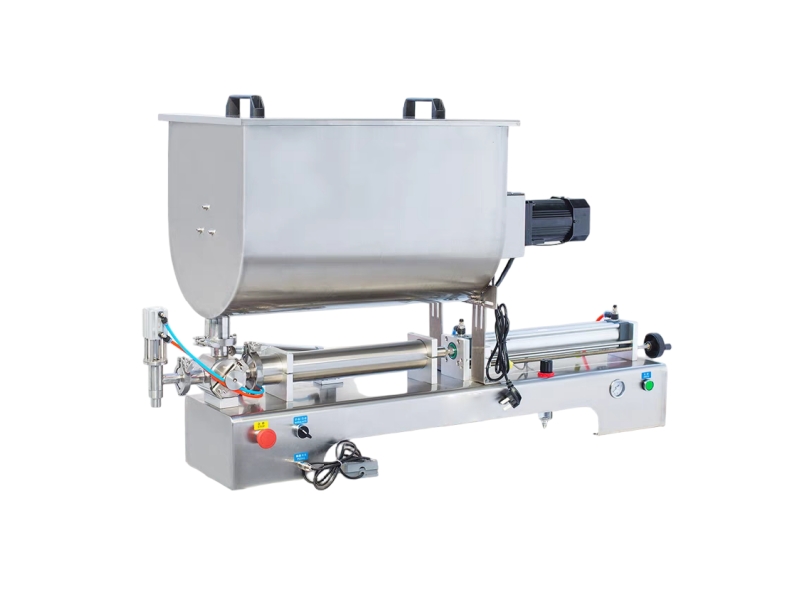
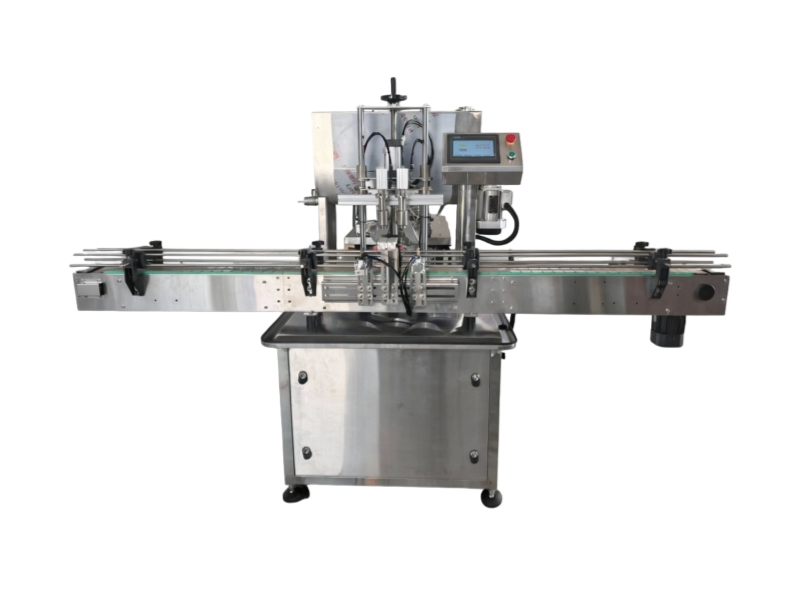
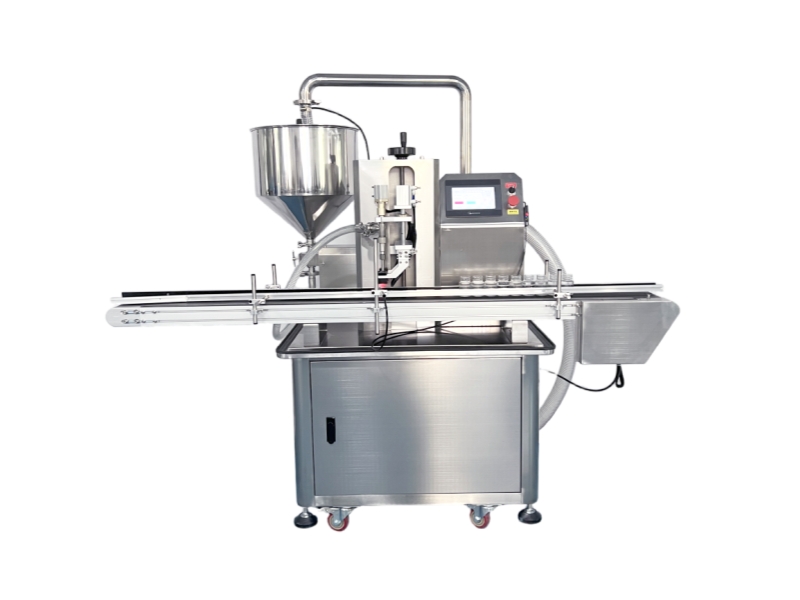
A successful bottling line is more than a collection of individual machine. It's a synchronized system where bottle filling capping labeling and marking machines communicate and coordinate with each other. In this article, you can see the integrated equipment design shown in the following video for chili oil sauce in 400g plastic bottles, highlighting the integration principles that make it efficient today and scalable for tomorrow.
II. The Complete Line Configuration
Firstly, let us figure out the complete line work flow and the integration work between these devices. There are many food packaging methods on the market, here our food package is bottle type, so the line design is all around the bottle package and mainly applied for the bottle package.
2.1 Work Flow
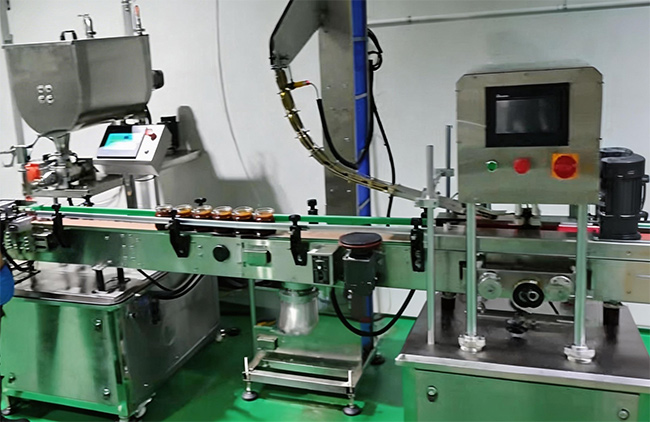
Bottle Unscrambler → Piston Pump Filling Machine → Automatic Cap Feeding and Screw Capping Machine → Automatic Round Bottle Labeling Machine → Laser Marking Machine
2.2 Station-by-Station Integration
1)Bottle Unscrambler → Filling Machine
Integration point: Feed rate control
● Unscrambler speed is synchronized with filler demand.
● There is a photoelectric sensor that detects a bottle before filling begins. At the same time, it also triggers a pneumatic bottle-stopping device, which automatically extends and holds the bottle in place to prevent it from moving during filling.
2)Filling Machine → Cap Feeding and Screw Capping Machine
Integration point: Timing cap conveyor and screw capping machine
● The conveyor speed is set to match the filling speed.
● Bottles are capped sequentially at a set speed. A photoelectric sensor detects a bottle and automatically dispenses and caps the bottle.
3)Capping Machine → Aluminum Foil Sealing Machine
Integration point: Sealer activation
● Sealing machine runs continuously, but only activates when a bottle passes under the sealing head.
● Bottle detection sensor triggers sealing cycle.
● Ensure energy efficiency and prevents overheating.
4)Sealing Machine → Labeling Machine
Integration point: Bottle orientation
● After sealing, bottles pass through a bottle positioning device that aligns them for labeling.
● Critical for consistent label placement on round bottles
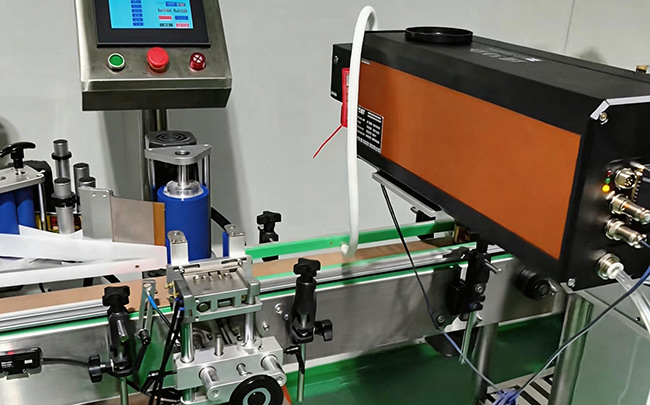
5)Labeling Machine → Laser Marker
Integration point: Cap positioning
● Photoelectric sensors: Installed before both the labeling and marking machines. The arrival of a bottle immediately triggers the machine to start.
● Encoders: These are crucial for synchronization, measuring the actual operating speed of the production line in real time and simultaneously sending the data to both the labeling and marking machines.

III. The Bottleneck Analysis
Currently, the single-head piston filling machine is the bottleneck:
Station | Current Speed | Max Capacity | Utilization |
Unscrambler | 15bpm | 30bpm | 50% |
Filling machine | 15bpm | 15bpm for 400g filling weight | 100% |
Cap feeding and screwing machine | 15bpm | 30-40bpm | 37% to 50% |
Aluminum foil sealing machine | 15bpm | 30-40bpm | 37% to 50% |
Labeling machine | 15bpm | 30-40bpm | 37% to 50% |
Laser marking machine | 15bpm | Over 100bpm | Below 15% |
This intentional design ensures all downstream stations have ample capacity for future upgrades. The different devices are controlled independently, and the filling section can be upgraded to a higher speed on its own, with no problem matching other devices.
IV. Control Philosophy: Distributed Intelligence with Centralized Coordination
This sauce bottling design employs distributed intelligence that each machine has its own PLC that handles its internal logic( bottle unsrambler is too simple to use PLC, button control is enough).
However, to achieve precise synchronization, we implemented a sensor-based communication network that allows stations to "talk" to each other through:
● Photoelectric sensors for bottle presence/position detection
● Feed control signals between adjacent machines
● Encoders on key conveyors to track bottle positions accurately
● Emergency stop and interlock chains for safety
This approach offers several advantages:
● Each machine can be developed, tested, and maintained independently
● Faults are isolated – one station's PLC failure doesn't crash the whole line
● Scalability is simplified – adding a second filler head only requires minor PLC adjustments
● Troubleshooting is faster – operators can diagnose issues at the machine level
V. Conclusion
This integrated bottling line shows the smart cooperation of the filling capping labeling marking machines in one line. It brings the customers a highly automated filling line. Also, such line design demonstrates how thoughtful equipment integration can deliver immediate value while preserving future flexibility. By matching speeds, coordinating controls, and deliberately over-sizing non-bottleneck stations, we created a system that works perfectly today and can grow with the customer's business tomorrow.
There are also many other equipment integration ways for different production need. Welcome to follow us to know more machine knowledge.