


 English
 French
SLFT-H700 Salad Dressing Emulsification Test
By:Salinovate Team Jun 30,2026
Our company recently conducted a salad dressing emulsification test for a domestic food company using the SLFT-H700 large-scale vacuum emulsifier mixer(equipped with water and oil tanks). The formula required heating during emulsification (steam heating to ≤50°C). The test batch size was 250 kg based on the customer’s materials (against a rated equipment capacity of 500 kg). The entire process from loading to discharge took approximately 20 minutes. The finished product exhibited a smooth, viscous texture and a slightly acidic taste; the client provided positive feedback and intends to make minor adjustments to the formula.

I. Test Background
A domestic customer aimed to purchase a new advanced equipment to make salad dressing. They showed great interest in our emulsifying mixer and commissioned us to conduct emulsification testing for their salad dressing. The client’s formula is unique, requiring the emulsification process to take place under heated conditions; this placed high demands on the temperature control precision and emulsification capabilities of our equipment. And their primary raw materials for the salad dressing are as follows:
Raw Material | Function |
Pasteurized liquid egg | Emulsifier; provide emulsifying capability |
Soybean oil | Primary oil phase component |
Sugar powder | Sweetness adjustment |
White vinegar | Acidity adjustment and pH control |
Modified starch | Thickening and stabilization |
II. Test Equipment
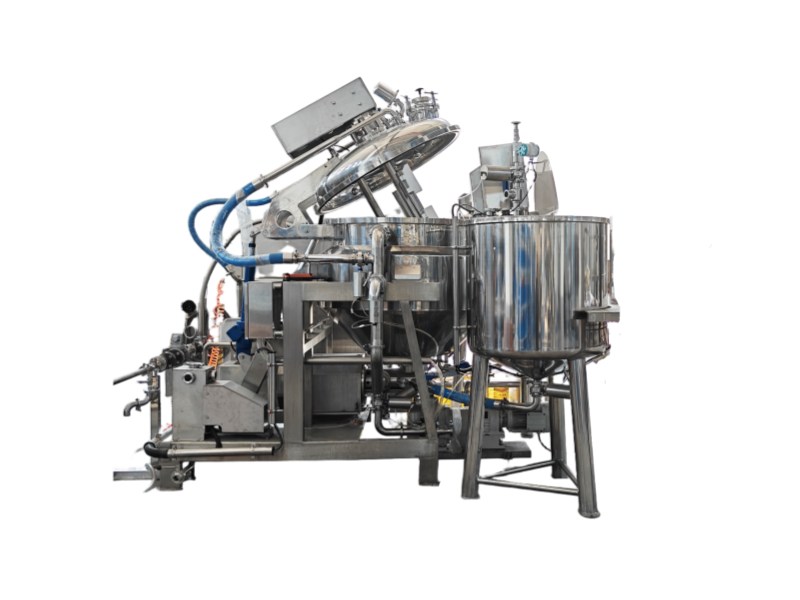
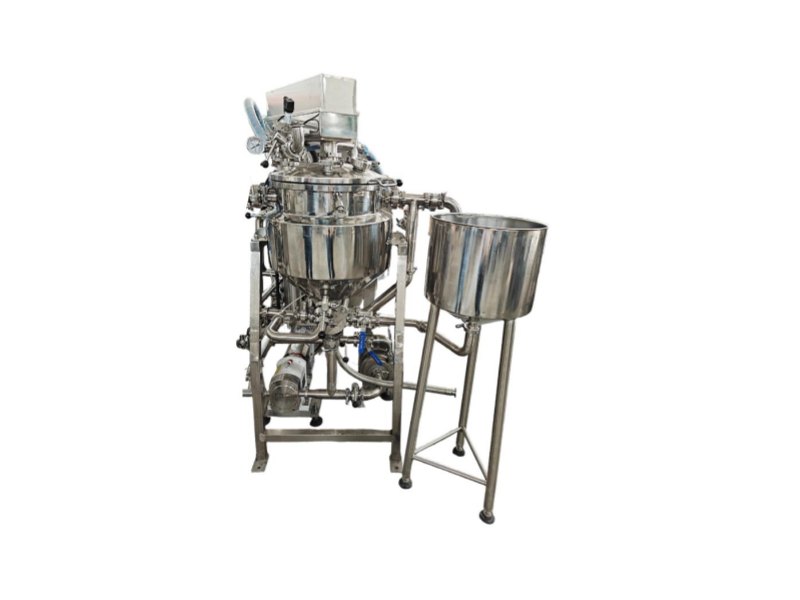
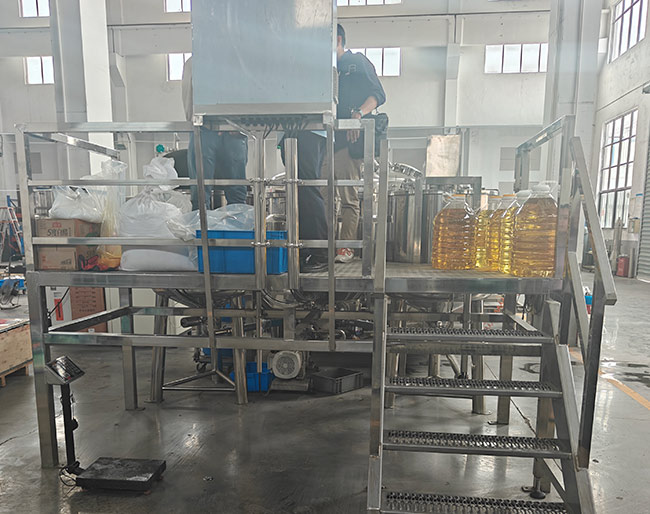
Given that salad dressing is a high-viscosity product and the client required testing with a substantial volume of material, we utilized the SLFT-H700 large-scale vacuum emulsifier mixer to conduct the production trial. The SLFT-H700 features an integrated bottom-mounted emulsification system based on advanced international design concepts. It incorporates pumping and self-priming capabilities, enabling it to process high-viscosity materials. Meanwhile, the unit is equipped with separate pretreatment tanks, allowing the respective phases to undergo preliminary dispersion and mixing before being drawn into the main emulsification vessel. This setup allows the main vessel to focus exclusively on high-shear homogenization, thereby significantly enhancing production efficiency and emulsification quality.
2.1 Equipment Specifications
Item | Parameter |
Equipment model | SLFT-H700 model |
Batch capacity | Up to 500 kg/batch |
Test batch size | Approx. 250 kg |
Emulsification system | Integrated bottom-mounted multi-stage emulsification pump |
Mixing system | Anchor-style agitator with wall scrapers |
Main pot design | Triple layer with the heating jacket and heat insulation layer. |
Vacuum system | Support |
Pre-treatment method | Separate pre-dispersion and mixing in oil and water tanks |
III. Testing Process
The overall production test primarily consists of three main stages: pre-treatment of the water and oil phases, steam heating, and material suction/emulsification. A brief description of the test steps follows.
3.1 Pre-treatment of Water and Oil Phases
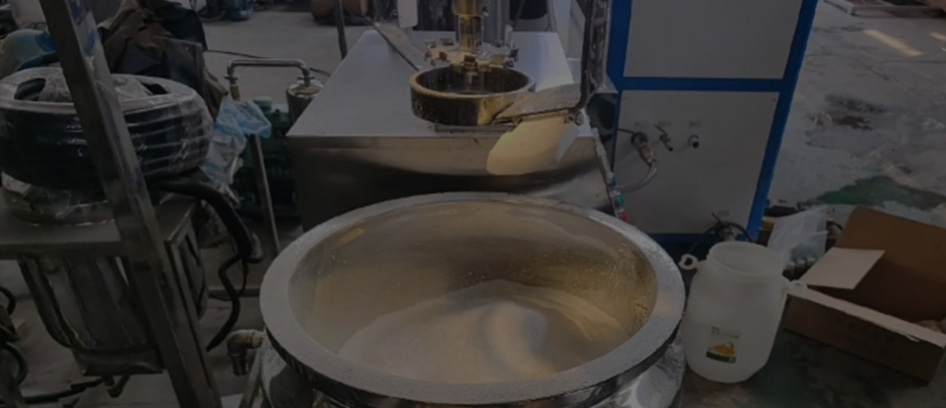
1)Water phase preparation: Ingredients such as pasteurized liquid egg, powdered sugar, white vinegar, and modified starch are charged into the mixing vessel. Agitation is initiated to achieve pre-dispersion, ensuring that all powders are fully dissolved and free of lumps.
2)Oil phase preparation: Soybean oil is prepared in the oil vessel (or dispersed separately in the mixing vessel, depending on process requirements).
3)Pre-dispersion and agitation of the water and oil phases are completed in their respective vessels, preparing the materials for the subsequent emulsification stage.
3.2 Steam Heating
Most salad dressing formulas are typically processed cold and do not require steam heating. However, the formula used in this test required emulsification under heated conditions, with a steam heating temperature not exceeding 50°C. To meet this heating requirement, we utilized an in-house electric steam generator to precisely control the steam temperature before feeding it into the jacket of the emulsification vessel. The vessel is also equipped with a temperature sensor at the bottom, allowing for real-time monitoring of the internal temperature and facilitating precise heating control.
3.3 Material Intake and Emulsification
1)Water phase intake: The pre-dispersed water-phase material from the preparatory tank is drawn into the main emulsification vessel via the bottom-mounted emulsification pump.
2)Heating and homogenization: Steam heating is activated in the vessel jacket (temperature maintained below 50°C), while the wall-scraping agitator is started simultaneously.
3)Oil phase intake and emulsification: Controlled by a proportional valve, the oil phase is slowly drawn into the main emulsification vessel; the integrated bottom emulsification pump subjects the oil-water mixture to high-shear homogenization.
4)Vacuuming: The vacuum system is activated to effectively remove air bubbles entrapped during emulsification, ensuring a smooth, glossy finish for the final product.
5)Continuous emulsification: The material circulates through the piping, undergoing continuous agitation within the vessel and homogenization via the emulsification pump, until a stable, smooth emulsion is achieved.
3.4 Total Duration
The entire process from pre-treatment in the tanks to discharge from the main vessel takes approximately 20 minutes, encompassing pre-dispersion, heating, emulsification, and degassing. The test batch size was approximately 250 kg; given the equipment's maximum batch capacity of 500 kg, there is ample production headroom.
IV. Test Results
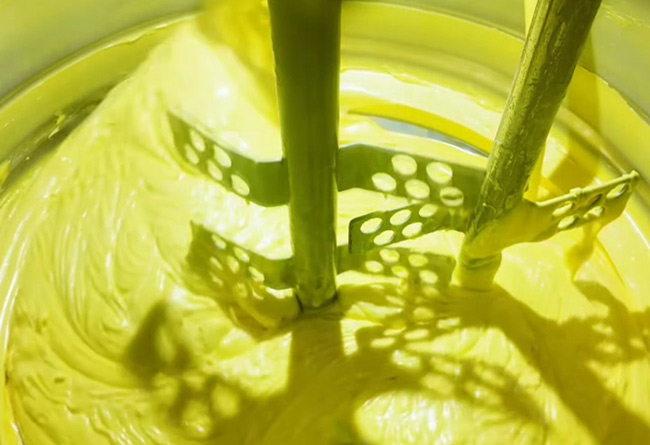
For you clearly know the test results, we have already made an explanation sheet below for you. Meanwhile, we shot a video to show you the final emulsifying state of the salad dressing, you can watch the following video to check the real sauce state.
Test Item | Result |
Water/Oil phase pre-treatment | Water and oil phases dispersed evenly; no lumps. |
Heating & Temperature control | Shown on the control panel, real-time monitoring. |
Emulsification effect | Oil and water fully emulsified; no separation. |
Vacuum degassing | Air bubbles were effectively removed. |
Finished product state | Smooth and viscous; uniform texture. |
Taste | Slightly acidic; vinegar ratio adjustable via formula. |
Total processing time | About 20min |
V. Conclusion
In this salad dressing emulsification test, the SLFT-H700’s main emulsification pot and pre-treatment pot worked in tandem. The whole functional system completed the entire production process, from pre-dispersion to the final smooth, viscous salad dressing, in approximately 20 minutes. This demonstrates that our SLFT series vacuum emulsifier mixers are suitable for producing a wide range of hot and cold processing high-viscosity food sauces extending beyond just mayonnaise and salad dressings.
For any emulsifying test need or for any enquiry, welcome to contact Salinovate Team for help.