


 English
 French
The global rice flour market is evolving beyond its traditional role in Asian staple foods. Rice flour is increasingly used in gluten-free bakery products, noodles, snacks, sauces, prepared foods and specialized food formulations. For food manufacturers and prospective investors, these developments create opportunities but also raise important questions about product specifications, processing technology, production costs and market positioning.
Understanding the rice flour market therefore requires more than examining its projected growth rate. Businesses need to understand where rice flour is used, what drives demand, how different applications influence product requirements, and what manufacturers must consider when establishing or expanding a rice flour production operation.
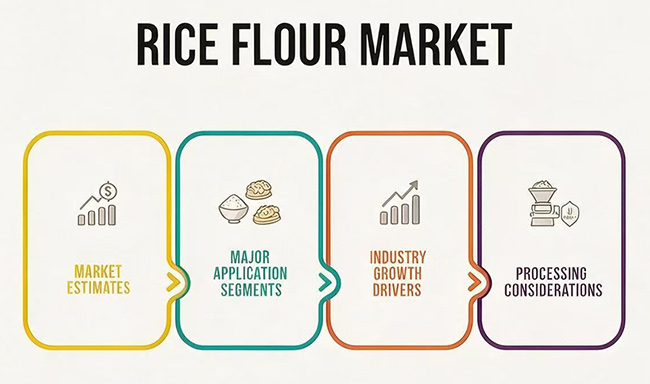
This article reviews published market estimates, major application segments, industry growth drivers and processing considerations to provide a practical perspective on the global rice flour market.

I. Global Rice Flour Market Size and Growth Outlook
The global rice flour market is projected to grow over the coming years, although published estimates differ substantially between research providers. These figures are useful for understanding the direction of the industry, but they should be interpreted according to each report’s market definition, base year and forecasting methodology.
1.1 Published Market Estimates
Fortune Business Insights estimated the global rice flour market at USD 1.51 billion in 2025 and projected it to reach USD 3.14 billion by 2034, representing a compound annual growth rate (CAGR) of 8.49% over its forecast period [1].
A separate report by Spherical Insights estimated the market at USD 865 million in 2024 and projected it to reach USD 1.375 billion by 2035, with a forecast CAGR of approximately 4.3% [2].
These estimates should not be combined into a single market-size figure. Their differences may reflect variations in market coverage, product definitions, data sources and forecasting assumptions. A company evaluating market entry should consult the underlying report methodology before using either estimate in an investment plan.
The more useful conclusion is that market research providers generally identify rice flour as an established ingredient market with opportunities linked to food product development and expanding applications. However, the growth outlook for a particular manufacturer will depend on its target countries, customer segments, product specifications and competitive position.
1.2 What Is Driving Market Interest
Three developments help explain why rice flour continues to attract commercial attention.
First, rice flour is used in many established food categories, including noodles, traditional foods, bakery products and snacks. These applications provide a foundation beyond any single consumer trend.
Second, food manufacturers are developing more gluten-free products. Rice flour can be used as a wheat-flour alternative in selected formulations, although its functional performance differs from that of wheat flour.
Third, manufacturers are exploring specialized rice ingredients, including brown rice flour and pregelatinized rice flour, for applications with different nutritional, processing or texture requirements.
These developments create opportunities for ingredient suppliers, food processors and equipment manufacturers. Nevertheless, demand for a particular type of rice flour should be evaluated at the application level rather than inferred from the growth of the entire market.
Market takeaway: Published forecasts suggest continued opportunities in rice flour, but the figures are not directly interchangeable. For business planning, application-specific demand and product requirements are more useful than relying on a single global growth number.
II. Major Applications: Where Is Rice Flour Used
Rice flour serves several distinct food-processing markets, and each application can require different functional properties. Manufacturers that understand these differences are better positioned to select raw materials, define product specifications and target the right customers.
2.1 Gluten-Free Bakery Products
Gluten-free bakery products are an important area of rice flour application. Rice flour can be used in bread, cakes, cookies, crackers and other baked products where manufacturers need an alternative to wheat-based ingredients.
Research reviews have examined rice flour’s role in gluten-free bread, pasta and other foods, including the technical challenges associated with replacing gluten’s structural functions [3].
Rice flour does not behave exactly like wheat flour. Because it does not form the same gluten network, product developers may need to adjust the formulation, particle size, hydration conditions and use of other ingredients to obtain the required texture and structure.
For this reason, a bakery ingredient supplier may need to provide more than a generic product labeled “rice flour.” Buyers may require a defined particle-size range, consistent functionality and suitability for a particular recipe.
2.2 Rice Noodles, Pasta and Traditional Foods
Rice flour is widely associated with noodles, rice-based pasta, cakes and traditional foods, particularly in markets where rice is a staple ingredient. In these applications, the final product’s texture and processing performance are often as important as fineness. Rice variety, starch properties, moisture and the intended manufacturing process can influence how the flour performs.
A noodle manufacturer, for example, may have different requirements from a bakery ingredient producer. Both may purchase rice flour, but they may not need the same raw material or particle-size specification.
This creates opportunities for suppliers that can produce flour tailored to a defined application rather than offering only a general-purpose product.
2.3 Snacks, Coatings and Prepared Foods
Rice flour can also be used in snack products, coatings, batters and prepared foods. Its neutral flavour and formulation versatility make it useful in selected food systems.
In these applications, the required particle size depends on the product formulation and processing method. A coating ingredient may require different flow and hydration characteristics from a flour used in a baked snack. Consequently, manufacturers should avoid assuming that one rice flour specification will serve every application equally well.
2.4 Sauces, Thickening Systems and Specialized Ingredients
Rice-derived ingredients are also used in thickening and formulation systems. However, conventional rice flour, rice starch and pregelatinized rice flour are different products and should not be treated as interchangeable.
Pregelatinized rice flour undergoes processing that changes its functional properties, while rice starch is a more specifically separated starch ingredient. These products may require different production steps and quality-control procedures. For manufacturers considering these markets, the first question should be what the end user expects the ingredient to do, not simply how finely the rice needs to be ground.
Application takeaway: Rice flour is not a single standardized product category. Bakery products, noodles, snacks and specialized ingredients can have different raw-material, particle-size and functional requirements. Defining the target application is the first step toward building a commercially viable production operation.
III. Key Trends Shaping the Rice Flour Market
The rice flour market is influenced by several overlapping trends, but their commercial impact varies across regions and applications. The strongest business opportunities are likely to emerge where consumer demand, food formulation needs and manufacturing capabilities align.
3.1 Growth in Gluten-Free Food Development
Gluten-free food development has created additional applications for rice flour, particularly in bakery products and other foods traditionally made with wheat flour.
The scientific literature also highlights an important limitation: rice flour does not reproduce every property of wheat flour. Gluten-free product development may require blending, formulation adjustments or other processing techniques to achieve the required texture and structure [3].
For ingredient producers, this means that demand is not necessarily limited to the lowest-cost rice flour. Some customers may value consistent particle size, reliable functional performance and the ability to meet a specific formulation requirement.
However, gluten-free demand should not be interpreted as proof that all rice flour segments will grow at the same rate. Regional consumption habits, product prices and competition from other gluten-free ingredients can affect the actual opportunity.
3.2 Demand for Application-Specific Ingredients
Food manufacturers increasingly need ingredients that fit particular product-development goals. In the rice flour market, this can involve selecting different rice varieties, grain types, processing methods and particle-size specifications. For example, a manufacturer producing fine rice flour for bakery formulations may have different requirements from a company producing flour for traditional noodles.
The distinction is commercially important because a specialized ingredient may be judged on consistency and performance rather than price alone. Rice flour suppliers that understand their customers’ manufacturing processes can use these requirements to differentiate their products and build more targeted product portfolios.
3.3 Product Diversification: White Rice, Brown Rice and Pregelatinized Flour
Market reports commonly segment rice flour by rice source, grain type and processing method. These categories reflect differences in both raw material and intended application [1, 2].
White rice flour remains relevant to many established food applications. Brown rice flour may appeal to customers looking for ingredients containing more of the grain’s bran-associated components. Pregelatinized rice flour serves applications where its modified functional properties are required.
These products should not be evaluated as simple substitutes. The choice depends on the customer’s formulation, nutritional objectives, functional requirements and processing conditions. Diversification may create opportunities, but it also increases the importance of product-specific testing and quality control.
3.4 Regional Demand and Established Food Traditions
Rice flour demand is closely connected to local food traditions, manufacturing capacity and ingredient supply chains.
Asia-Pacific has a strong foundation in rice-based foods and is identified as a major regional market in published industry research [2]. In other regions, growth opportunities may be associated with gluten-free bakery products, specialty foods and ingredient diversification.
Nevertheless, regional market rankings depend on the report’s definitions and forecast assumptions. A manufacturer should assess its intended export market using customer interviews, local product categories, import requirements and competitor research rather than assuming that the fastest-growing region is automatically the best market to enter.
Trend takeaway: Gluten-free development, specialized formulations and product diversification are important areas to monitor. Their value to an individual business depends on the needs of its target customers, not merely on broad consumer trends.
IV. How Raw Materials and Particle Size Influence Rice Flour Quality
The commercial value of rice flour depends partly on whether the product consistently meets its intended application requirements. Raw-material selection and grinding conditions can affect the final powder, so manufacturers should define product specifications before selecting production equipment.
4.1 Rice Variety and Raw-Material Condition
Rice flour can be produced from different types of rice, including long-grain, medium-grain, short-grain and glutinous rice. Their starch characteristics and intended uses may differ.
The condition of the incoming rice also matters. Moisture content, grain condition, impurities and the presence of broken rice can influence the processing approach and the consistency of the finished product.
Before equipment selection, manufacturers should establish whether they will process white rice, brown rice, glutinous rice or another defined raw material. They should also confirm the acceptable moisture range and any cleaning or pre-processing requirements.
4.2 Particle Size Must Match the Application
Particle size is an important processing variable, but finer powder is not automatically better for every rice flour product.
A fine powder may be suitable for one formulation, while another application may require a different particle-size distribution. Research on rice-based gluten-free foods has also discussed the influence of flour characteristics and processing on final product quality [3].
Buyers should therefore specify particle size in a way that can be verified. Depending on the application, this may involve a mesh specification, a percentage passing a particular sieve or a particle-size distribution expressed in microns.
Mesh numbers alone can be misleading if the buyer and supplier interpret the specification differently. The test method and acceptance criteria should be agreed upon before production.
4.3 Grinding Method and Product Consistency
Different grinding technologies can produce different particle-size distributions and operating characteristics. The appropriate method depends on the raw material, target fineness, throughput, heat sensitivity, cleaning requirements and overall production design.
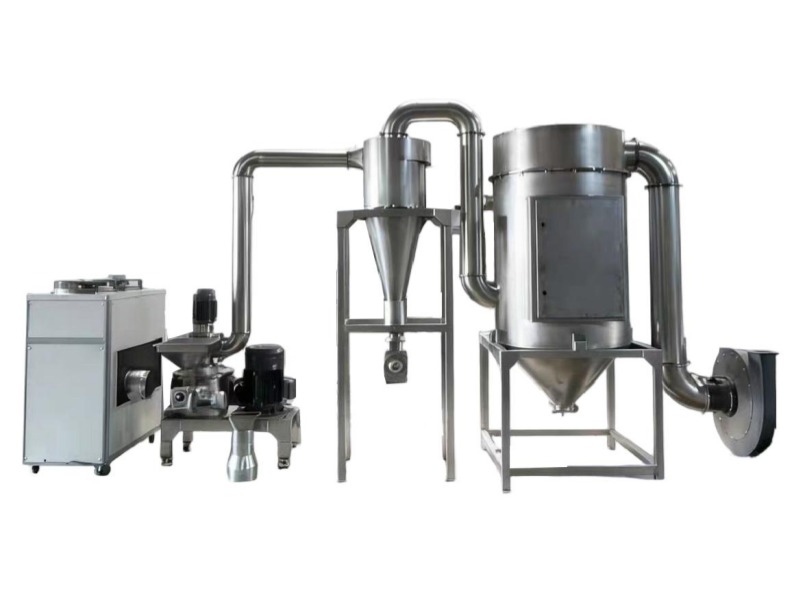
For example, a screen-controlled grinder uses a screen to influence the size of particles that can pass through the grinding chamber. An air classifier mill combines mechanical grinding with air classification to control the separation of particles according to their aerodynamic behaviour.
Neither method is universally best. A screen-controlled machine may be appropriate for cost-sensitive applications requiring moderate fineness, while an air classifier mill may be worth evaluating when finer powder or greater control over the particle-size distribution is needed.
Quality takeaway: Commercial rice flour should be specified by its intended function, raw-material characteristics and measurable particle-size requirements. Selecting a grinding machine based on mesh number alone can lead to mismatches between the equipment and the finished product.
V. Rice Flour Production: What Should Manufacturers Consider
Entering the rice flour market requires more than obtaining a grinder. A production operation must match its equipment, material handling, collection system and quality-control procedures to the intended product and output volume.
5.1 Define the Production Target Before Selecting Equipment
The initial specification should identify the type of rice, target application, required fineness, hourly capacity and expected production schedule. For example, a small producer supplying local food businesses may have different requirements from an industrial supplier producing hundreds of kilograms of flour per hour.
Manufacturers should also consider whether the product requires a relatively broad particle-size distribution or a narrower, more tightly controlled specification. These decisions affect the grinding technology, auxiliary equipment, investment level and operating costs.
5.2 Screen-Controlled Grinding Versus Air Classification
Two equipment approaches may be relevant to rice flour production, depending on the required fineness and production conditions.
1)Screen-controlled grinding
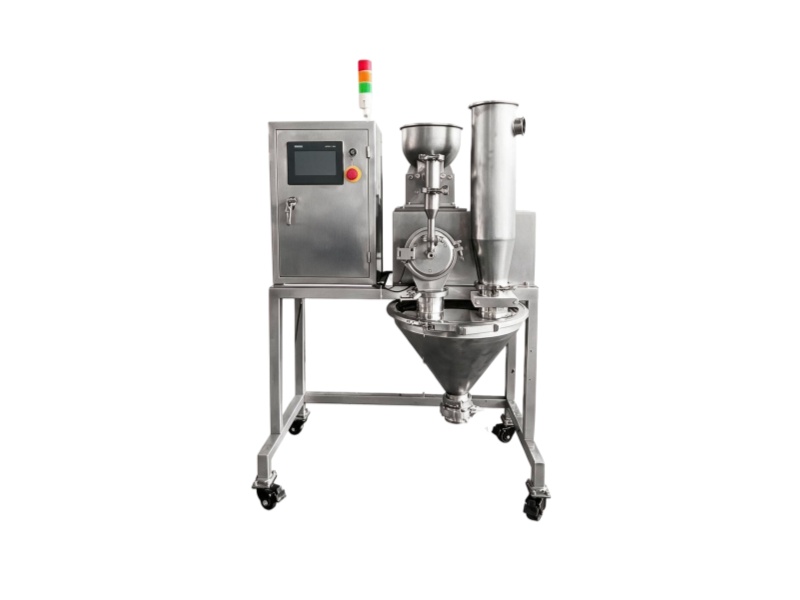
A screen-controlled grinder uses a replaceable screen to influence the size of particles leaving the grinding chamber. It can be a practical option for manufacturers seeking a relatively straightforward system for moderate fineness and cost-sensitive production.
The selected screen, raw-material condition and operating parameters all affect the result. A screen specification should not be assumed to guarantee that every particle in the output falls within a single mesh range.
2)Air classifier milling
An air classifier mill combines grinding and classification. It can be considered when manufacturers need finer powder or more control over particle separation without relying on a conventional grinding screen.
Its performance depends on the raw material, feed rate, grinding conditions, classifier settings and the required final particle size. Finer specifications can reduce throughput, so capacity must be assessed at the actual target fineness.
The decision should be based on material testing and the total production requirement rather than on a general claim that one technology is superior to the other.
5.3 Capacity, Collection and Plant Layout
The stated capacity of a grinding machine is only one part of production planning. Manufacturers should confirm whether the quoted output applies to their actual rice type and target fineness.
The complete system may also require feeding equipment, powder conveying, cyclone separation, dust collection and suitable packaging or downstream handling. Plant layout matters as well. Available floor space, machine height, maintenance access and cleaning procedures can influence the final configuration.
For food applications, manufacturers should evaluate contact materials, cleanability, contamination control and the hygiene requirements of the intended market. Dust management and equipment safety should be incorporated into the plant design rather than treated as optional additions after the grinder has been selected.
5.4 Why Material Testing Matters
A material test helps connect theoretical machine capability with the customer’s actual production target. A useful test should record the rice type, incoming material condition, machine configuration, operating settings, measured output, particle-size test method and collection arrangement.
When capacity is important, the test should distinguish a short sample run from a sustained production result. When particle-size consistency is critical, the output should be checked against an agreed measurement method. This evidence gives manufacturers a stronger basis for estimating investment, operating performance and product suitability.
Production takeaway: A viable rice flour operation is designed around the finished product and production target. Raw-material testing, equipment selection, collection-system design and measurable quality requirements should be considered together.
VI. Commercial Opportunities and Challenges for Rice Flour Businesses
The rice flour market offers several possible business models, but opportunities depend on a manufacturer’s ability to meet customer requirements consistently and operate competitively.
6.1 Opportunities for Ingredient Producers
Businesses may focus on supplying general-purpose rice flour, application-specific ingredients, gluten-free product manufacturers or customers in established rice-based food categories. A producer may also explore product differentiation through raw-material selection, particle-size control, packaging formats and documented quality specifications.
However, differentiation must correspond to a real customer need. Producing finer flour or offering more product varieties does not automatically create a pricing advantage.
6.2 Production Costs and Competitive Pressure
Rice flour producers must consider raw-material costs, energy consumption, labour, maintenance, packaging, quality assurance and distribution.
The cost structure can vary significantly between a small operation and a large industrial plant. Equipment with a lower purchase price may not always deliver the lowest total cost per kilogram, particularly if it requires more labour, additional screening or frequent process adjustments.
Conversely, a more sophisticated grinding system may be difficult to justify when the target product does not require its additional capabilities. A practical investment analysis should compare total operating costs with the required product quality and production volume.
6.3 Food Safety and Quality Assurance
Rice flour manufacturers serving food customers need appropriate controls for raw-material quality, foreign material, hygiene, storage and product traceability. Gluten-free claims also require careful management of cross-contact risks when a facility handles wheat or other gluten-containing ingredients. The applicable requirements depend on the destination market and relevant regulations.
Manufacturers should establish suitable quality procedures before committing to a particular market, especially when supplying food businesses that require documented specifications and supplier verification.
Commercial takeaway: The strongest opportunity is not necessarily the largest market segment. It is the segment where a producer can meet a clear customer need, maintain consistent quality and compete on total delivered value.
VII. How Businesses Can Evaluate a Rice Flour Market Opportunity
Before investing in a rice flour production operation, businesses should validate the demand for their intended product and confirm that the proposed manufacturing process can meet customer specifications.
A practical assessment can follow five steps:
1. Identify the target customers. Determine whether the intended buyers are noodle manufacturers, bakeries, snack producers, ingredient distributors or other food businesses.
2. Define the product specification. Confirm the rice type, moisture requirements, particle-size range, functional properties, packaging and quality standards.
3. Estimate realistic demand. Use customer discussions, purchase requirements, competitor research and local market data instead of relying exclusively on global forecasts.
4. Validate the production process. Test the raw material with suitable equipment and record the output quality, capacity and operating conditions.
5. Calculate the total production cost. Include raw materials, energy, labour, maintenance, collection equipment, packaging, compliance and distribution.
This process helps separate a broad market trend from a commercially viable opportunity. It also reduces the risk of investing in equipment that produces a powder specification the target customer does not need.
For businesses evaluating rice flour production machinery, Salinovate’s Industrial Grinder Machine Options for Rice Flour in Food Grinding Solution section provide relevant starting points for comparing equipment options and processing approaches.
Planning takeaway: Validate the customer, product specification and production economics before scaling investment. Market forecasts can indicate where to investigate, but material testing and customer requirements determine whether a specific rice flour business is feasible.
VIII. Conclusion: The Rice Flour Market Depends on More Than Market Growth
The rice flour market benefits from established food applications and continued product development in areas such as gluten-free bakery products, noodles, snacks and specialized ingredients. Published market forecasts indicate potential growth, but their estimates differ and should be interpreted according to each research provider’s methodology.
For manufacturers, the commercial opportunity lies in matching the right product to the right application. Rice variety, raw-material condition, particle size, functional properties and quality requirements all influence the finished flour and its suitability for customers.
Production planning should follow the same principle. A suitable rice flour grinding system must meet the required fineness and capacity while accounting for collection, cleaning, maintenance, hygiene and operating costs.
Ultimately, a successful rice flour business is built by connecting market demand with a clearly defined product specification and a production process that can deliver it consistently. Market research identifies potential opportunities; customer validation and material testing help turn them into practical business decisions.
References
[1] Fortune Business Insights. (2026). Rice Flour Market Size, Share, and Industry Analysis, By Source, Type, Nature, Application, and Regional Forecast, 2026–2034. Fortune Business Insights. Report updated September 21, 2026. Available at: https://www.fortunebusinessinsights.com/rice-flour-market-110272
[2] Spherical Insights & Consulting. (2025). Global Rice Flour Market Size, Share, and COVID-19 Impact Analysis, 2025–2035. Spherical Insights & Consulting. Report released October 2025. Available at: https://www.sphericalinsights.com/reports/rice-flour-market
[3] Park, J., & Kim, H.-S. (2023). Rice-Based Gluten-Free Foods and Technologies: A Review. Foods, 12(22), 4110. https://doi.org/10.3390/foods12224110
[4] Yeh, A.-I. (2019). Preparation and Applications of Rice Flour. In Rice: Chemistry and Technology (3rd ed.), Chapter 17, pp. 495–539. AACC International. https://doi.org/10.1094/1891127349.017
[5] U.S. Department of Agriculture, Foreign Agricultural Service. (n.d.). Rice: Production. USDA Foreign Agricultural Service. Available at: https://fas.usda.gov/data/production/commodity/0422110