


 English
 French
The nut butter market has already been one of the more mature food markets, characterized by intense competition. So how can existing companies discover new competitive advantages in this crowded market? And how can new investors looking to enter this market find their unique path to success? This article will explore the future investment value and chance in the nut butter market, hoping to provide insights for both established and emerging businesses.
I. Overall Market Assessment: Is There Any Investment Value for the Nut Butter Market?
1.1 Market Growth Drivers
1)Health Consumption Trends: According to the U.S. Department of Agriculture, nut butter, as a source of high-quality plant protein and healthy fats, aligns with global healthy eating trends.
2)Plant-Based Diet Revolution: The global plant-based food market is growing at an annual rate of over 12%, and nut butter, as a core component, continues to benefit.
3)Accelerated Product Innovation: New ingredients, functional additives, and sustainable packaging are expanding market boundaries.
4)Diversified Retail Channels: E-commerce sales are breaking down the limitations of traditional channels, opening up new growth opportunities.
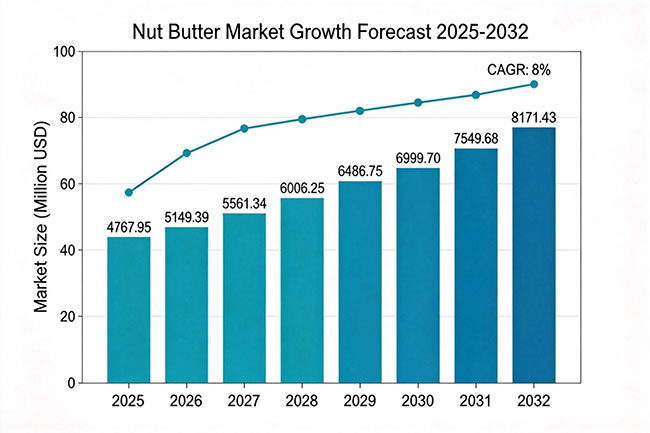
5)Market Development Trends: According to the nut butter market analysis report updated in February 2026 by ReAnIn Research and Consulting Pvt Ltd(ID No.Rn029271955), the nut butter market continues to grow. It is projected to expand at a compound annual growth rate of 8% from 2025 to 2032(see chart below).

1.2 Investment Risk Assessment
1)Positive Factors: The market concentration is moderate, with the top three brands (including J. M. Smucker, Kraft Heinz, and Conagra) accounting for approximately 55% of the market share, leaving room for emerging brands.
2) Challenges: Volatile raw material prices, stricter allergen labeling regulations, and slowing growth in the traditional peanut butter market.
Conclusion: The nut butter market still possesses significant investment value, but success requires focusing on niche markets and innovative product categories.
II. Nut Butter Classification and Market Space Analysis
2.1 Nut Butter Classification
Traditional peanut butter still dominates the market, but its growth is slowing. Following closely are almond butter, cashew butter, mixed nut butter, hazelnut butter, macadamia nut butter, and walnut butter. The market growth rate of these spreads is increasing, meeting the increasingly diversified consumer demand.
Our observation: The market is transforming from a single-category monopoly to a diversified matrix. New entrants who can avoid fierce competition and establish technological barriers in niche categories will gain market share more quickly.
2.2 Comparison of the Various Nut Butters
Type | Development Trend | Raw Material Cost | Advantage |
Peanut Butter | Traditional Mainstream | Low | Low cost, high market demand. |
Almond Butter | Traditional Mainstream | Medium | Healthy, cost-effective. |
Mixed Nut Butter | High-Growth New Stream | Medium or High | Customized nutrition, with a variety of flavors. |
Hazelnut Butter | Niche Market | High | The perfect partner for chocolate sauce. |
Cashew Butter | Niche Market | High | Ketogenic, vegan diet. |
Hawaiian Butter | Niche Market | High | Unique flavors, high-end dining. |
Walnut Butter | Niche Market | High | Rich in Omega-3. |
Functional Nut Butter | Innovative Market | High | Targeting sexual function value. |
As shown in the table above, different nut butters have their unique cost advantages, nutritional value advantages, and unique application advantages. These different advantages can be utilized to promote them in different markets.
III. Customer Group Analysis
3.1 Core Groups
Group Division | Purchase Preference |
Health-Conscious Consumers | Prefers organic, sugar-free, and non-GMO products. |
People with Special Dietary Needs | Ketogenic, vegetarian, and gluten-free diets. |
Families with Children | Focus on nutrition, convenience, and children's tastes. |
Food Lover | We pursue high-end, distinctive, and handcrafted products. |
3.2 Market Share Distribution
1)By Age: The 25-44 age group accounts for 54% of consumption, representing the core consumer base.
2)By Income: Households with an annual income of over $75,000 account for 68% of the high-end market.
3)By Region: The North American market accounts for 45% of the global market, while the Asia-Pacific region is experiencing the fastest growth (9.8% annual increase).
3.3 Emerging Customer Groups
1)Young Consumers (18-24 years old): Concerned about brand values, sustainability, and social media presence.
2)Male Fitness Enthusiasts: Growing demand for high-protein nut butter, with this segment growing by 17% annually.
3)Health-Conscious Seniors: Increased demand (12%) among people over 50 for heart-healthy nut butter.
4)Global Consumers: Increased awareness of nut butter in the Middle East and Asia Pacific regions, leading to increased import demand.
IV. Investment Opportunities and Strategic Recommendations
4.1 Most Promising Investment Directions
1) High-end mixed nut butter: Positioned for both healthy snacking and cooking ingredients
2) Functional nut butter: Adding adaptogens, prebiotics, and other ingredients, achieving a 30-50% price premium
3) Sustainable brands: Ethical brands with carbon-neutral packaging and regenerative agriculture ingredients
4.2 Market Entry Strategy
1)Differentiated positioning: Avoid direct competition with traditional peanut butter, focusing on niche demands
2)Channel strategy: DTC (direct-to-consumer) model combined with selective retail to control brand narrative
3)Innovation pace: Launch limited-edition flavors every 6-9 months to maintain market attention
4)Certification investment: Obtain organic, non-GMO, B Corp, and other certifications to enhance credibility
4.3 Risk Mitigation Recommendations
1)Diversify raw material sourcing to avoid the impact of price fluctuations of a single type of nut
2)Invest in small-scale packaging lines to flexibly respond to changes in market demand
3)Pay attention to regulatory changes, especially allergen labeling and health claim regulations
4.4 Strategic Option Optimization
Regarding the above strategies, existing companies and new investment companies can focus on different aspects based on their own circumstances.
1)Existing companies can optimize their online marketing strategies based on their existing products and create trending products. They can also upgrade their existing nut butter products, adding multiple flavors and functional flavors. Expanding their product line based on existing production lines will be more cost-effective.
2)For companies entering this industry for the first time, investors can prioritize niche nut butter products, which face less market competition, and strive to perfect a single product. They should also actively build online marketing platforms and aim to be a leader in their niche market.
V. Conclusion
The nut butter market is evolving from traditional spreads to a diversified category of healthy foods, and its investment value remains significant. Key success factors include:
1)Avoiding saturated competition: Focusing on high-growth segments such as almond butter and mixed nut butters.
2)Precisely targeting customer segments: Serving growing groups such as health-conscious consumers and those with specific dietary needs.
3)Continuous product innovation: Developing functional additives and sustainable product lines.
4)Building trust: Meeting modern consumer expectations through authoritative certifications and transparent supply chains.
Final recommendations: We have provided different strategic planning suggestions for both established companies and new entrants. Of course, all decisions should be based on the actual situation and market position of the company. By considering all these factors, you can make the best choices for your company's development. As a food processing equipment supplier, Salinovate is very willing to contribute to this process. If you are looking to expand your production lines or build new ones, please feel free to contact us for consultation.
References:
1. Market Data: Industry reports published in ReAnIn Research, Grand View Research, Mordor Intelligence, and Statista
2. Consumer Trends: U.S. Department of Agriculture, International Nut and Dried Fruit Council (INC), Nielsen Consumer Research
3. Health Evidence: Studies published in the American Journal of Clinical Nutrition and Nutrition & Metabolism Journals
4. Industry Insights: Food Marketing Institute (FMI), Plant Based Foods Association (PBFA) industry analysis