


 English
 French
This article provides a systematic powder mixing technologies analysis of the mainstream dry powder mixers, which are the v shape mixer, double cone mixer, ribbon mixer and the plough mixer.
I. Introduction: The Two Major Technical Approaches to Powder Mixing
Dry powder mixing is a fundamental process across various industries, including food, chemicals, pharmaceuticals, and building materials. Based on differences in equipment structure and mode of operation, powder mixers are broadly categorized into two major technical approaches:
Technical Approach | Working Principle | Representative Mixer | Core Characteristics |
Rotary (Container-Rotating Type) | The entire container rotates, causing the materials to tumble and mix along with it. | V-type, Double-cone, 3D mixer | Container movement; no internal mixing mechanism. |
Horizontal (Fixed-Container Type) | The container remains stationary while internal mixing agitators rotate to mix the materials. | Ribbon, Plow-type | Mixing mechanism movement; stationary container. |
Each of the two technical approaches possesses its own distinct advantages and disadvantages, making them suitable for different material characteristics and production scenarios. This article will provide an in-depth comparative analysis to help you make the optimal choice.
II. Rotary Powder Mixing Technology
A common characteristic of rotary mixers is that the entire container rotates, and the materials achieve mixing through the combined action of gravity and the container's geometry. Typically, no internal mixing mechanism is installed. Instead, the container's unique geometric shape and rotational motion induce mixing effects such as convection, shear, and diffusion within the materials. Certainly, customized agitators are supported.
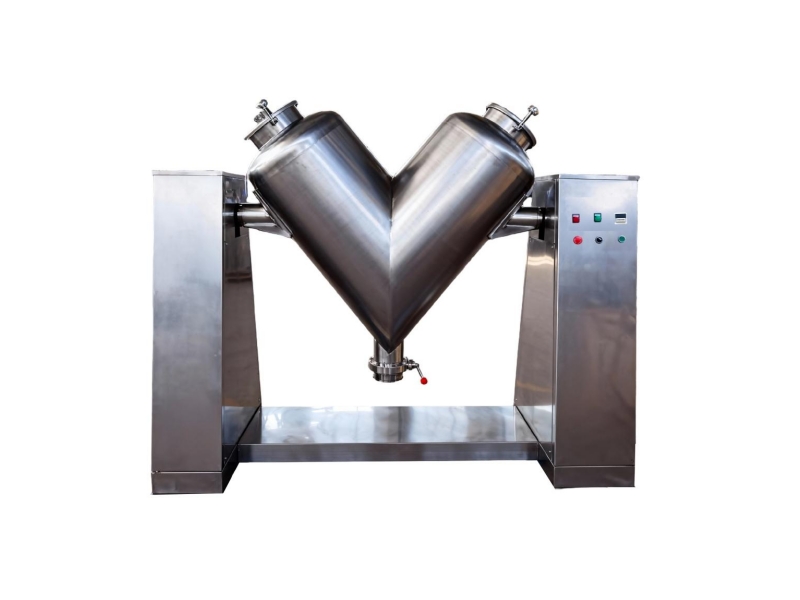
2.1 SLV Series V-Type Mixer
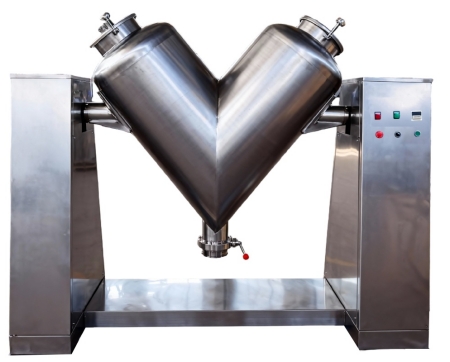
Product Page:Stainless Steel V Mixer Machine for Powder
Structural Features: Two cylindrical vessels are welded together to form a V-shape, with an included angle typically ranging from 80 to 90 degrees.
Parameter | Description |
Mixing Principle | As the container rotates, the materials within the V-shaped vessel undergo repeated splitting, merging, and overturning. |
Applicable Materials | Dry powders and granules with good flowability. |
Loading Coefficient | 30%-50% |
Advantages | No dead spots (stagnant zones), easy to clean, minimal residue. |
Disadvantages | Longer mixing times; not suitable for materials containing liquids. |
Distinction from other rotary mixers: The V-type and W-type structures are similar; however, the specific V-shaped design enhances the impact action on the materials, thereby preventing powder accumulation. If enhanced mixing performance is required, a forced-agitation device can be installed.
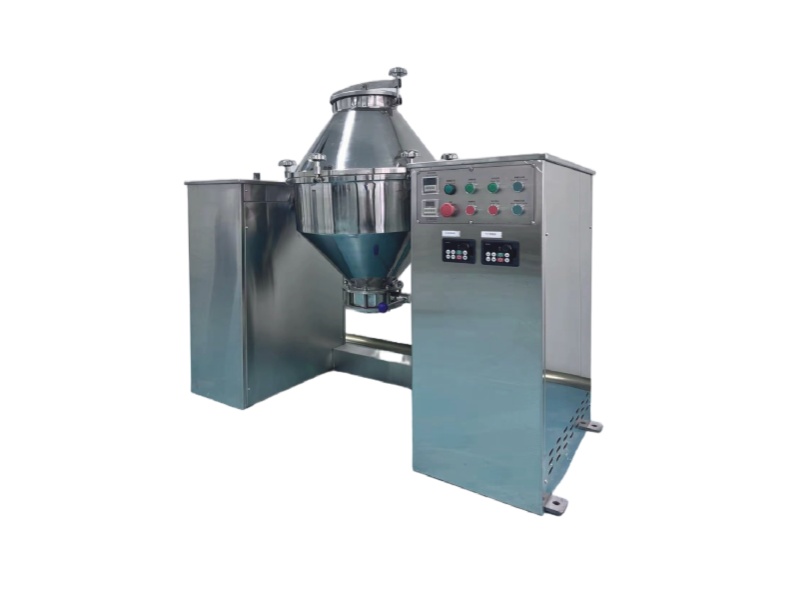
2.2 SLW Series Double-Cone Mixer
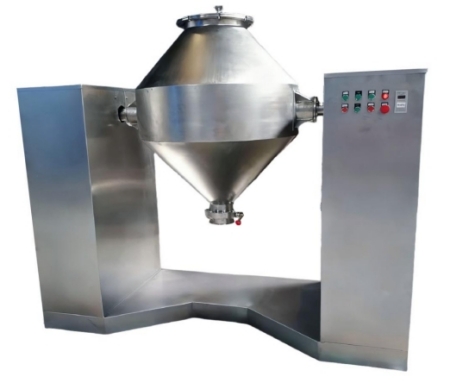
Product Page: Double Cone Mixer for Powder Mixing
Structural Features: Conical at both ends, with a cylindrical section in the middle.
Parameter | Description |
Mixing Principle | The double-cone vessel rotates, causing the materials to flow back and forth between the conical sections. |
Applicable Materials | Pharmaceutical, food, and chemical powders. |
Loading Coefficient | 30%-50% or 30%-80% |
Advantages | High mixing uniformity; thorough discharge. |
Disadvantages | The equipment is relatively tall for large models, imposing specific requirements on plant ceiling height. |
Unique advantages of the double-cone mixer: In addition to the option of installing a standard forced agitator, it can be customized with a forced ribbon agitator. This effectively combines the functions of both rotary mixing and horizontal mixing, thereby achieving a more efficient mixing outcome.
2.3 SLT Series Three-Dimensional Mixer

Product Page: Three-Dimensional Mixer for Mixing Use
Structural Features: The mixing vessel undergoes multi-directional movement within a three-dimensional space.
Parameter | Description |
Mixing Principle | The vessel executes a compound motion involving oscillation, translation, and rotation across the X, Y, and Z dimensions. |
Applicable Materials | Materials with significant differences in specific gravity; high-value materials. |
Loading Coefficient | 30%-70% |
Advantages | Optimal mixing efficiency; no dead spots; no internal mixing components. |
Disadvantages | Higher equipment investment cost; complex structure. |
Core Advantages of Three-Dimensional Mixing:
1)Unlike V-type and double-cone mixers, which are limited to rotational movement along a single vertical axis, three-dimensional mixer is capable of mixing across all three spatial dimensions.
2)Because the design eliminates the need for internal mixing components, cleaning is significantly easier, and there are no residual dead spots. This makes the technology particularly well-suited for the food and pharmaceutical industries, where hygiene standards are exceptionally rigorous.
2.4 Comparative Summary of Rotary Mixing Technologies
Type | Mixing Dimensions | Internal Components | Ease of Cleaning | Mixing Effectiveness | Applicable Scenarios |
V-Type | 2D | None / Optional Forced Agitator | Easy | Good | General Powders |
Double Cone Type | 2D | None / Optional Forced Agitator or Ribbon | Easy | Good/Very Good | General Powders |
3D Type | 3D | None | Easy | Optimal | High-Requirement & High-Value Materials |
III. Horizontal Powder Mixing Technology
A common characteristic of horizontal mixers is that the mixing vessel remains stationary while internal paddles rotate to actively drive and blend the materials. Compared to rotary mixers, horizontal mixers offer higher mixing efficiency, though they present a bit challenge in terms of cleaning. You can find from us the ribbon type horizontal powder mixer and the plow type powder mixer.
3.1 SLR Series Ribbon Mixer

Product Page: Industrial Ribbon Mixer Horizontal Screw Design
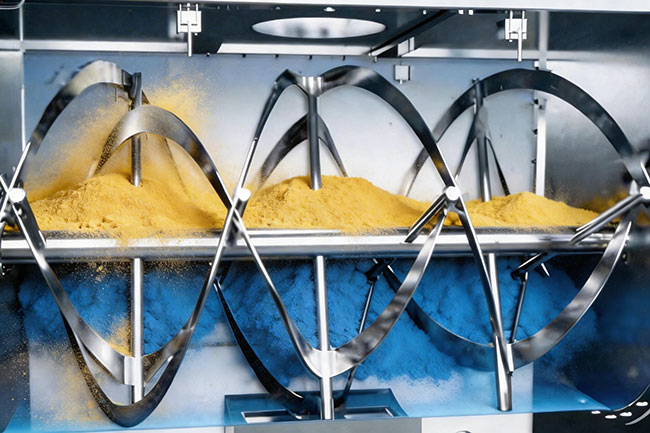
Structural Features: Features a U-shaped vessel fitted with a dual-layer internal spiral ribbon—an inner ribbon and an outer ribbon.
Parameter | Description |
Mixing Principle | The inner ribbon pushes materials outward, while the outer ribbon pushes them inward, creating a convective circulation flow. |
Applicable Materials | Medium-to-high viscosity powders, materials prone to agglomeration, and mixtures of multiple powder types. |
Loading Coefficient | 30–60% |
Advantages | High mixing efficiency; short mixing duration; supports the addition of a liquid spraying function. |
Disadvantages | More difficult to clean; removal of residual material is more involved compared to rotary mixers. |
Core Advantages:
1)Dual-Ribbon Agitation: The inner and outer ribbons operate simultaneously, generating a vigorous convective circulation of materials within the vessel.
2)Customizable Spraying Function: For applications requiring the addition of small quantities of liquid (e.g., oils, water, fragrances), a spraying device can be customized to facilitate effective liquid-solid mixing.
3)High Mixing Efficiency: Reduce mixing time by 30–50% compared to rotary mixers.
4)Applicable Scenarios: General powder mixing applications; the preferred choice for the majority of industrial uses.
3.2 SLPS Series Plow-Type Mixer
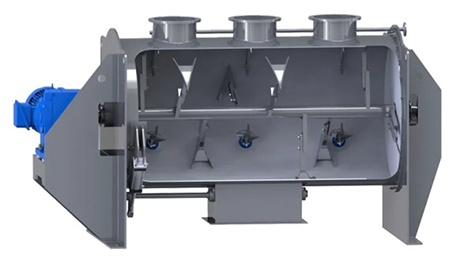
Product Page: Horizontal Plough Mixer
Structural Features: Horizontal mixing design, the mixing system is the plow blade mixing type. Also, you can see the flying blades on the sides of the mixing barrel.
Item | Description |
Mixing Principle | Plow blade tumbling and flying blade disintegration |
Applicable Materials | Viscous powders, fiber-containing powders, and materials that are difficult to disperse. |
Loading Coefficient | 20–60% |
Advantages | Strong shearing force, excellent dispersion effect; suitable for materials that are difficult to mix. |
Disadvantages | Higher equipment cost, higher energy consumption. |
The Core Value of the Plow Blades: By adding plow blades in the horizontal mixing system and flying blades on the side, the machine is able to shear and toss the materials. This makes it particularly suitable for:
● Viscous powders (e.g., oil-containing powders)
● Fiber-containing powders (e.g., herbal powders, fibrous materials)
● Materials prone to agglomeration or difficult to disperse
Selection Recommendation: Under standard circumstances, a ribbon mixer is generally sufficient. The plow-type mixer should only be considered when processing viscous or fibrous materials.
3.3 Comparative Summary of Horizontal Mixing Technologies
Model Type | Mixing Mechanism | Shear Force | Applicable Materials | Cleaning Difficulty | Price |
Ribbon Type | Inner & Outer Ribbon Convection | Moderate | Moderate | Moderate | Moderate |
Plow Type | Plow dispersing + Flying blade shearing | High | Viscous / Fibrous Powders | Moderate | Relatively High |
IV. Technical Comparison: Rotary vs. Horizontal Mixers
Comparison Dimension | Rotary Type (V-type / Double Cone / 3D) | Horizontal Type (Ribbon / Plow) |
Working Principle | Container rotates; material tumbles via gravity | Container remains stationary; paddles provide forced agitation |
Mixing Method | Primarily diffusion mixing | Convective mixing + shear mixing |
Mixing Efficiency | Lower | Higher |
Mixing Uniformity | Good | Very Good |
Loading Coefficient | 30–50%(standard type) | 30–60% |
Ease of Cleaning | Easy (No internal components) | Moderate (Contains internal agitation components) |
Applicable Materials | Dry powders with good flowability | Dry powders, powders containing liquids, viscous materials |
Liquid Addition Function | Usually Not supported | Supported (Spray nozzles can be added) |
Equipment Investment | Lower (3D type is higher) | Higher |
4.1 Core Advantages of Rotary Mixers
Advantage | Description |
Hygienic & Easy to Clean | No internal agitation components; no dead spots; particularly suitable for the food and pharmaceutical industries. |
Minimal Residue | Thorough discharge; minimal material waste. |
Simple Structure | Low maintenance costs; low failure rate. |
Optimal 3D Mixing | The 3D mixer variant offers the best mixing results, making it suitable for materials with stringent mixing requirements. |
(Remark: the v mixer and double mixer can be added with forced agitator or even inside ribbons to strengthen the mixing performance. This customized design can also been see one advantage.)
4.2 Core Advantages of Horizontal Mixer
Advantage | Description |
High Mixing Efficiency | Inner designed mixing agitators ensures short mixing times and high throughput. |
Strong Adaptability | Support the addition of spray functions for processing materials containing liquids. |
Specialized Plow Type | Suitable for viscous, fibrous, or difficult-to-mix materials. |
V. Academic Basis and Industry Standards
According to relevant research in the field of Powder Engineering, the mixing uniformity of powders is closely correlated with the type of equipment used, the mixing duration, and the loading coefficient. Studies indicate the following:
● Rotary mixers rely on diffusive mixing; while mixing uniformity improves as time progresses, it tends to stabilize after a certain duration, and excessive mixing may lead to segregation.
● Horizontal forced mixers rely on convective mixing, offering faster mixing speeds and making them suitable for materials that require short mixing cycles.
● The multi-dimensional motion of three-dimensional mixers enables the effective processing of materials with significant differences in specific gravity, yielding mixing uniformity that is notably superior to that of traditional two-dimensional mixing methods.
In accordance with the JB/T 14141-2021 standard, Food Machinery — Blending Equipment, powder mixing equipment is required to achieve a mixing uniformity (CV) of ≤ 5% and a discharge residue rate of ≤ 1%.
VI. Conclusion
The above analysis presents the different powder mixing technologies, demonstrating that different types of mixers vary in their mixing principles and suitability for specific materials. Furthermore, specialized customization options are available to accommodate the unique characteristics of different powder materials. If you are in need of powder mixing equipment, we invite you to contact us to obtain a customized solution.
References
1. JB/T 14141-2021: Food Machinery — Blending Equipment. Ministry of Industry and Information Technology.
2. Guide to Selecting Powder Mixing Equipment. Food Machinery and Equipment Network.
3. Technical Data on V-Type, Double-Cone, and 3D Mixers. Pharmaceutical Network.
4. Technical Comparison: Ribbon Mixers vs. Plow Mixers. Food Processing Equipment.