


 English
 French
Low-Cost Dust Control Design for Ribbon Blender Powder Charging
By:Salinovate Team Aug 17,2026
When a ribbon blender is used to mix fine powders, controlling dust during material charging can become an important part of the equipment design. In many production environments, the powder itself is not the main problem. The challenge occurs when bags of dry powder are manually opened and poured into the mixer. Fine particles can become airborne, settle around the equipment, and increase cleaning work for operators.
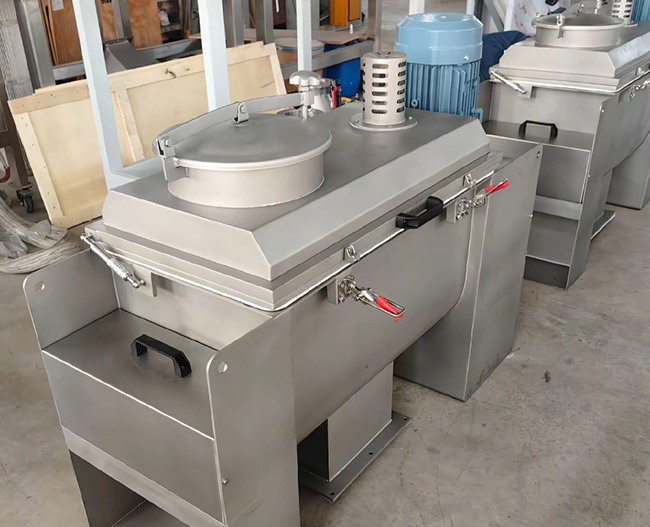
The best solution is to integrate the ribbon blender with a vacuum powder loading/screw conveying system, and dedicated dust-free feeding station. However, not every customer has the budget for a complete automated powder handling system from the beginning. This was the situation behind a recent SLR-1000L ribbon blender project, where we developed a simple four-sided dust guard mounted directly on the mixer cover. The objective was not to claim a completely dust-free process. Instead, the design was intended to physically contain and reduce the amount of powder dispersed during manual charging at a low cost.
I. Why Does Powder Dust Become a Problem During Ribbon Blender Charging
A ribbon blender normally receives dry powders and granules through openings on the top cover. This is a practical and widely used charging method for horizontal ribbon mixers. The problem starts when a fine powder is poured from a bag or container into the mixer. Depending on the material, particle size, moisture content and pouring method, some powder may become airborne instead of immediately entering the mixing chamber.
This can lead to several practical problems:
• Powder settles on the mixer and surrounding floor.
• Operators need to spend additional time cleaning the production area.
• Fine material may spread to nearby equipment.
• Cross-contamination can become a concern when different powders are processed.
• The working environment can become less comfortable for operators.
For facilities handling very fine or potentially hazardous powders, dust control may also become a much more important engineering and safety consideration. This is why Salinovate team provides different charging and discharging options, including manual charging, vacuum conveying, screw conveying, dust-collection, and automatic powder collection systems, etc.
II. Does a Ribbon Blender Need a Automatic Conveying System to Control Dust
Such system is optional, but it is a really good solution to well control the dust problem because the powder can be transferred from the feeding point into the mixer through a closed conveying route. Also, the dust-free feeding station can work together with the conveying system and mixer to form the real dust-free powder mixing equipment. It is particularly useful when:
• The powder is very fine.
• The production line operates frequently.
• Manual bag handling needs to be reduced.
• The plant requires a higher level of containment.
• The customer wants to automate powder transfer.
• The material needs to be transferred over a distance or from a lower level.
However, this system means additional equipment, installation space, electrical controls and investment. For a customer with a limited equipment budget, adding a complete conveying system to a ribbon blender may not always be the most economical first step. That is where a simpler mechanical dust-reduction design can make sense.
III. A Simple Alternative: Four-Sided Dust Guard
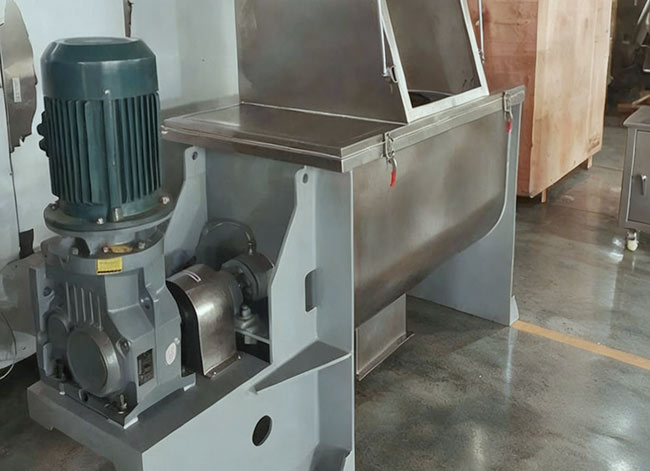
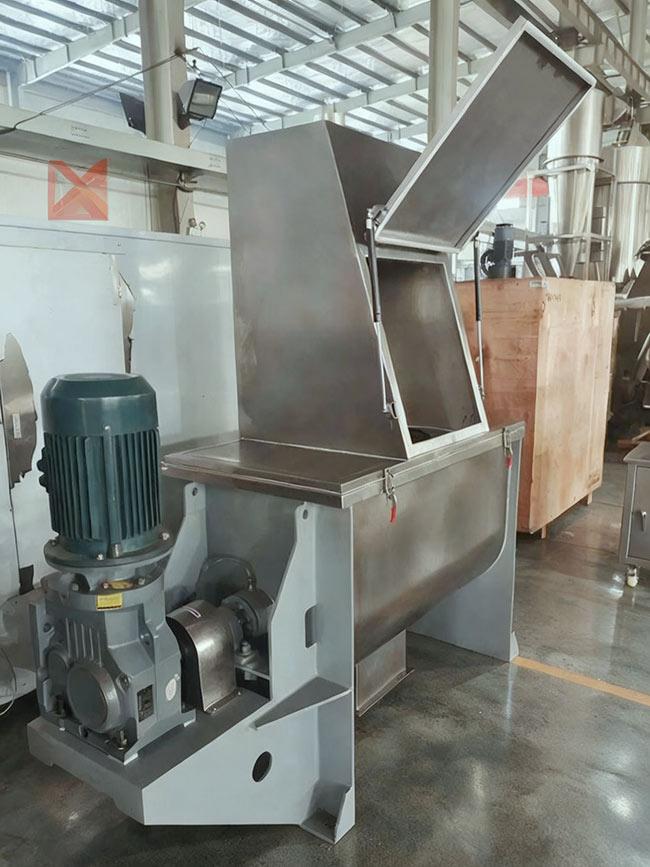
For one recent customer project, we supplied an SLR-1000L ribbon blender with a customized dust guard installed above the mixer cover. The design uses a simple principle: Physically isolate the charging area so that powder has less opportunity to disperse into the surrounding workspace. Instead of leaving the top charging area completely open, the guard forms a four-sided enclosure around the powder feeding area. The guard is fixed directly to the ribbon blender’s top cover.
During manual charging, the operator pours the powder into the designated charging area while the surrounding panels act as a physical barrier. This does not remove airborne particles through filtration, but it can significantly reduce the tendency of powder to spread outward during normal manual feeding. The basic design includes:
• Four-sided physical shielding
• Mounting directly on the mixer cover
• A dedicated opening for manual powder charging
• Easy access for loading and cleaning
• A simple mechanical structure
• No separate vacuum conveying system required
The four-sided guard is designed primarily for the powder charging stage. The dust control result is dust reduction but not the dust-free as done by the dust-free automatic conveying system.
IV. When Is This Low-Cost Design Worth Considering
A simple low cost physical dust guard may be worth considering when the customer:
• Uses manual bag charging.
• Has a limited equipment budget.
• Wants to reduce powder spreading around the mixer.
• Does not require a fully automated feeding line.
• Processes food, spice, agricultural or general industrial powders.
• Has relatively moderate dust-control requirements.
• Wants to improve the existing mixer without adding a complete conveying system.
If you are planning to purchase a ribbon blender for powder mixing with dust control, this design can be a economical choice for you. Certainly, we also have the other efficient dust-free mixing solutions for you if you have higher requirements. Welcome to contact Salinovate team for your customized powder mixing solutions.