


 English
 French
Almond Paste Grinding Test - Processing Split White Almonds with an SLJM-80 Colloid Mill
By:Salinovate Team Oct 21,2026
What kind of almond paste can a colloid mill produce from split white almonds, and what should buyers expect in terms of fineness, texture, and processing capacity?
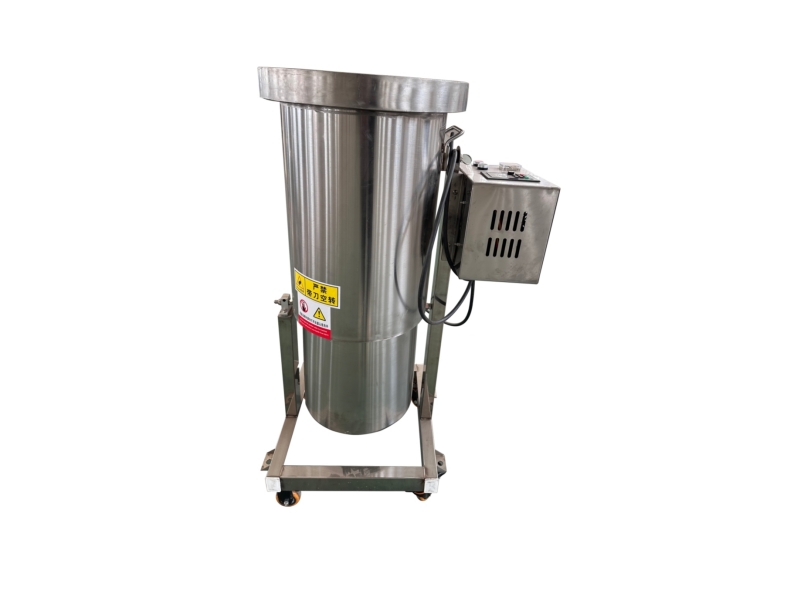
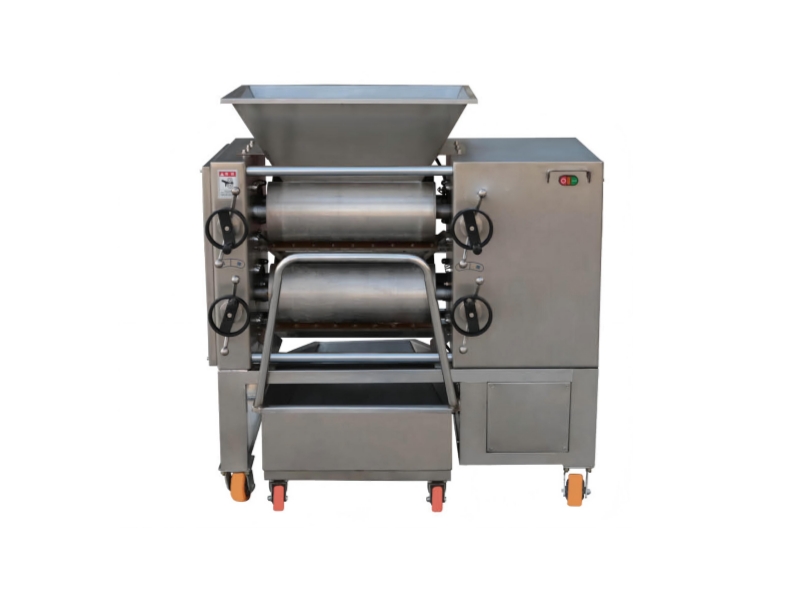
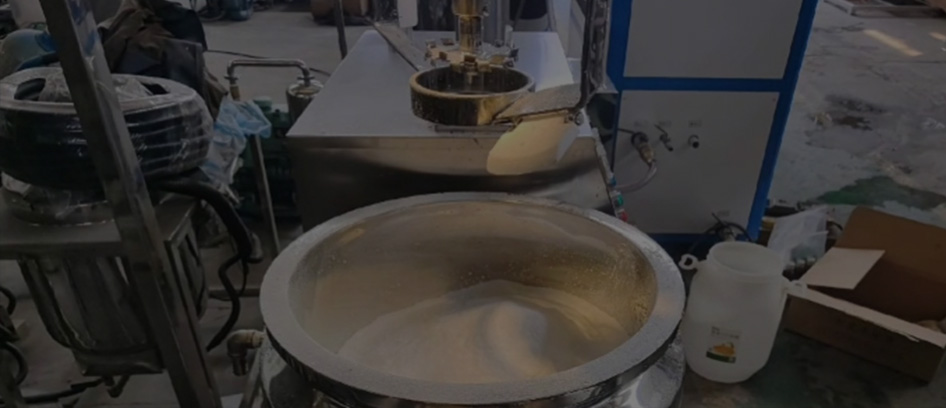
In this equipment test, Salinovate team evaluated the SLJM-80 colloid mill for almond paste grinding. The main output fineness was approximately 60-80 mesh, with an estimated processing capacity of around 100 kg/h. The resulting paste was relatively thick, with fine particles still perceptible in its texture. These results provide a useful reference for food processors evaluating an almond paste grinding machine. However, the actual production rate and final texture should always be verified against the raw material condition, grinding gap, and required product consistency.

I. Almond Paste Grinding Test: Key Results at a Glance
The purpose of this test was to evaluate the SLJM-80 colloid mill’s performance when processing split white almonds into almond paste. Rather than focusing only on the equipment’s specifications, the evaluation considers the main output fineness, the resulting paste consistency, and the estimated processing capacity.
The following table summarizes the key information available from this test:
Test Parameter | Test Result |
Raw material | Split white almonds |
Target product | Almond paste |
Grinding equipment | SLJM-80 colloid mill |
Main output fineness | Approximately 60-80 mesh |
Product consistency | Relatively thick and paste-like |
Observed texture | Fine particles remain perceptible |
Estimated processing capacity | Approximately 100 kg/h |
Further refinement options | Second grinding pass or suitable high-pressure homogenization |
The test indicates that the SLJM-80 can process split white almonds into a thick paste with a perceptible fine-particle texture. The result is not an extremely smooth, particle-free product after a single grinding pass.
Important: The capacity of approximately 100 kg/h is an estimate, not a guaranteed continuous-production rate. The 60-80 mesh figure describes the reported main output fineness; it should not be interpreted as a complete measurement of the finished paste’s smoothness. For equipment selection, these results should be considered together with the intended product application and the customer's required texture.
II. Raw Material and Processing Objective
The raw material used in this test was split white almonds. The objective was to grind the almonds into a cohesive paste rather than produce dry almond flour or coarse almond particles.
This distinction matters because almond paste and almond flour require different processing outcomes. Almond flour production primarily focuses on reducing the material into dry particles of a desired size. Almond paste production, by contrast, involves breaking down the almond structure and incorporating the naturally released oil into a concentrated paste.
The final consistency depends on the raw material’s characteristics and the grinding conditions. Feed size, moisture content, pretreatment, and temperature can all influence the processing behavior and finished product. For the present test, the raw material was split white almonds with a certain moisture.
III. Why Use a Colloid Mill for Almond Paste Grinding
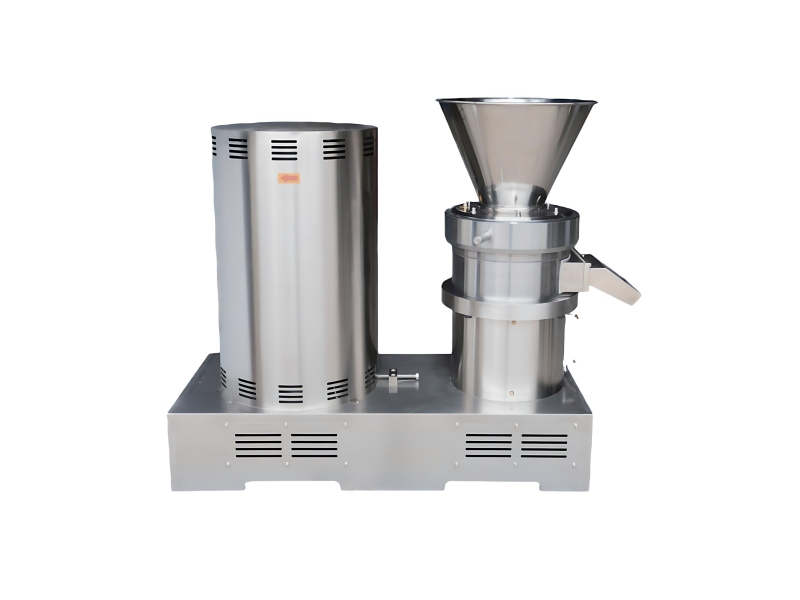
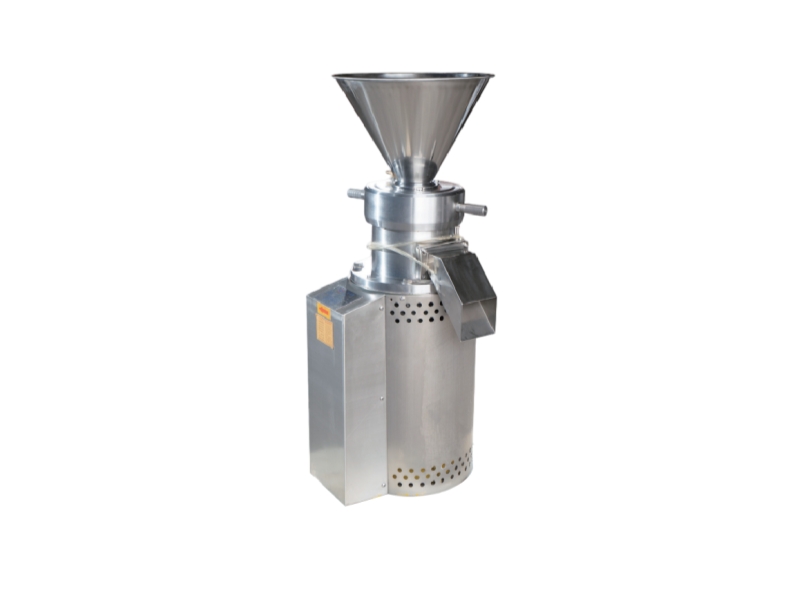
A colloid mill is a relevant equipment option for processing almonds into paste because its grinding mechanism combines mechanical shear and friction to reduce particles and help form a cohesive product. The SLJM-80 belongs to Salinovate’s SLJM colloid mill series. In this application, the machine was evaluated for paste grinding rather than dry powder production.
3.1 How a Colloid Mill Processes Almonds
A colloid mill typically uses a rotating component and a stationary grinding surface. Material passes through the working gap, where mechanical shear and friction help reduce particle size. As almond particles become smaller, the natural oil released from the almonds contributes to the development of a paste-like consistency.
The final result depends on several factors, including the working gap, material feeding, raw material condition, and the number of grinding passes. Consequently, the same equipment model may produce different textures under different operating conditions. A machine’s suitability should be judged by the actual product result rather than by its model designation alone.
3.2 Almond Paste Grinding Is Different from Almond Flour Grinding
The intended product should guide equipment selection.If the objective is dry almond flour, a suitable dry grinding system may be more appropriate. If the objective is a concentrated almond paste, a colloid mill is a relevant option to evaluate.
The distinction is particularly important for manufacturers planning to produce nut butter, spreads, bakery ingredients, or other food products that require a paste rather than a dry powder. For a broader comparison of equipment options, see Salinovate’s Nuts Grinding Machine for Powder and Butter.
IV. Actual Grinding Result: 60-80 Mesh with a Thick, Fine-Grained Texture
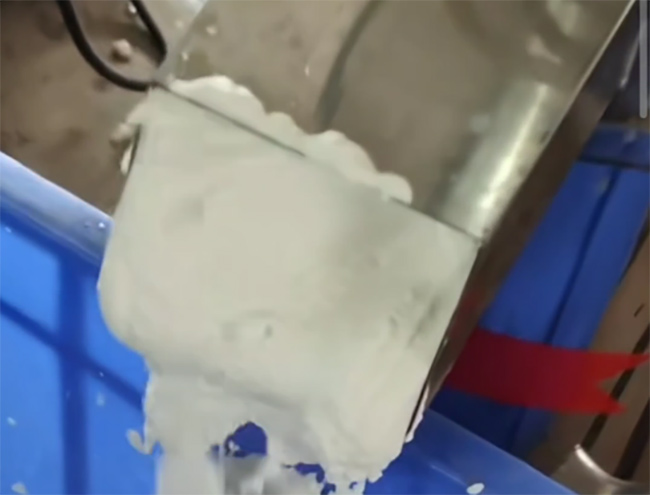
The SLJM-80 test produced almond paste with a main output fineness of approximately 60-80 mesh. The finished material was relatively thick rather than runny, and fine particles remained perceptible in its texture. This observation is important because a fineness figure alone cannot fully describe the sensory properties of almond paste.
The following video shows the actual test and the resulting product texture:
The video demonstrates the almond paste produced from split white almonds. The material has a relatively thick consistency, with fine particles still perceptible after grinding.
4.1 What Does the Texture Mean for Buyers
The test result provides two useful pieces of information. First, the product has a concentrated, paste-like consistency rather than the appearance of a thin liquid. Second, the texture retains a slight granular sensation. The result should therefore not be presented as an ultra-smooth almond butter with no perceptible particles.
Whether this texture is acceptable depends on the finished product’s intended application. For some food-processing applications, a thick almond paste with a fine-particle texture may be suitable. For products where a particularly smooth mouthfeel is essential, further refinement may be necessary.
Buyers should therefore evaluate the actual test video alongside their own product requirements instead of relying exclusively on the nominal mesh value.
4.2 Why Mesh Size Does Not Fully Determine Smoothness
Mesh is commonly used to describe particle sizes in dry screening applications. However, almond paste is a concentrated mixture of solid particles and naturally released oil, so its sensory properties cannot be completely characterized by a mesh figure alone.
Perceived smoothness also depends on particle-size distribution, the presence of larger particles, oil distribution, and the overall structure of the paste. This explains why a product reported at approximately 60-80 mesh may still have a perceptible fine-particle texture. For a more rigorous product specification, the target particle size and the method used to measure it should be clearly defined. Where mouthfeel is the main acceptance criterion, a product sample or agreed sensory standard is also valuable.
The practical conclusion is that the SLJM-80 test provides a useful reference for almond paste grinding, but the reported fineness should not be treated as a guarantee of an exceptionally smooth final product.
V. How to Achieve a Smoother Almond Paste
For manufacturers who require a smoother almond paste than the result shown in the test video, two processing options can be considered: a second grinding pass or additional high-pressure homogenization. The appropriate choice depends on the required texture, the paste’s physical properties, and the production capacity needed.
5.1 Option One: Second Grinding Pass
Passing the almond paste through the colloid mill for a second grinding stage may help reduce remaining larger particles and improve the uniformity of the product. This option may be worth evaluating when the first grinding pass produces a suitable paste consistency but does not achieve the desired smoothness.
However, the improvement depends on the initial particle-size distribution, machine settings, material temperature, and paste characteristics. A second pass does not automatically guarantee a specific final particle size or a completely smooth mouthfeel. The additional pass also affects processing time and effective production capacity. For production planning, the throughput of the complete grinding process should be evaluated rather than assuming that the initial estimated capacity remains unchanged.
A follow-up trial is recommended to determine whether a second pass can meet the target texture at an acceptable production rate.
5.2 Option Two: High-Pressure Homogenization
For applications with more demanding texture requirements, high-pressure homogenization may be considered as an additional processing stage.
High-pressure homogenization can help refine particle dispersion and improve uniformity in suitable formulations. Its effectiveness depends on the characteristics of the material and the operating capabilities of the selected equipment. Almond paste, however, is a relatively concentrated, oil-rich material. Its viscosity and solids content may make it unsuitable for some homogenizers designed primarily for lower-viscosity liquids.
Before selecting this option, the manufacturer should confirm that the high pressure homogenizer can handle the actual paste, including its viscosity, solids content, and feeding requirements. A processing trial is the most reliable way to determine whether high-pressure homogenization provides a meaningful improvement in the desired texture.
5.3 Which Option Should You Choose
The decision should be based on the finished product requirements rather than the assumption that more processing is always better.
Requirement | Option to Evaluate | Main Consideration |
Thick almond paste with a slight fine-particle texture | Single-pass colloid milling | Confirm that the initial result meets product requirements
|
Smoother paste with reduced perceptible particles | Second grinding pass | Evaluate texture improvement and effective throughput |
More demanding particle-dispersion requirements | Suitable high-pressure homogenization | Verify material compatibility and equipment capability |
These options are preliminary process considerations, not guaranteed outcomes. The appropriate configuration should be confirmed through testing with the intended raw material and target product.
VI. Estimated Processing Capacity: Approximately 100 kg/h
The estimated processing capacity for the SLJM-80 almond grinding application was approximately 100 kg/h. This figure provides an initial reference for manufacturers assessing whether the machine may suit their production requirements. It should not be interpreted as a guaranteed rate for every almond variety, paste formulation, or operating condition.
Actual throughput can vary with raw material characteristics, feeding stability, grinding settings, and the required final texture.
6.1 Why Production Capacity Must Be Evaluated with Product Quality
Grinding capacity and product quality should be considered together. A process designed to produce a relatively thick almond paste with a slight fine-particle texture may have different operating requirements from one designed to deliver an exceptionally smooth product.
If additional grinding is needed, the extra pass introduces another processing stage and may reduce the effective output of the overall process. If high-pressure homogenization is introduced, its feeding requirements and processing rate must also be considered. Therefore, the estimated 100 kg/h figure should be treated as a reference for the reported grinding application, not as a guaranteed production rate for a complete system incorporating additional refinement.
For manufacturers planning commercial production, the final configuration should balance the target texture, required output, operating time, and downstream processing requirements.
Conclusion: Is the SLJM-80 Suitable for Almond Paste Grinding
The SLJM-80 colloid mill was tested using split white almonds for almond paste production. The main output fineness was approximately 60-80 mesh, and the estimated processing capacity was around 100 kg/h. The resulting paste was relatively thick, with fine particles still perceptible in its texture.
For applications that accept this texture, the test provides a starting point for assessing the SLJM-80 as an almond paste grinding solution. If you need higher processing capacity, we also have larger model colloid mill. For applications requiring a smoother mouthfeel, a second grinding pass or suitable high-pressure homogenization may be worth evaluating, subject to further testing.
Ultimately, the right equipment configuration depends on the desired product texture, raw material condition, required throughput, and the performance of any additional processing stages.