


 English
 French
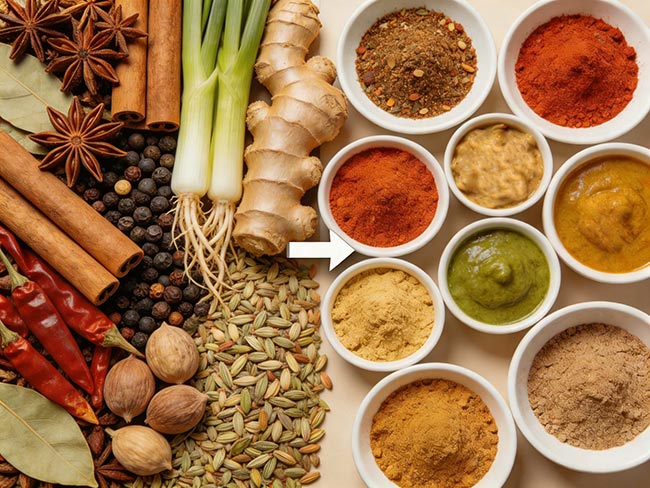
What are the methods of grinding spices? This article synthesizes technical literature and equipment application practices in the spice processing industry, systematically analyzing the principles, equipment selection, and application scenarios of dry grinding and wet grinding technologies. Hope that you can read this article to find the most suitable spice grinding methods.

I. Introduction: Technical Classification of Spice Grinding
Spice grinding is a fundamental process in food processing, condiment production, and the flavor and fragrance industry, directly affecting the aroma release, taste, and final quality of products. Based on the state of the raw materials and the requirements of the finished product, spice grinding is mainly divided into two technical routes:
Technical Route | Raw Material State | Finished Product Form |
Dry Grinding | Dried spices | Spice powder, seasoning powder |
Wet Grinding | Fresh or processed spices | Coarse and fine garlic paste, ginger paste, chili sauce, curry sauce |
This article will delve into the technological principles, equipment selection, and application points of these two grinding technologies, providing a systematic technical reference for spice processing enterprises.
Note: Nearly all the spice grinders mentioned below, you can find in the product page of our Seasoning Grinder Machine. If you think that the articles are too long, you can click to see the specific spice grinder machines with different grinding methods.
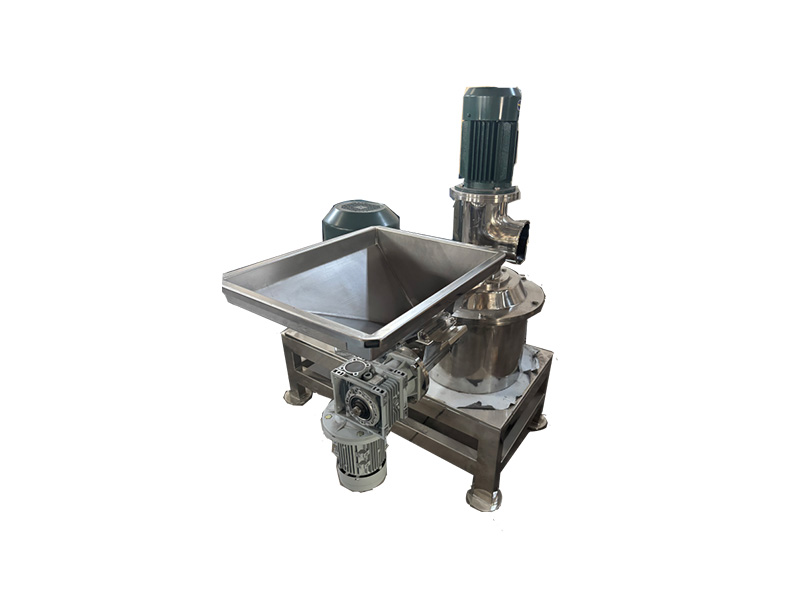
II. Dry Grinding Technology: A Complete Path from Coarse Powder to Ultra Fine Powder
Dry grinding refers to the process of pulverizing dried spices (moisture content typically <10%) into powder. Based on fineness requirements, material characteristics, and production capacity needs, dry grinding mainly has the following three technical paths:
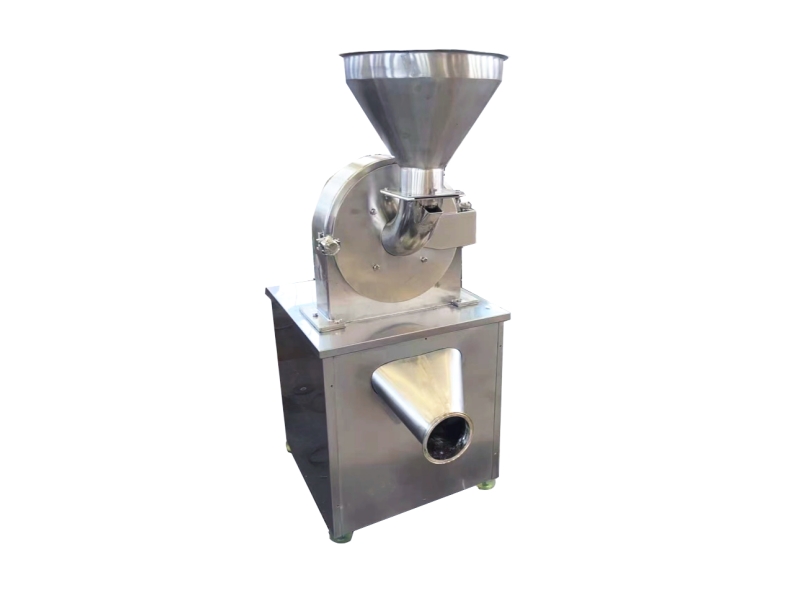
2.1 Mechanical Cutter Grinding Method - A Mainstay of Industrialization
The mechanical cutter grinding method is frequently seen in the industrial spice powder production. You can see the introduction below to know more details.
1)Cutter Type and Applicable Materials
Cutter Type | Working Principle | Applicable Spices | Grinding Performance |
Hammer beater | High-speed hammering and impact | Ginger, turmeric, cinnamon, chili, etc | 10-120 mesh (most 10-80mesh) |
Turbine cutter | High-speed rotation generates airflow impact | White pepper, ginger, chili, etc | 10-120 mesh (most 10-80mesh) |
Blade type cutter | Cutting and grinding | Fiber spices (vanilla, basil) | 10-120mesh (most 10-80mesh) |
2)Screen Adjustment System
Mechanical cutter grinders typically have a built-in replaceable screen. The fineness of the powder is controlled by selecting different screen apertures. Usually for oil spices like chili pepper, white pepper, cumin, etc, 20mesh screen is commonly used. For the fibrous spices like ginger, turmeric, cinnamon, etc, 60mesh or 80mesh screen is more suggested.
3)Cooling System Configuration
Fragrance grinding processes easily generate frictional heat, leading to aroma volatilization and material charring. Mainstream equipment is equipped with a water-cooled jacket:
● Tap water (15-25℃): Basic cooling
● Cooling water (5-10℃): Enhanced cooling
● Chilled water (0-5℃): High-end configuration, suitable for heat-sensitive fragrances
Following are the videos of our SLU-20 model grinder to grind dried chili into powder(no cooling water inlet) and SLU-300 model grinder for chili powder making with cooling water, you can have a see and comparison:
4)Grinder Technical Data
● Machine Series: SLU series and SL series
● Screen Mesh Diameter: 0.4mm-0.8mm
● Capacity: about 20-1500kg/h
● Fineness Range: 10-120mesh
Applicable Scenarios: Small, medium and large-scale industrial production, suitable for most dry spices.
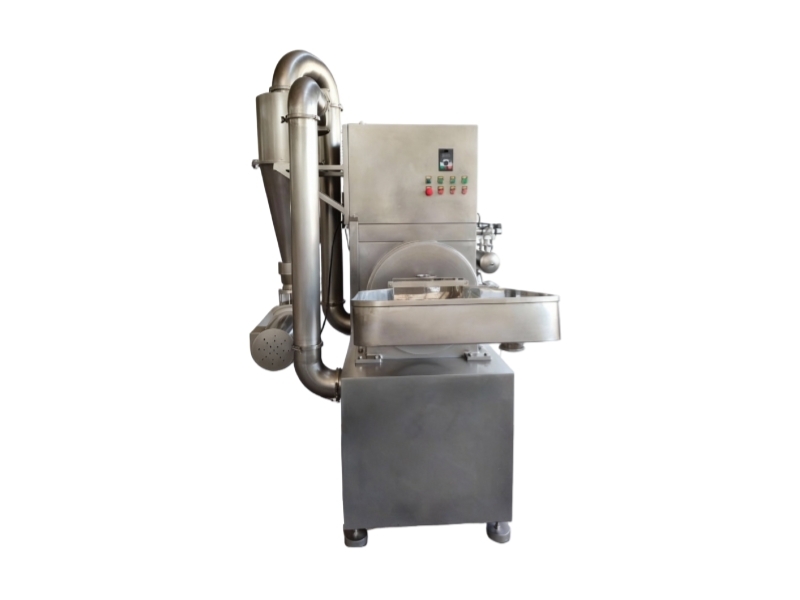
2.2 Mechanical Blade Plus Air Classification – An Upgraded Method for Ultra fine Grinding
This is a combined grinding method for spice grinding when you need to make fine spice powder like 80-200mesh.
1)Working Principle
● Material is ground by the grinding blades and then enters the classification zone.
● The high-speed rotation of the classification wheel generates centrifugal force.
● Fine powder passes through the classification wheel and enters the collection system
● Coarse powder returns to the grinding zone for further grinding.
2)Technical Parameter
● Machine series: SLA series
● Fineness range: about 60-300 mesh
● Output size control: by grade speed
● Production capacity: about 50-1500kg/h
3)Advantage
● Extremely fine particle size, up to 300mesh and finer
● Narrow particle size distribution and excellent uniformity
● Fineness can be adjusted as needed
4)Suitable Application
● High-end spice powder(such as turmeric powder, cinnamon powder), functional food ingredients. You can see the video below of the SLA series fine grinder for fine ginger powder making:
5)Cooling Support
For applications requiring strict flavor control, a cooling fan can be installed to introduce cool air (0-10℃) into the grinding chamber, further reducing the grinding temperature and protecting heat-sensitive aroma components.
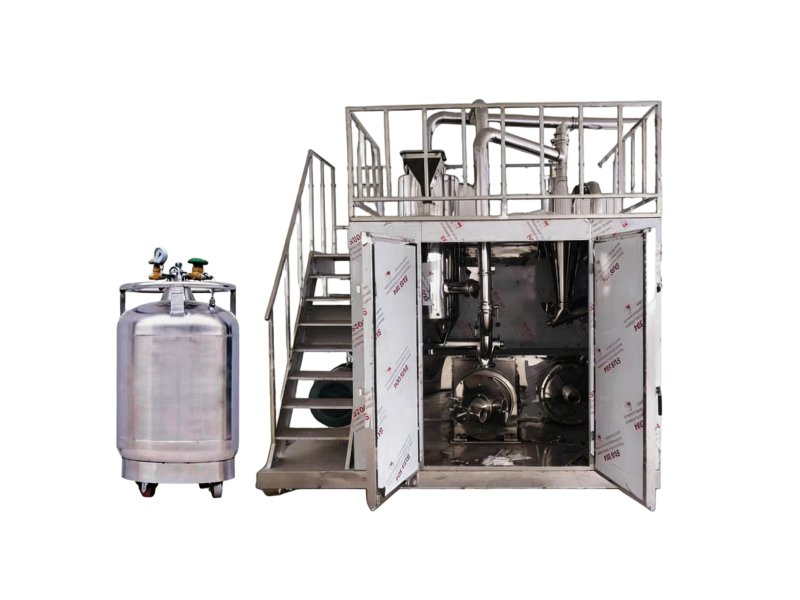
2.3 Liquid Nitrogen Cryogenic Grinding Method – A Technology for Ultimate Fineness
Cryogenic liquid nitrogen cryogenic grinding is currently the finest spice grinding technology. The fragrance is first frozen and embrittled in liquid nitrogen at -196℃, and then ground.
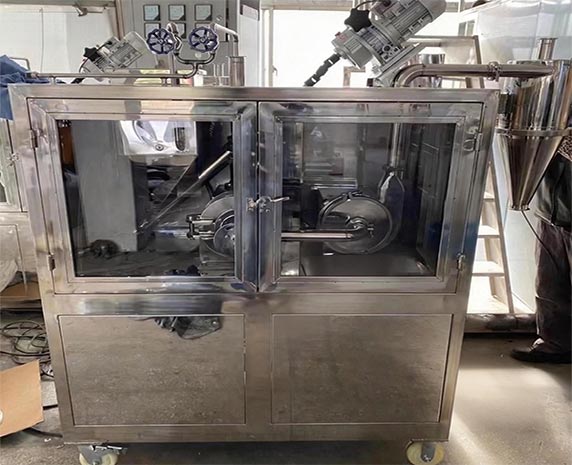
1)Working Principle
● Liquid nitrogen enters into the mill chamber, and the temperature is lowered to -196℃.
● The freezing temperature freezes the spices to be cryo-embrittled.
● The shatterable spices are easy to ground into fine powder.
● The powder fineness can reach 100-300 mesh.
2)Technical Parameters
● Grinding Temperature: -196℃
● Fineness Range: 100-300 mesh
● Production Capacity: 50-500 kg/h
● Liquid Nitrogen Consumption: Approximately 1kg spice grinding costs 1 kg liquid nitrogen
3)Advantages
● Extremely fine particle size, up to 300 mesh
● Preserves aroma components (low temperature prevents volatilization)
● Suitable for high-oil and high-sugar materials
4)Disadvantages
● Extremely high operating costs (liquid nitrogen consumption)
● Large equipment investment
● Requires liquid nitrogen supply facilities
5)Suitable Scenarios
● Ultra-high-end flavor powders, pharmaceutical-grade flavor powders. Few customers choose this option; it is only suitable for products with extremely high requirements for fineness and aroma.
2.4 Comparison and Summary of Dry Grinding Technologies
Method/Technology | Fineness Range | Production Capacity | Temperature Control | Operating Cost | Applicable Materials |
Mechanical cutter | 10-120mesh | Wide range | Cooling jacket design | Low | Most spices |
Blade plus air classification | 60-300mesh | Wide range | Cooling jacket design | Medium | Fibrous spices |
Cryogenic grinding | 100-300mesh | Wide range | Cooling jacket design | Very high | All spices |
Actually, we have an article named How to Grind Spices - Industrial Guide, which explains in detail all the listed spice grinders above mentioned. You can click and have a read.
III. Wet Milling Technology: From Fresh Spices to Sauce Paste
Wet milling refers to the process of pulverizing fresh or processed spices into a paste, puree, or sauce-like form, widely used in the production of seasoning sauces. Unlike dry milling, wet milling processes fresh spices with high moisture content (typically >60%), producing a semi-fluid product, primarily used for making garlic paste, ginger paste, chili sauce, curry sauce, etc.
3.1 Cutting Grinding Method – High-Efficiency Single-Material Processing
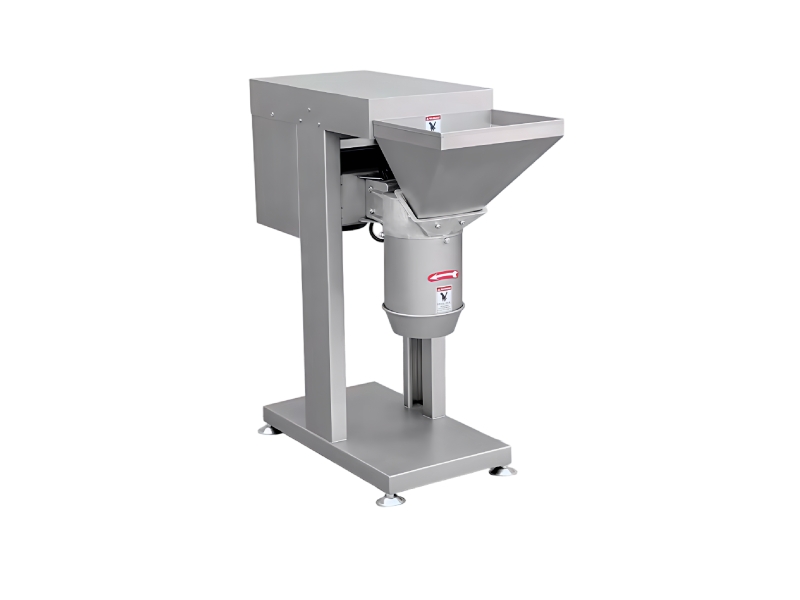
For large-scale processing of a single spice, cutting type grinding method is the most economical and efficient option. Our SLVC series shredder is the corresponding machine model.

1)Working Principle
● High-speed rotating blades quickly crush fresh spices into a paste, allowing for the processing of large batches at once.
2)Technical Parameters
● Machine series: SLVC series
● Capacity: 200-400 kg/h
3)Advantages
● High production capacity, suitable for medium-scale processing of single materials
● Simple operation and convenient maintenance
● Moderate investment
4)Applicable Scenarios
● Medium sized production of single spices such as minced garlic, minced ginger, and minced onion.
3.2 Dual Function of Chopping and Mixing – Multi-Material Mixing Processing
For complex seasoning sauces (such as curry sauce and chili sauce) that require simultaneous processing of multiple spices, our SLCM series cutter mixer is an ideal choice.
1)Working Principle
● High-speed rotating blades at the bottom chop simultaneously, completing both chopping and mixing.
2)Technical Features
● Low Speed: For coarse chopping, retaining a granular texture
● High Speed: For refining into a smooth and uniform paste or slurry
● Variable Frequency Speed Control: Allow flexible switching between low and high speeds
3)Technical Parameters
● Blade Speed: 0-3000 rpm
● Loading Capacity: 10-100 kg, small models to medium models in supply
● Function: Integrated chopping and mixing
4)Advantages
● Multi-functional, capable of processing multiple spices simultaneously
● Adjustable finish texture
● Sealed processing reduces aroma evaporation
You can watch the video below of this type cutter mixer for mixed spice cutting and mixing:
5)Applicable Products
● Suitable for: Compound sauces (curry sauce, chili sauce, XO sauce), and mixed spice pastes.
3.3 Colloid Mill: The Ultimate Choice for Fine Sauces
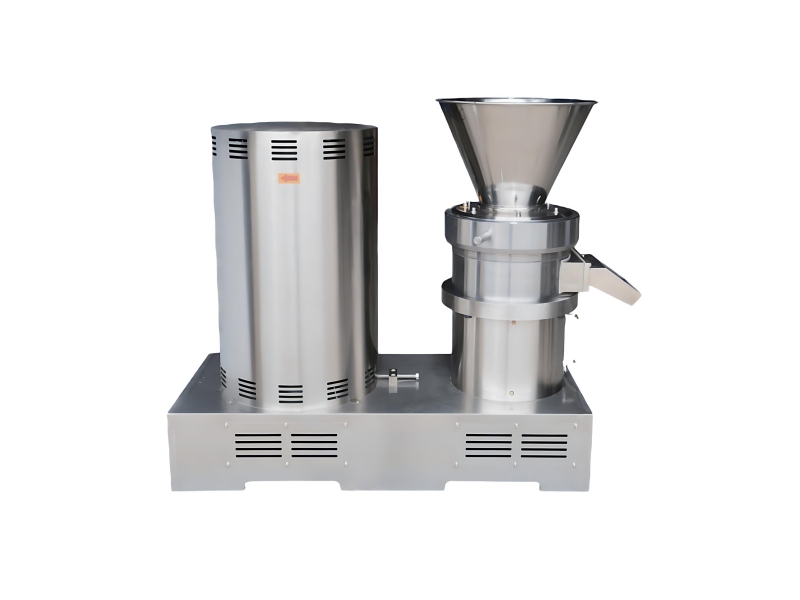
For sauces requiring extreme fineness (such as chili sauce and garlic sauce), high-speed mechanical shearing method is suitable. Our SLJM series colloid mill adopts such grinding method, very suitable for wet spice fine grinding use. The output size can reach micron-level. The following is the fine chili paste making video by the colloid mill:
1)Working Principle
● Materials pass through the tiny gap between the high-speed rotating rotor and stator, undergoing intense shearing, friction, and cavitation effects, thus being refined to the micron level.
2)Technical Parameters
● Rotation Speed: 2900 rpm
● Fineness: 2-50um
● Capacity: 100-1000 kg/h
3)Advantages
● Extremely high fineness, resulting in a delicate texture
● Excellent emulsification, ensuring sauce stability
● Continuous production capability
4)Suitable Scenarios
● High-end chili sauce, garlic sauce, ginger sauce, and other products requiring extreme fineness.
3.4 Comparison and Summary of Wet Milling Technologies
Wet Milling Method | Finished Product Form | Capacity | Fineness | Applicable Scenarios |
Cutting grinding | Grated ginger, garlic, onion, chili, etc | Medium scale capacity | Coarse to Medium level | Single spice or mixed spice grinding at one time for coarse pastes |
Chopping and mixing | Pastes or shreds | Small to medium capacity | Medium to fine level | Single spice or various spice grinding at one time for shreds or pastes |
High speed mechanical shearing | Fine pastes | Small to large capacity | Fine level | Single spice or mixed spice grinding at one time for high-end fine pastes |
Note: for the wet spice grinder, we have one grinder selection guide article named Grind Fresh Red Chili - How to Choose Grinder to have a overall analysis. For most wet spices, the grinder selection is very much like the fresh chili grinder selection. If you feel interested, you can read this article by clicking.
IV. Conclusions and Recommendations
What are the methods for pulverizing spices? From the above introduction, we can understand that spice pulverization methods cover a complete spectrum, from ordinary mechanical crushing to modern liquid nitrogen pulverization. Furthermore, dry grinding and wet grinding each have their own technical characteristics and applicable scenarios:
4.1 Dry Grinding Method Selection Recommendations
1)Economy Grinding Needs: Choose mechanical blade pulverization. Equipment options include our SLU series and SL series spice grinder with cooling design.
2)Ultra-fine Powder Needs: Blade + air-classification pulverization. Equipment options include our SLA series, achieving a fineness of 60-300 mesh.
3)Ultimate Quality: Liquid nitrogen cryogenic pulverization, optimal aroma preservation (extremely high cost).
Note: For spices with high oil content, separate discussion is needed.
4.2 Wet Grinding Method Selection Recommendations
1)Single Spice Coarse Crushing: Cutting grinding method, the grinder option can be our SLVC series cutting machine.
2)Compound Spice Mixing: Chopping mixing method, the grinder option is our SLCM series cutter mixer, multi-purpose.
3)Fine sauces: You can choose the high-speed shearing method. Our SLJM series colloid mill is a good spice grinder option, the fineness up to 2-50μm.
Core principle: Select the most suitable pulverization method based on material characteristics (oil content, hardness, moisture content), finished product requirements (fineness, flavor), production capacity, and cost budget.
References:
1. Research progress in spice pulverization technology. Food Industry Technology, 2022, 43(15): 412-418.
2. Application of low-temperature pulverization technology in spice processing. China Condiments, 2021, 46(8): 156-160.
3. Application of wet pulverization in the production of compound seasoning sauces. Food Industry, 2022, 43(12): 89-93.
4. Process optimization of colloid mill in sauce processing. China Food Additives, 2023, 34(3): 145-151.