


 English
 French
Ribbon Blade Mixer with Dust-Free Vacuum Feeder for Spice Factory
By:Salinovate Team
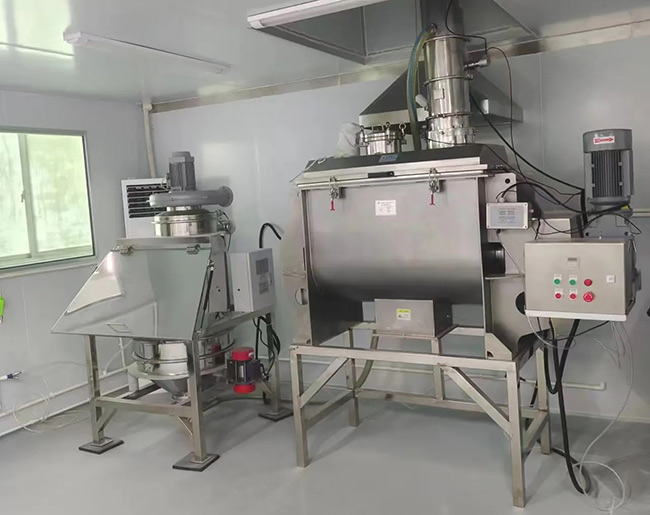
This case is to show you the ribbon blade mixer with dust-free vacuum feeder for a spice factory to achieve self-operated production. The whole production has high degrees of automation and the production is almost dust-free.

I. Project Background: The Spice Factory's Capacity Expansion Needs
Firstly, let us start from the customer background to know the basic project information.
1.1 Customer Overview
The customer in this case study is a spice powder manufacturer specializing in the production of various spice powders, including:
● Single spice powders (chili powder, black pepper powder, cumin powder, turmeric powder, etc.)
● Compound seasoning powders (barbecue seasoning, curry powder, etc.)
● Mixed seasonings (mixed products of spice powder, salt, and sugar)
With the expansion of its business, the customer's original production methods could no longer meet the increasing order demands.
1.2 Customer Pain Points: From Renting Equipment to Self-Investment
Stage | Production Method | Pain Points |
Past | Renting mixing equipment | Low short-term rental costs, high long-term operating costs |
Present | Self-purchased equipment | Require one-time investment, but more economical in the long run |
Core Needs | Uniform mixing of spice powder, salt, and sugar | Good mixing effect to meet quality requirements |
The customer stated:
"Previously, I always rented equipment, and the rental fees added up to a considerable amount over a year. Now that orders are stable, it's time to buy my own equipment. But this is my first time buying, so I hope I can choose the right one."
II. Solution Discussion: Why Choose a Ribbon Mixer?
After analyzing the customer’s production requirements, we suggested the ribbon mixer for him and the solution was accepted. You can see the analyzing process below to see the reasons.
2.1 Material Characteristics Analysis
The materials the customer needs to mix include:
Material | Characteristics | Mixing Requirements |
Spice Powder | Powdered, prone to dust | Uniformly dispersed |
Salt | Granular, high density | Does not settle |
Sugar | Granular, easily absorbs moisture | Does not clump |
Key Requirements: The three materials have significant density differences (salt and sugar are denser than the spice powder), requiring equipment that prevents the denser materials from settling.
2.2 Why Choose a Ribbon Mixer?
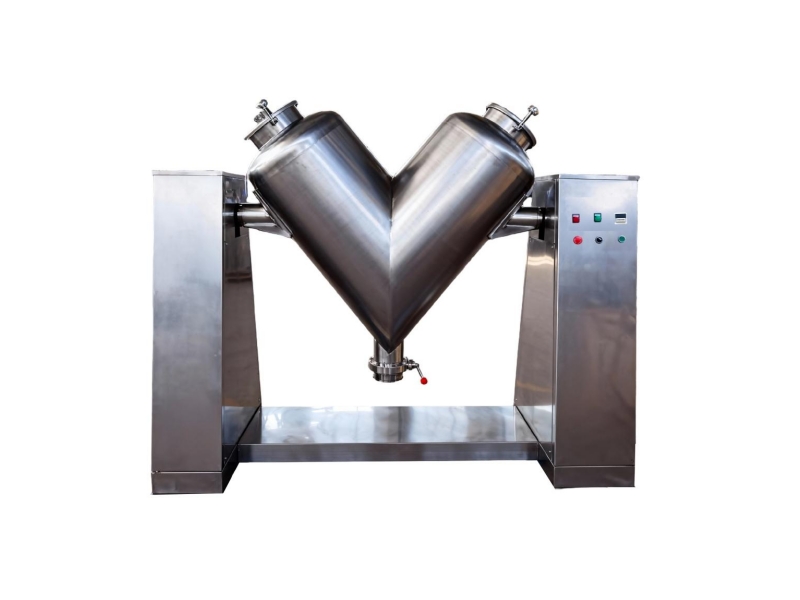
Comparison Dimensions | V-Type Mixer | Ribbon Mixer | Selection Criteria |
Mixing principle | Gravity tumbling | Forced mixing | Ribbon mixers are better suited for materials with large density differences |
Density difference adaptability | Average | Good | Forced tumbling by the ribbon prevents settling |
Residue | Less | Less | Both are acceptable |
Price | Lower | Slightly Higher | Acceptable by Customers |
To clearly see the working flow of the two type powder mixers, you can watch the v powder mixer and ribbon type mixer working videos below:
Final Choice: Considering the density differences of spice powder, salt, and sugar, the SLR series ribbon mixer can better prevent salt and sugar from settling, ensuring uniform mixing.
(Remark: The common SLW series has the similar function as the v type mixer and basically the price is same. The advanced SLW series double cone mixer and the SLT series three dimensional mixer are more expensive than the SLR series ribbon mixer. So we only discussed the v type mixer and ribbon mixer in this part.)
III. Final Solution: 200L Ribbon Mixer + Dust-Free Automatic Feeding System
What is the final solution? Please read the following design details:
3.1 Core Equipment Configuration
Equipment | Model/Specification | Function |
Ribbon mixer | SLR-200 | Mixing of spice powder, salt, and sugar, etc |
Dust-free feeding station | Supporting equipment | Prevent dust from flying during manual feeding |
Vacuum feeder | Supporting equipment | Automatically convey materials to the mixer |
3.2 Equipment Parameters
Project | Parameter |
Mixer volume | 200L |
Batch loading capacity | 120 kg/batch (Loading coefficient 0.6) |
Mixing method | Forced ribbon mixing |
Mixing time | 8-12 minutes (depending on materials) |
Material | 304 stainless steel, food grade |
3.3 Dust-Free Automated Feeding System
To address the issues of high dust levels and labor intensity associated with manual feeding, the customer also configured:
1)Dust-Free Feeding Station:
● Manually pour bagged materials into the feeding station.
● Negative pressure environment prevents dust leakage.
● Improves the workshop working environment.
2)Vacuum Feeder:
● Automatically transports materials from the feeding station to the ribbon mixer.
● Reduces manual handling and feeding.
● Enables automated continuous production.
3.4 Why are Dust-Free Feeding and Automated Feeding Needed?
Pain Points | Traditional Methods | This Solution | Improvements |
Dust Issues | Manual feeding generates a lot of dust | Dust-free feeding station with negative pressure collection | Improve the working environment |
Labor Intensity | Manual handling and feeding | Vacuum automatic feeding | Reduce labor |
Efficiency | Slow manual feeding | Fast automatic feeding | Improve efficiency |
Losses | Easily spills material during manual feeding | Loss-free closed conveying | Save raw materials |
IV. Summary of Solution Value
Regarding the given mixing solution, it has the following value for the customer in this case.
4.1 The Leap from Rental to Self-Investment
Comparison Dimensions | Rental Equipment | Self-Purchase | Improvement |
Long-term costs | Continuous expenses | One-time investment | More economical in the long run |
Equipment stability | Not fixed | Owned stability | Controllable production |
Flexibility | Limited | Available anytime | Flexible scheduling |
Return on Investment | None | Payback period within one year | Long-term value |
4.2 Core Value of this Solution
Value Points | Explanation |
Correct selection | Ribbon mixer is suitable for materials with large density differences. |
Dust-free upgrade | Dust-free feeding station + vacuum feeder improves the working environment. |
Automation | Automatic feeding reduces manual labor and improves efficiency. |
V. Summary
This customer case study showcases the upgrade journey of a spice factory from renting equipment to self-procuring it. It also demonstrates how a ribbon blade mixer paired with a dust-free vacuum feeder enables automated feeding and mixing of spice powders, resulting in greater efficiency and hygiene. If you are also looking for powder mixing solutions, please contact us for selection advice.