


 English
 French
This article synthesizes research findings from the academic journal Food Bioscience, advanced emulsification technology data from SGN Germany, and research progress in high-pressure homogenization technology from China Agricultural University, providing a systematic analysis of the three generations of process evolution in mayonnaise production technology: manual stirring, shear emulsifier technology, and three-stage emulsification system technology.
I. Introduction: Mayonnaise—The Pinnacle of Water-Oil Emulsification Technology
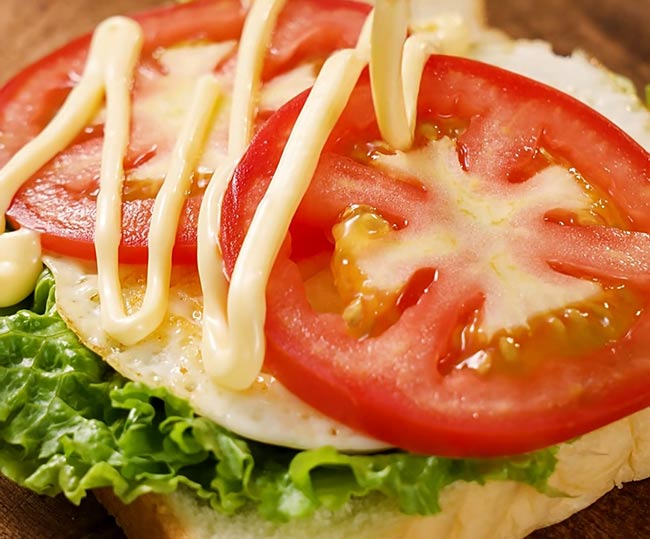
Mayonnaise, as one of the world's most popular condiments, is essentially an oil-in-water emulsion, with an oil content generally exceeding 40%. Ordinary stirring or homogenization easily leads to non-emulsification or rapid separation of mayonnaise. Therefore, mayonnaise production technology has been constantly evolving. From manual stirring in the kitchen to industrialized three-stage emulsification systems, mayonnaise emulsification technology has undergone three generations of process evolution. This article will delve into the principles, equipment characteristics, and applicable scenarios of each generation of technology.
II. First Generation Technology: Manual Stirring and Kitchen Mixers
Initially, mayonnaise production relied on stirring technology, using a distributed addition and rapid stirring method to make mayonnaise.
2.1 Process Principle
The traditional process of making mayonnaise can be traced back to 18th-century French cuisine. Its basic principle is to utilize the lecithin in egg yolks as an emulsifier, breaking down the fat into tiny droplets through mechanical beating, and dispersing them in an aqueous phase formed by vinegar or lemon juice.
Process Flow: Egg yolks + seasoning (vinegar/lemon juice) → Slowly add fat → Continuously beat → Emulsification complete
Following is the kitchen use stand mixer for mayonnaise making for your reference(video from the KitchenAid UK):
Key process points:
● Feeding speed: The oil must be added slowly; adding it too quickly will cause "demulsification."
● Mixing intensity: Sufficient shear force needs to be continuously provided.
● Temperature control: The raw material temperature needs to be close to room temperature.
2.2 Equipment Limitations
Equipment Type | Features | Limitations | Product Quality |
Manual Egg Beater | No power, purely manual | High labor intensity, extremely low efficiency, insufficient shear force | Oil droplet size >50μm, shelf life 1-3 days |
Kitchen Countertop Mixe | Single-stage mixing paddle | Requires multiple feedings, cannot produce continuously, limited shear force | Oil droplet size >50μm, shelf life 1-3 days |
Scientific explanation: Ordinary mixers generate limited shear force, making it difficult for oil droplet sizes to exceed 20μm. According to research in Food Industry Technology, when oil droplet sizes exceed 10μm, emulsion stability decreases significantly, and stratification occurs within a few days.
III. Second-Generation Technology: Single Stage High Shear Homogenizing System
The development of the mayonnaise market has led to upgrades in mayonnaise production technology. The second-generation technology is a single-stage stator-rotor high-shear homogenization technology.
3.1 Technical Principles and Equipment Features
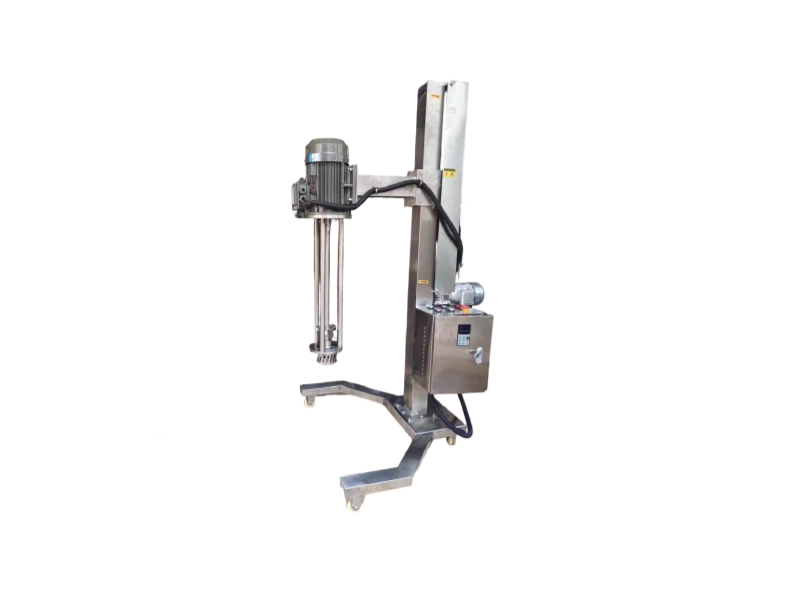
Second-generation technology is represented by high-shear emulsifiers. Through the precise coordination between a high-speed rotating rotor and stator, a strong shear force field is generated, breaking oil droplets into smaller particle sizes.
Working Principle:
● High-speed rotor rotation (up to 2800-3000 rpm)
● The material undergoes intense mechanical and hydraulic shearing, centrifugal extrusion, and impact tearing within the gap between the rotor and stator.
● The dispersed phase is broken down to the micron level, forming a homogeneous mixture with the continuous phase.
3.2 SIngle Stage Shear Homogenizing
1)Structural Form: Utilizes a suspended lifting structure, allowing the emulsification head to be raised and lowered for easy cleaning and container replacement. Alternatively, it can be a single-stage emulsification pump with the stator and rotor integrated within the cavity.
2)Representative Brand: Silverson (UK) is a global leader in this technology, renowned for its equipment characterized by high linear velocity and high shear efficiency. Silverson's high shear mixer can reach speeds of 3000-10000 rpm, with linear velocities exceeding 25 m/s, resulting in superior emulsification compared to ordinary domestic equipment.
Technical Limitations:
● Batch Production: Still requires multiple batches of feed, not continuous production.
● Limited Emulsification Effect: Single-stage stator-rotor structure, oil droplet size is generally 20-50 μm.
● Short Shelf Life: Mayonnaise produced by ordinary shear emulsifiers typically has a shelf life of 7 days, after which stratification occurs. Silverson's design technology is significantly superior to domestic Chinese technology, resulting in a much longer shelf life.
Analysis of Reasons: While single-stage shearing can refine oil droplets, the particle size distribution is relatively wide. The presence of large-diameter oil droplets (>10 μm) causes the emulsion to gradually destabilize during storage.
Following is the video of our SLH series hanger type high shear mixer and SLIM inline high shear mixer working video for your reference:
IV. Third-Generation Technology: Three-Stage Emulsification Pump and Vacuum Homogenization System
Currently, the three-stage emulsification system is the most advanced mayonnaise production technology, resulting in a smoother, better-tasting finished product.
4.1 Technical Principle of the Three-Stage Emulsifying Pump
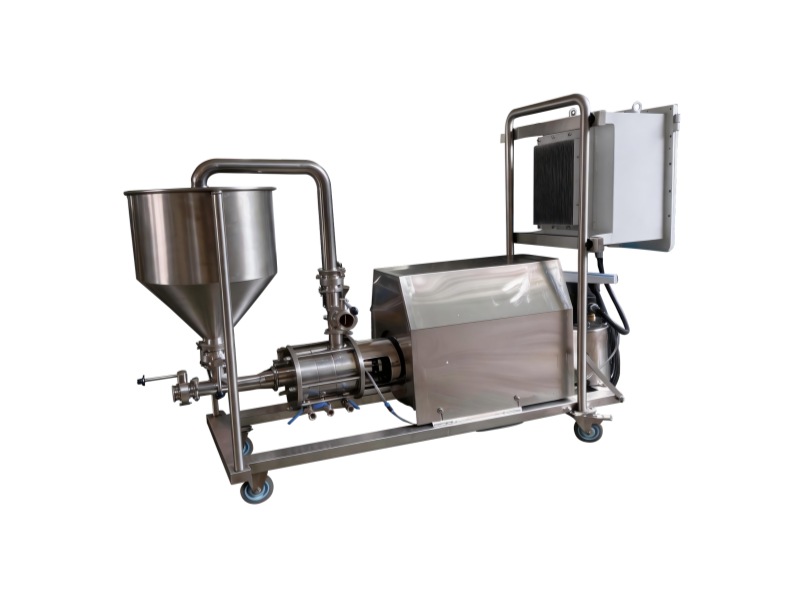
The third-generation technology uses a three-stage emulsifying pump as its core, employing a three-stage stator-rotor series design. The material undergoes three stages of coarse crushing, medium crushing, and fine grinding, thereby achieving progressive refinement of oil droplets and ultimately reaching an extremely narrow particle size distribution, forming a stable water-in-oil emulsion. Following is the video of our SLFT series three-stage vacuum emulsifying mixer:
4.2 Integrated Design of the Vacuum Homogenizing Emulsifying Mixer
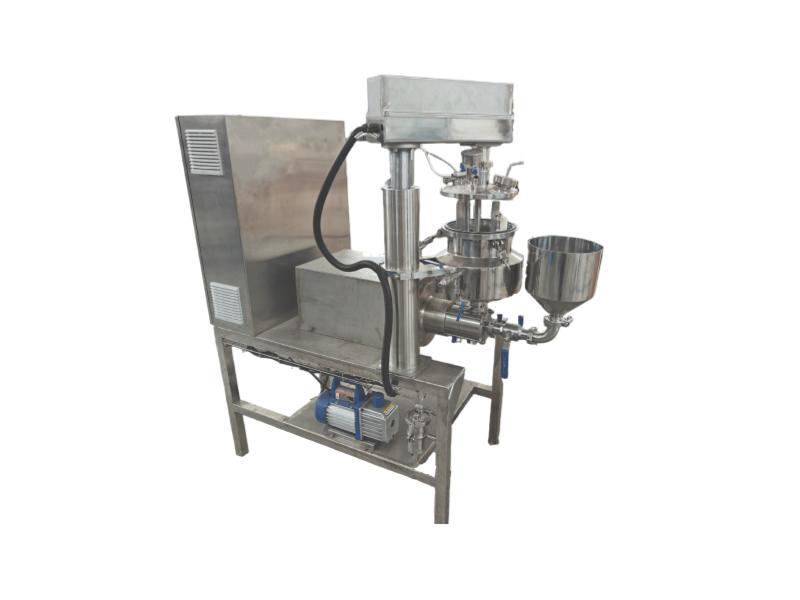
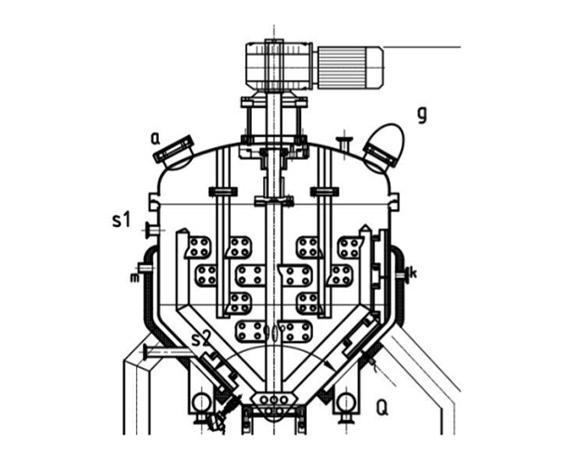
The ultimate solution for industrialized mayonnaise production is a vacuum homogenizing emulsifier, which integrates a three-stage emulsification system with functions such as vacuum degassing, wall scraping and stirring, and CIP cleaning. The main parts of the mixer are fabricated with stainless steel sheet metal to provide corrosion resistance, durability, and a hygienic surface suitable for food processing environments.
Core Components:
Component | Function |
High-speed homogenizer | Three-stage emulsification system, fine oil droplets |
Slow-speed wall-scraping agitation | Continuously creates new interfaces on the container wall, eliminating dead zones. |
Vacuum system | Removes air bubbles and prevents oxidation. |
Jacketed heating/cooling | Precise temperature control, optimized emulsification. |
CIP cleaning system(optional) | Online cleaning, compliant with GMP standards |
4.3 Leading International Brands
Fryma (Germany): A global leader in high-end emulsification equipment, its vacuum homogenization system features a unique design that precisely integrates a conical tank and homogenizer, enjoying a prestigious reputation in the pharmaceutical and high-end food industries.
Other international brands: Ross (Italy), Charles Ross (USA), etc., all offer high-end integrated three-stage emulsification systems suitable for mayonnaise production lines with extremely high product quality requirements.
4.4 Scientific Breakthroughs in Shelf Life
1)Conventional high shear mixer: Droplet size 20-50μm, shelf life around 7 days
2)Three-stage emulsification pump: Droplet size 5-10μm, shelf life up to 6 months to 1 year
V. Conclusion: The Choice of Emulsification Technology Determines the Product Lifeline
The above are the introduction of the mayonnaise production technology. From hand-beating in the kitchen to single stage high shear homogenizing, and then to advanced three-stage vacuum homogenization system, each iteration of mayonnaise emulsification technology corresponds to more precise control over the droplet size. Different technology will determine different product lifeline. If you would like to see more about machine selection, you can read the Emulsifying Mixer Selection Guide for Mayonnaise - One Week or One Year Shelf Life.
The above information is based on research of publicly available materials from peers, industry data, and literature, as well as professional experience. If you would like to discuss further technical information or have any differing opinions, please feel free to contact us.