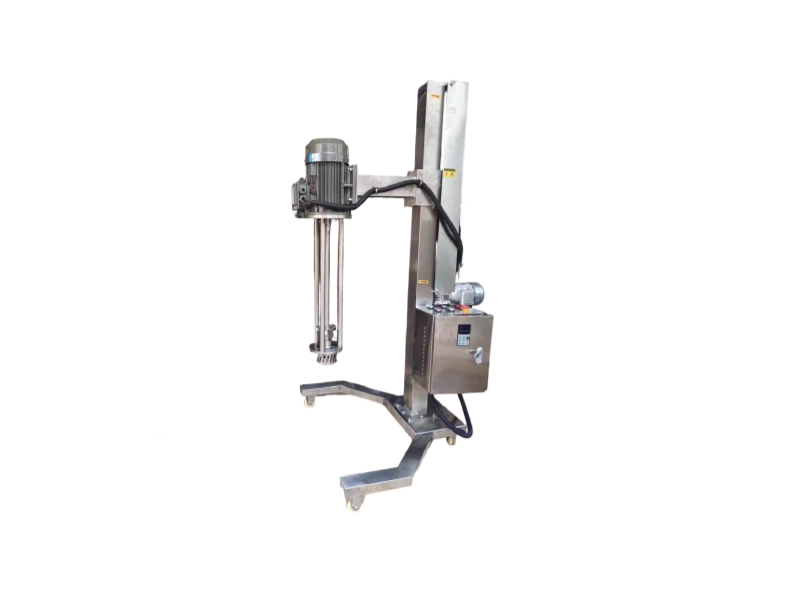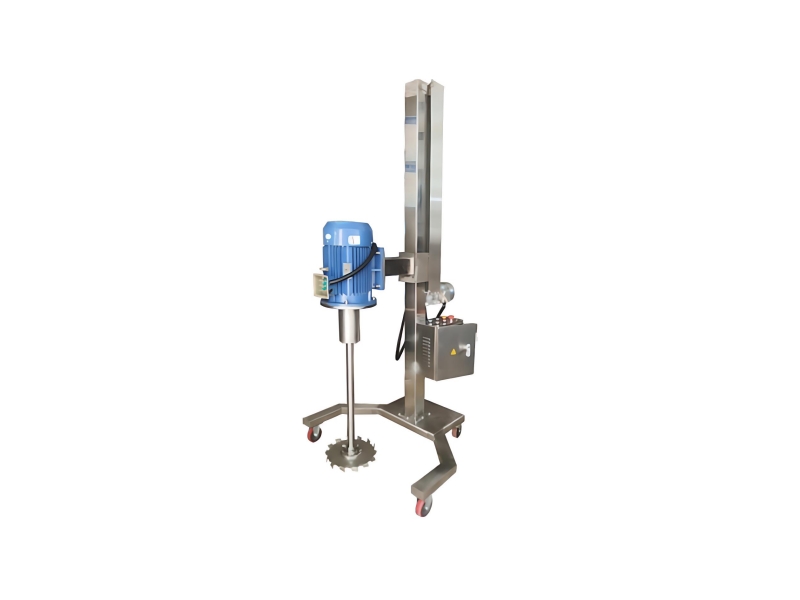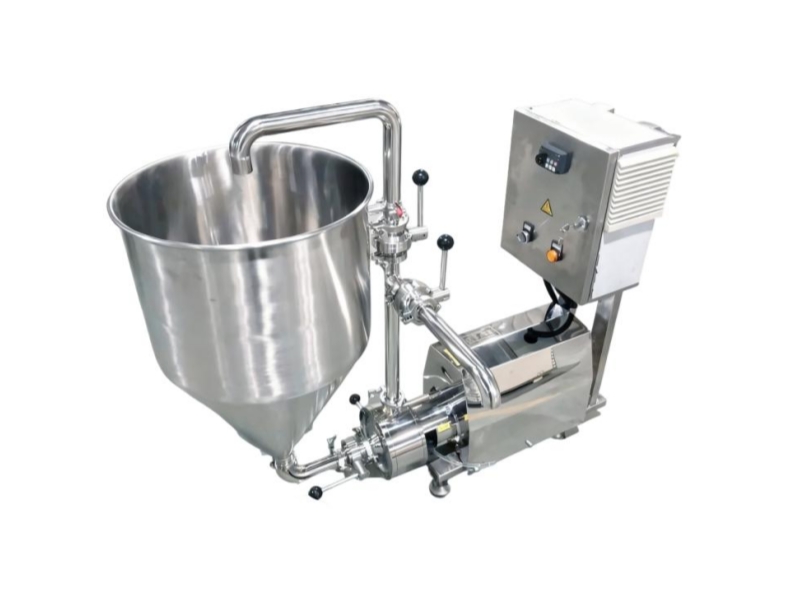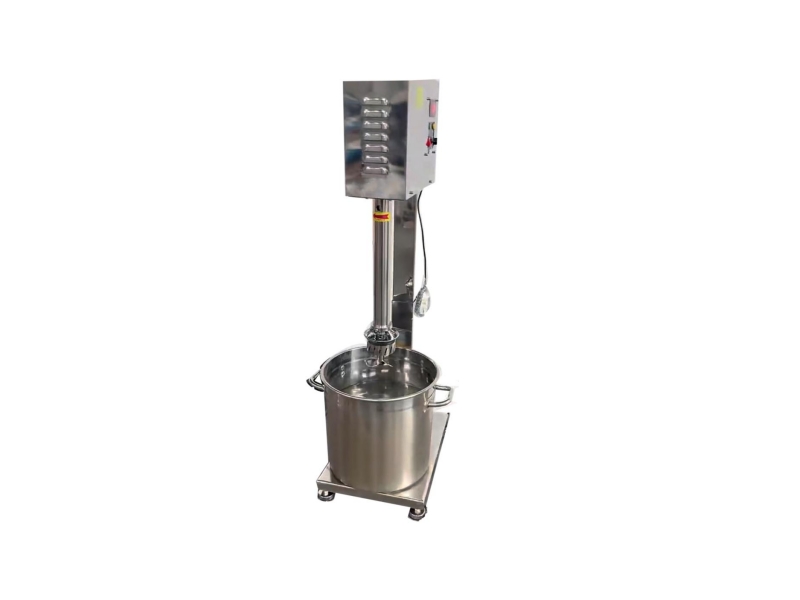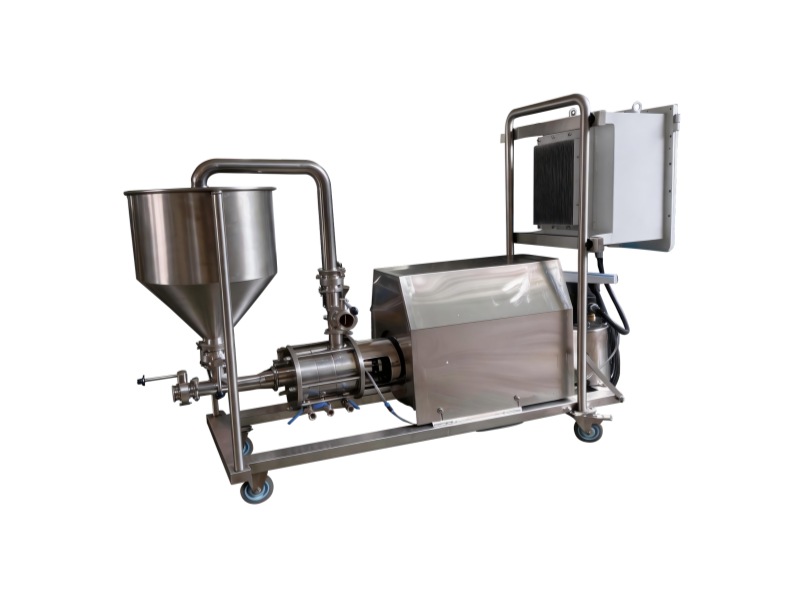



Mixer type: inline type powder liquid mixer
Mixer function: homogenize, emulsify, inline circulating, etc
Mixer series: SLIM series
Mixing system: high shear homogenizing system of the emulsifying pump
Machine usage: mix and homogenize powder and liquid materials into an emulsion
What is the inline powder liquid mixer? We will have a specific introduction to the structural principles, operating modes, equipment configurations, and typical applications of this type mixer(the device in the following video) here. Integrating powder-liquid mixing, circulation homogenization, and high-shear emulsification, it is an ideal choice for the production of liquid emulsions such as food pastes, cosmetic lotions, and pharmaceutical creams.
The inline powder-liquid mixer is an in-line emulsification device specifically designed for the mixing and homogenization of powders and liquids. As the name suggests, it employs an inline structure wherein materials flow continuously through a closed piping system. Powder-liquid mixing and homogenization are achieved through the high-shear action generated by the emulsification pump.
Core Features | Description |
Inline Structure | Materials are processed in a circulating loop within a closed piping system. |
Powder-Liquid Mixing | Specifically designed for the mixing of powder and liquid materials. |
Circulation Homogenization | Materials are continuously circulated through the emulsification pump until the desired quality standards are met. |
High-Shear Emulsification | Features a stator-rotor structure that delivers powerful shearing and dispersion capabilities. |
This mixer primarily consists of a feed hopper, an emulsification pump, circulation piping, discharge piping, and control valves.
Structural Description:
Component | Function | Description |
Feed hopper | Inlet for powders and liquids | The two types of materials undergo preliminary mixing here. |
Emulsification pump | Core homogenization unit | Feature a rotor-stator structure for high-shear emulsification. |
Circulation piping | Material circulation channel | Materials that do not yet meet specifications are returned to the hopper for further processing. |
Discharge piping | Finished product outlet | Discharge is initiated once the material meets specifications. |
Control valve | Circulation/Discharge switching | The circulation valve and the discharge valve are interlocked. |
What is the working principle behind this equipment? Its operational core lies in the precise coordination between the emulsification pump's high shear homogenizing function and the system's pipeline circulation capabilities. This ensures that powdered and liquid materials undergo continuous circulation and homogenization. Thereby the mixer can meet the specific fineness requirements of various clients. For a detailed understanding, please refer to the equipment's workflow description below.
Step 1: Feeding
• Powdered and liquid materials are introduced via the hopper.
• The two types of materials make initial contact within the hopper.
Step 2: Emulsification and Homogenization
• The materials enter the emulsification pump.
• They undergo high-shear, dispersion, and emulsification processes facilitated by the pump's stator and rotor components.
• The powdered material is uniformly dispersed throughout the liquid phase.
Step 3: Circulation Processing
• The homogenized material returns to the hopper via the circulation pipeline.
• It re-enters the emulsification pump for a secondary round of processing.
• The number of circulation cycles determines the final fineness of the emulsion.
Step 4: Discharge (Upon Meeting Specifications)
• The operator can monitor the emulsification status at any time.
• Once the required specifications are met, the circulation valve is closed, and the discharge valve is opened.
• The finished product is discharged, marking the completion of the batch.
For you to see clearly the working process, following is a video show of custard sauce making by such type mixer:
This inline mixer—also referred to as an inline emulsifier—is a highly versatile piece of equipment suitable for widespread application across the food, cosmetics, and pharmaceutical industries, among others.
Industry | Product Type | Examples |
Food industry | Food pastes & Liquid emulsions | Salad dressings, mayonnaise, chocolate sauce, cheese sauce, jams |
Cosmetics industry | Cosmetic lotions & creams | Face creams, body lotions, sunscreens, facial cleansers |
Pharmaceutical industry | Pharmaceutical creams & Emulsions | Ointments, topical emulsions, oral emulsions |
• Liquid Emulsions
• Cream-based Products
• Emulsion Systems (Oil-in-Water / Water-in-Oil)
• Powder-Liquid Suspensions
To ensure the equipment's long-term durability, our design incorporates a water-cooling protection system and a mechanical seal mechanism.
Why is water cooling necessary? When an emulsification pump operates at high speeds, it generates a significant amount of heat. Without effective cooling, the following issues may arise:
• Aging and damage to sealing components
• Thermal deformation of the stator and rotor
• Overheating and degradation of the processed materials
• Reduced service life of the equipment
The water-cooling system dissipates heat through the circulation of cooling water, thereby ensuring the equipment operates stably even at high rotational speeds.
Item | Description |
Seal Type | Mechanical Seal |
Advantages | Excellent sealing performance; long service life |
Applicable media | Food products, cosmetics, pharmaceutical-grade materials |
Hygienic standards | Leak-free operation; compliant with sanitary standards |
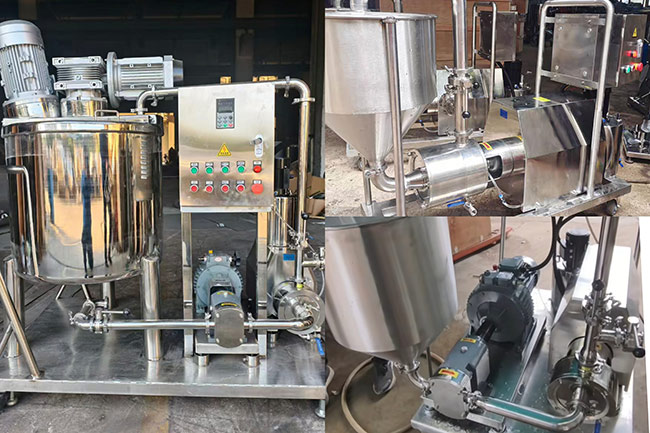
For this device, there are primarily three types of configuration forms as show in the above picture. You can see the specific explanations of the three types as followed:
1)Configuration 1: Standard Model (Independent Feeding Head Design)
Configuration | Description |
Structure | Emulsification pump + mixing hopper + circulation piping + discharge piping |
Applicable scenarios | Moderate material volume; relatively fixed powder-to-liquid ratio |
Advantages | Simple structure; low investment cost |
Limitations | Manual control required for powder feeding speed during mixing |
2)Configuration 2: Upgraded Model (Paired with Mixing Tank)
Configuration | Description |
Structure | Mixing tank + emulsification pump + circulation piping + discharge piping |
Applicable scenarios | Large material volume; wide variety of powder and liquid ingredients |
Advantages | Higher efficiency, as materials undergo preliminary mixing in the tank before being drawn into the emulsification pump |
3)Configuration 3: High-Viscosity Model (Paired with Rotor Pump)
Configuration | Description |
Structure | Mixing tank + rotor pump + emulsifying pump + circulation piping + discharge piping |
Applicable scenarios | High-viscosity materials, cream-based products |
Advantages | Rotor pump assists in material transfer, effectively resolving flow issues associated with high-viscosity materials. |
Briefly, the inline powder liquid mixer employs a circulating homogenization mode of operation. Materials undergo repeated processing within the high-shear stator-rotor assembly of the emulsification pump. Combined with water-cooling protection and a mechanical seal design, this system achieves highly efficient mixing and homogenized emulsification of powders and liquids.
For further details or to schedule a sample test, please feel free to contact Salinovate Team.
Provide you with the industry`s best solutions

Offer the pre-sales and after-sales technical support
Back to Top
We are devoted to the R&D, production and selling of the grinder machine, mixer machine and filling machine for the food factories. They work for the dry and wet food.
0086 150-5215-2936

 English
 French