


 English
 French
Powder grinding capacity generally decreases as the required particle size becomes finer, but the reason depends on the grinding technology. In a screen-controlled grinder, a smaller screen opening restricts material discharge and can increase grinding time. In an air classifier mill, stricter classification causes more oversized particles to return for further grinding. In a variable-speed pin mill, increasing rotor speed raises grinding intensity, which can produce finer powder but may reduce throughput.
These differences matter when selecting an industrial powder grinder. A machine that achieves a certain fineness at a particular production rate may not maintain the same capacity when the target particle size changes. This guide explains why capacity drops in three common grinding technologies, what other operating factors influence throughput, and how manufacturers can evaluate equipment performance before purchasing a machine.
I. Why Does Finer Grinding Generally Reduce Capacity
Finer grinding generally requires more size-reduction work per unit of finished product, while the grinding system must also meet the required particle-size specification. As a result, the amount of qualified powder produced per hour may decrease.
1.1 More Size Reduction Is Required
Grinding reduces particle size through impact, shear, compression, or a combination of these mechanisms. Producing finer particles usually requires additional breakage events, although the actual energy requirement depends on the material and grinding process.
Comminution theory describes the relationship between energy input and particle-size reduction through models such as Kick’s, Bond’s, and Rittinger’s laws. These models provide useful theoretical frameworks, but they do not predict the exact production capacity of every industrial grinding machine. For fine grinding, the creation of additional particle surface area can become an important part of the energy requirement. Material hardness, toughness, moisture, fat content, and particle structure also influence the result.
1.2 Capacity Must Be Evaluated at the Required Fineness
A machine’s maximum advertised capacity does not necessarily represent its capacity when producing a finer powder. For example, a grinder may handle a relatively high feed rate when producing a medium-fine powder. If the target changes to a substantially finer product, the machine may need a lower feed rate to achieve the required particle-size distribution.
The important measurement is therefore not simply how much raw material enters the machine, but how much finished product meets the specification per hour.
1.3 Specific Energy Consumption Can Increase
Specific energy consumption is the energy used per unit mass of product, commonly expressed in kWh/t. For example, if a machine consumes 30 kW and produces 300 kg/h of qualified powder, its nominal specific energy consumption is: 30 kW ÷ 0.3 t/h = 100 kWh/t. If the qualified output falls to 150 kg/h while power consumption remains at 30 kW, the calculated value becomes: 30 kW ÷ 0.15 t/h = 200 kWh/t.
These are illustrative calculations, not measured performance data for a specific machine. Actual values depend on operating power, material properties, and the amount of finished product meeting the specification.
The general principle is that finer powder often requires more energy per tonne, but the way this affects capacity depends on the grinding technology being used.
II. How Does a Screen-Controlled Grinder Lose Capacity at Finer Settings
In a screen-controlled grinder, a smaller screen opening can reduce throughput because particles must become small enough to pass through the screen before they can leave the grinding chamber. Material that cannot pass through remains in the chamber and may undergo further impacts.
2.1 How Screen-Controlled Grinding Works
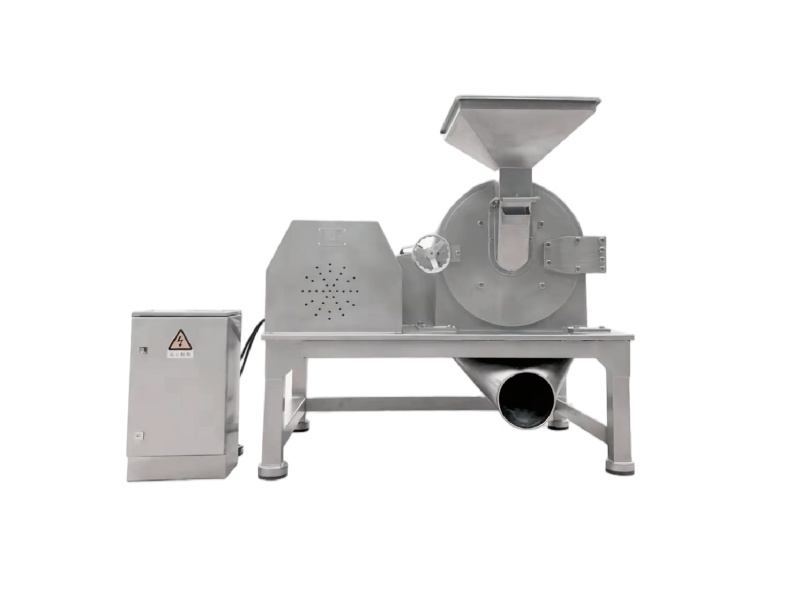
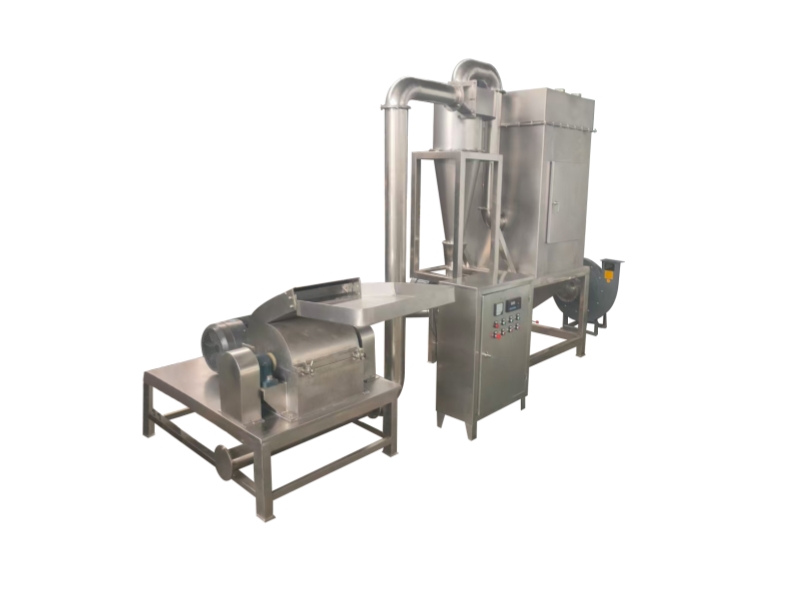
A screen-controlled grinder typically uses a rotating grinding mechanism to reduce particle size. A screen installed at the discharge area restricts the passage of particles larger than its openings.
The process can be summarized as follows:
1)Raw material enters the grinding chamber.
2)The rotating grinding elements break the material into smaller particles.
3)Particles small enough to pass through the screen can discharge.
4)Larger particles remain in the grinding chamber and continue to be processed.
The screen therefore affects both the particle-size distribution and the material’s residence time inside the machine.
Research on hammer milling has examined the relationship between output screen size, feed particle size, and mill speed. Hajratwala’s study found that output screen size influenced the resulting particle-size distribution under the experimental conditions. [1]
2.2 Why a Smaller Screen Can Reduce Throughput
When the screen opening becomes smaller, fewer particles may be able to pass through at any given moment. This can increase the time material spends inside the grinding chamber. More impacts may be required before the particles become small enough to discharge.
A smaller screen may also increase the resistance to material flow through the discharge area. The extent of this effect depends on screen design, open area, material behaviour, feed rate, and grinding conditions. Consequently, a finer screen setting can reduce the amount of finished powder discharged per hour.
However, screen aperture is not an exact guarantee of final particle size. The actual particle-size distribution also depends on the grinding mechanism, operating speed, material properties, and screen condition.
2.3 When Is a Screen-Controlled Grinder Suitable
Screen-controlled grinders can be appropriate when the material and target fineness are compatible with the machine’s design and the required production rate. For example, a universal grinder equipped with a suitable screen may be a practical option for applications requiring moderate fineness and straightforward operation. The correct screen should be selected according to the required product specification rather than choosing the smallest available opening automatically.
For a screen-controlled grinder, the key trade-off is between the required particle size and the ease with which material can pass through the screen. A finer screen may improve size control but can also reduce throughput.
III. Why Does an Air Classifier Mill Lose Capacity at Finer Particle Sizes
An air classifier mill can lose capacity at finer settings because its classification system allows qualified fine particles to leave while rejecting oversized particles for further grinding. A finer classification cut can increase internal material circulation and reduce the net output of finished product.
3.1 How Grinding and Classification Work Together
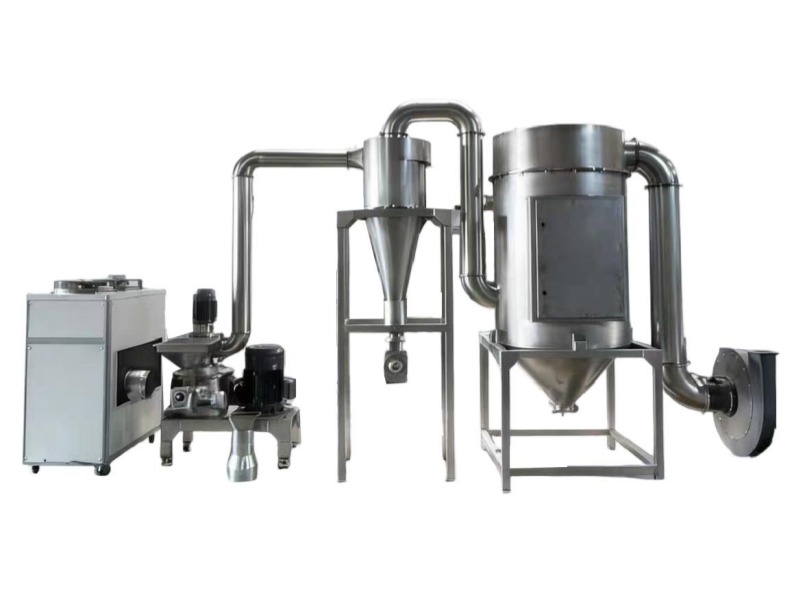
An air classifier mill combines mechanical size reduction with dynamic air classification. During operation:
1)Material enters the grinding chamber.
2)The grinding rotor reduces particle size through impact and related forces.
3)Air transports ground particles towards the classification zone.
4)Particles that meet the classification conditions can pass through.
5)Oversized particles are retained or returned for additional grinding.
Unlike a conventional screen-controlled grinder, the classification stage does not depend solely on a fixed screen aperture. It separates particles according to their behaviour in the classification airflow and the forces acting on them.
Research by Shin, Kim, and Kim investigated the effects of air classifier mill operating conditions on powder particle size. Their results showed that air flow rate, classifier speed, and mill speed influenced particle size, with the effects differing between the tested materials. [2]
3.2 Why a Finer Classification Cut Can Reduce Throughput
In many dynamic classifier designs, increasing classifier rotor speed increases the centrifugal force acting on particles. Under otherwise comparable conditions, larger particles become less likely to pass through the classifier. This can make the finished product finer, but it also means that more particles may be returned for further grinding.
The relationship can be summarized as: Finer classification → more oversized particles rejected → greater internal circulation → potentially lower finished-product throughput.
The classifier does not create an unlimited supply of fine particles. The grinding section must still reduce the rejected material to the required size. If the classifier rejects more material than the grinding section can efficiently process, the fresh-feed rate may need to be reduced to maintain the required product specification.
3.3 Why Airflow and Grinding Speed Also Matter
Classifier speed is not the only variable that affects performance. Airflow influences particle transport and separation. Grinding rotor speed influences the amount of size reduction occurring before classification. Feed rate and material properties also affect the interaction between grinding and classification.
A study of air classifier mill operating conditions found that the effects of classifier speed and airflow differed between PVC and rice hull, demonstrating that the same adjustment does not necessarily produce the same response for different materials. [2]
Therefore, increasing classifier speed alone does not guarantee a particular particle size or capacity. The grinding rotor, classifier, airflow, and feed rate must be evaluated as a coordinated system.
IV. Why Does a Variable-Speed Pin Mill Produce Less Powder at Finer Settings
In a variable-speed pin mill, increasing rotor speed generally increases the intensity of particle impacts, which can produce finer powder but may reduce throughput when the machine must meet a finer product specification. The actual response depends on the material, pin geometry, feed rate, and operating range.
4.1 How Rotor Speed Influences Particle Size
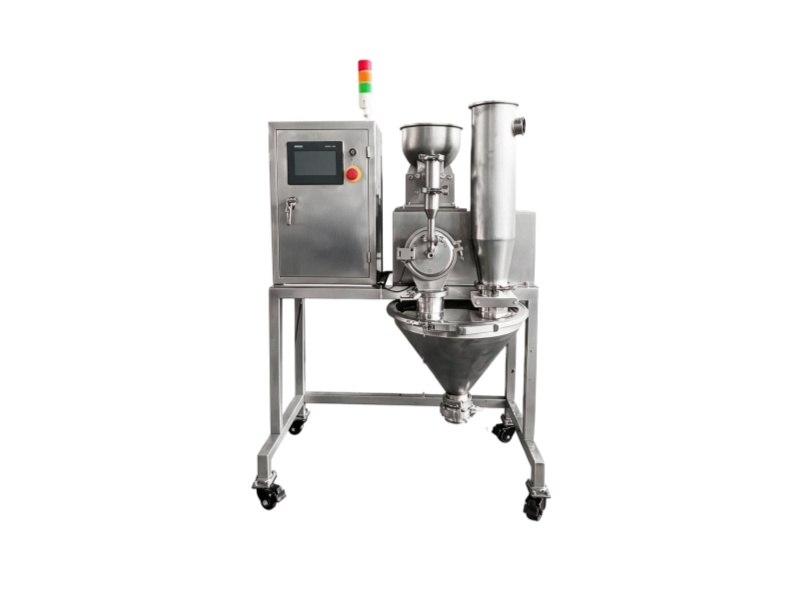
A pin mill uses rows of pins or similar impact elements to reduce particle size through repeated collisions. When rotor speed increases, the peripheral speed of the rotating elements also increases. This changes the impact conditions and the energy transferred to particles.
Under suitable operating conditions, higher rotor speed can produce finer particles. Lower speed may produce a coarser powder and can support a higher feed rate when the application permits a coarser product.
Research comparing pin milling and hammer milling found that pin mill product size could be varied over a wide range primarily by adjusting rotor frequency. The study also reported a relationship between production rate and particle size under its experimental conditions. [3]
4.2 Why Higher Speed Can Reduce Throughput
When a finer product is required, the pin mill may need to operate at a higher rotor speed or at a lower feed rate to provide sufficient grinding intensity.
If material is fed too quickly relative to the available grinding energy, a greater proportion of the discharged powder may remain coarser than the target. Reducing the feed rate gives the grinding process more capacity to deliver the required size reduction per unit mass of material. However, the appropriate operating point depends on the material and the specific machine.
It is important to distinguish a pin mill from an air classifier mill. A conventional pin mill does not necessarily have a separate dynamic classifier that returns oversized particles to the grinding chamber. Its particle-size control and capacity behaviour therefore depend on its own grinding mechanism and configuration.
4.3 How Variable-Frequency Control Helps
A variable-frequency drive allows the operator to adjust motor speed within the machine’s designed operating range. This provides flexibility when different applications require different particle sizes. The operator can test different speeds and feed rates to find a suitable balance between fineness and production rate.
However, a higher frequency does not automatically guarantee finer powder in every situation, and a lower frequency does not always result in higher capacity. The outcome depends on material properties, pin configuration, feed rate, and the target particle-size distribution. The operating range must also remain within the machine manufacturer’s specified limits.
For a variable-speed pin mill, the main trade-off is between grinding intensity and material throughput. Speed adjustment provides flexibility, but the correct operating point must be established through testing.
V. What Other Factors Can Reduce Grinding Capacity
The grinding mechanism is only part of the capacity equation. Material properties, feed preparation, heat, moisture, and the complete system configuration can also influence production.
5.1 Material Properties
Different materials respond differently to grinding. Hard or tough materials may require more energy to reach a given particle size. Fibrous materials may resist breakage differently from brittle materials, while oily or sticky ingredients can interfere with powder flow and discharge.
Food materials also differ in moisture content, fat content, structure, and thermal sensitivity. These differences mean that two materials processed on the same machine may achieve different capacities at the same nominal fineness.
5.2 Feed Size and Feed Rate
The condition of the material entering the machine affects the amount of work required to produce the final powder.
Larger or inconsistent feed particles may require more size reduction. Excessive or unstable feeding can also disturb the balance between grinding intensity and the system’s ability to discharge qualified product. Consistent feeding and suitable raw-material preparation can help maintain stable operation.
5.3 Moisture, Fat, and Temperature
Depending on the material, moisture and fat content can affect grinding behaviour and powder flowability. Heat generated during grinding may also contribute to softening, sticking, or agglomeration in heat-sensitive materials. These effects can interfere with material movement and reduce effective throughput.
The appropriate solution depends on the material and process. It may involve adjusting feed conditions, selecting a suitable grinding mechanism, improving heat management, or modifying the system configuration.
5.4 Airflow and Collection System
For an air classifier mill, airflow influences particle transport and classification. The fan, classifier, cyclone, and dust collector must operate as a coordinated system.
For other grinder types, discharge arrangements and dust collection can also influence how reliably material moves through the process. A capacity problem should therefore be diagnosed by reviewing the whole system rather than assuming that the target fineness is the only cause.
In short, capacity depends on the interaction between the material, grinding mechanism, operating conditions, and discharge or classification arrangement.
VI. How Should You Choose a Grinder When Both Fineness and Capacity Matter
The most reliable approach is to select a grinding technology based on the required product specification and verify its capacity using the actual material. Motor power or maximum fineness alone is not enough to establish suitability.
6.1 Define the Required Product
Before comparing machines, establish the target particle-size distribution and production rate.
A mesh designation can be useful, but it may not fully describe the required product. Depending on the application, a buyer may also need to specify a particle-size distribution, such as D50 or D90, or a maximum permitted particle size.
Mesh and micron values are approximate equivalents whose relationship depends on the applicable sieve standard.
6.2 Match the Grinding Mechanism to the Application
The three technologies have different strengths:
• Screen-controlled grinder: Consider when the material and target fineness are compatible with screen-based discharge and a straightforward grinding process is preferred.
• Air classifier mill: Consider when finer powder and dynamic classification are important, particularly where the upper particle-size range needs to be controlled.
• Variable-speed pin mill: Consider when impact-based grinding with adjustable rotor speed suits the material and the required fineness range.
These are general selection principles rather than universal rules. The most suitable machine depends on material characteristics, required throughput, product specification, cleaning requirements, and investment budget. See Salinovate’s Industrial Powder Grinder Machine page for an overview of the main equipment selection factors.
6.3 Verify Capacity Through Material Testing
Before purchasing a machine for a demanding application, ask for test results using the actual raw material and target fineness.
A useful test record should include:
• Raw material condition and feed size.
• Grinding machine model and configuration.
• Screen size, rotor speed, or classifier settings, as applicable.
• Target and measured particle-size distribution.
• Stable feed rate and finished-product output.
• Relevant operating conditions and any observed processing difficulties.
Where continuous production is required, a short sample test may not be sufficient to confirm sustainable capacity. A longer test under representative conditions may be necessary. The best equipment choice is the one that consistently meets the required product specification at a practical production rate, rather than the one with the highest advertised capacity or maximum fineness.
VII. Frequently Asked Questions
The following answers summarize the main differences between screen-controlled grinding, air classification, and variable-speed pin milling.
Q: Does finer powder always mean lower capacity?
A: Not in every situation, but finer targets commonly reduce throughput when additional size reduction is required or when the discharge or classification process becomes more restrictive. The magnitude of the reduction depends on the material, machine design, and operating conditions.
Q: Which grinding machine loses capacity when the screen opening becomes smaller?
A: A screen-controlled grinder may lose capacity because fewer particles can pass through the smaller openings at a given time. Material may remain in the grinding chamber longer and require additional impacts before discharge.
Q: Why does an air classifier mill produce less powder at a higher classifier speed?
A: In many dynamic classifier designs, higher classifier speed makes it more difficult for larger particles to pass through. More particles may be returned for further grinding, increasing internal circulation and reducing the net finished-product output.
Q: Can a pin mill produce finer powder by increasing rotor speed?
A: Increasing rotor speed generally increases grinding intensity and can produce finer particles under suitable conditions. However, the relationship depends on material properties, feed rate, pin design, and the operating range. Capacity may decrease if the finer specification requires lower feed rates.
Q: Can a larger motor maintain the same capacity at a finer particle size?
A: Not necessarily. Additional power may help in some situations, but screen discharge, classification, airflow, material properties, and heat generation may still limit production. The machine should be evaluated based on demonstrated capacity at the required fineness.
Q: How should I compare the capacity of different grinders?
A: Compare capacity figures using the same or clearly defined material, target particle-size distribution, feed condition, and operating basis. Confirm whether the figure refers to raw-material feed rate or finished-product output, and whether it was measured during a stable production run.
Conclusion
Powder grinding capacity often decreases at finer particle sizes, but the mechanism differs between screen-controlled grinders, air classifier mills, and variable-speed pin mills.
A screen-controlled grinder may discharge material more slowly through a smaller screen opening. An air classifier mill may recirculate more oversized particles for additional grinding. A variable-speed pin mill may require greater grinding intensity or a lower feed rate to meet a finer product specification.
Understanding these differences helps manufacturers compare equipment on a realistic basis. If you are selecting a powder grinder, provide your raw material, target particle size, and required hourly output. Salinovate team can help evaluate the appropriate grinding technology and arrange material testing where needed.
References
[1] Hajratwala, B. R. (1982). Particle size reduction by a hammer mill I: Effect of output screen size, feed particle size, and mill speed. Journal of Pharmaceutical Sciences, 71(2), 188–190. DOI: 10.1002/jps.2600710212.
[2] Shin, E.-S., Kim, K.-S., & Kim, Y.-W. (2016). Effects of Operating Conditions of an Air-Classifier Mill on the Particle Size of Fine Powder. Journal of the Korean Society of Manufacturing Technology Engineers, 25(6), 426–433. DOI: 10.7735/ksmte.2016.25.6.426.
[3] Comparison of Pin Mill and Hammer Mill in the Fine Grinding of Sphagnum Moss. (2023). Energies, 16(5), Article 2437.