


 English
 French
In powder processing, dust control is typically associated with mixing operations. However, feeding operation in the grinding step sometimes also presents the same dust challenges especially when the raw materials contains powder. This article will show you when the powder grinding needs dust-free feeding design, which means to combine the dust-free feeding station and vacuum conveyor, with the powder grinder.
I. Introduction: The Overlooked Dust Challenge in Grinder Feeding
In most cases, the dry material fed into the powder grinder is in the form of granules, flakes, or larger chunks; however, there are occasional instances where customers feed in powdered material for further grinding. When handling fine powders or granular materials with high powder content such as food additives, micronized spices, or ultra-fine chemical powders, the dust generation become easy at two critical points:
• During dumping: Material falls from the bag into the hopper, creating dust from the drop height
• Hopper backflow: Grinder operation can create internal pressure that escapes through the feed opening
This is especially problematic when:
• The facility maintains high hygiene standards
• Materials are high-value (dust loss equals profit loss)
• Materials are active or hygroscopic (exposure degrades quality)
• Operator health and safety are priorities
II. The Integrated Solution: Dust-Free Feeding Station + Vacuum Conveyor + Grinder
Similar as the dust-free powder mixer design, the dust-free powder grinder design is the combination of the closed loop conveying system and dust-free feeding station. For powder materials, the vacuum conveyor is more suggested as the automatic conveying device to form a closed loop conveying system.
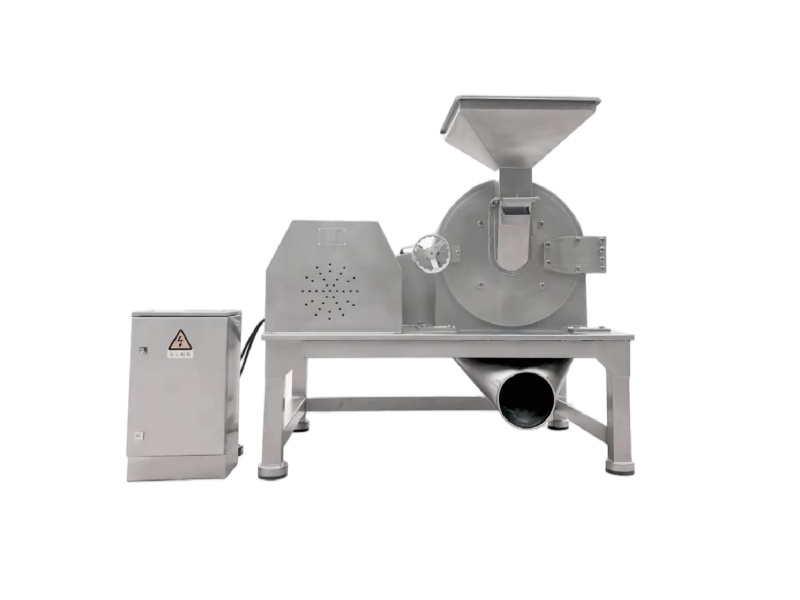
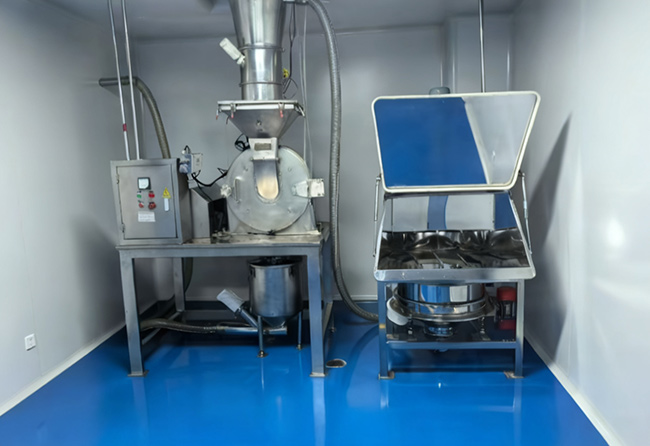
Recently, we have just installed such a grinding system for our domestic customer. The customer is a food additive manufacturer, he purchased our SLU-40 model powder grinder to grind micro-powdered ingredients into fine powder. This customer had specific requirements regarding the cleanliness of the workshop, so we designed a dust-free feeding system for them. Utilizing a combination of dust-free material input and automatic vacuum-assisted material transfer, the grinder was successfully equipped with the dust-free automatic feeding system.

The operation of the designed grinding system follows the sequence listed below:
• Dust-Free Dumping: The operator manually dumps material into the dust-free dumping station. Any dust generated is captured by the station's built-in dust collection system, keeping the workshop environment clean .
• Closed-Pipe Vacuum Conveying: Material passes from the dumping station through a sealed pipe connection to the vacuum conveyor. The vacuum conveyor creates negative pressure that draws material through the line to the grinder with no material and dust leakage .
• Controlled Grinder Processing: Material enters the grinder chamber for size reduction.
III. Core Value of the Integrated System
Value Point | Explanation |
Complete dust-free operation | Full closed-loop, negative-pressure processing-no dust escape from dumping to discharge |
Improved workshop hygiene | Dust contained within the system, meeting high-sanitation production requirements |
Reduced material loss | Closed conveying eliminates spillage and airborne loss |
Enhanced efficiency | Automated conveying reduces manual handling and feeding time |
Operator health protection | Eliminate dust inhalation risk |
IV. Dust-Free Feeding Design Compatibility
Do you really need dust-free feeding before a grinder? Not every powder grinding process requires a dust-free feeding system. For some applications, manual feeding is simple, economical and completely adequate. However, when the raw material is already a fine powder and the production environment has strict cleanliness or dust-control requirements, the feeding stage itself can become an important part of the overall powder-handling system. Following is a simple decision guide for your reference:
Production Condition | Recommended Feeding Approach |
Coarse granular material + low dust generation | Manual feeding may be sufficient |
Relatively fine powder + small production volume | Controlled manual feeding may be sufficient |
Relatively fine powder + visible dust during manual charging | Consider a dust-free feeding station |
Relatively fine powder + frequent manual material handling | Dust-free feeding + vacuum conveying |
Relatively fine powder + high workshop cleanliness requirements | Dust-free feeding + enclosed conveying |
Relatively fine powder + automated grinding process | Dust-free feeding + vacuum conveyor + grinder |
V. Conclusion
Dust-free solutions in powder processing should not stop at mixing operations. When handling fine powders, micro-granular materials, or high-hygiene materials, grinder feeding requires the same rigorous dust control. The integrated combination of dust-free feeding station + vacuum conveyor + powder grinder delivers fully enclosed, dust-free processing. For food additives, pharmaceutical ingredients, high-value powders, and similar materials, this integrated approach is the proven path to cleaner workshops, reduced material loss, and improved operator conditions. For any help in designing such system, welcome to contact Salinovate team.
References
1. Riedel Filtertechnik. (2025). Pneumatic Conveying of Bulk Materials.
2. CHEManager. (2010). Smart Powder and Bulk Material Transfer.
3. Volkmann USA. Bag Dump Station with Integrated Dust Collector.
4. Pneuconveyor Systems. Why Vacuum Powder Transfer System.