


 English
 French
Custom SLR-500 Ribbon Blender + Screw Conveyor – Safe & Efficient Sugar Powder and Corn Starch Mixing Solution
By:Salinovate Team
In food ingredient production, blending powdered sugar and corn starch is a common yet deceptively simple process. Many buyers focus solely on mixing uniformity, overlooking two critical factors: operator safety and seamless integration with downstream packaging. A recent project for a food manufacturer addressed exactly these challenges. The customer needed to blend sugar and corn starch according to a specific recipe and feed the blended powder directly into an existing packaging line. Their requirements were clear:
• PLC control with safety alarm system for operational security
• Automatic feeding integrated with the blender and packaging line
• Batch capacity of 300L with room for future expansion
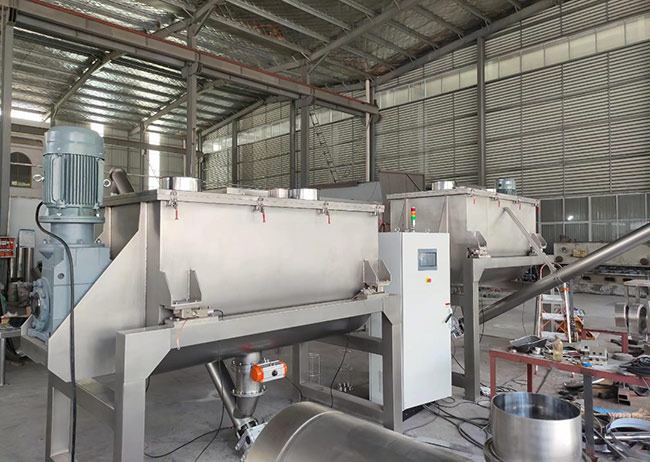
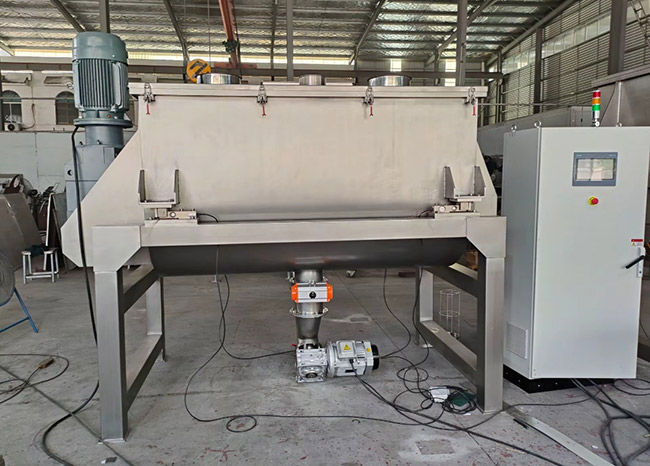
The solution: two custom SLR-500 ribbon blenders paired with screw conveyors, creating a complete powder handling system from feeding to mixing to packaging. Both units are now completed in our workshop, ready for delivery.

I. Understanding the Application: Sugar & Corn Starch Mixing Challenges
Before designing the solution, it is essential to understand the specific challenges posed by sugar and corn starch mixing. This chapter examines the material properties, capacity requirements, and safety considerations that guided our equipment selection.
1.1 Material Characteristics
Sugar powder and corn starch are both free-flowing fine powders, but they differ in bulk density. This difference can lead to segregation if the mixing action is not forceful enough.
Material | Characteristics | Mixing Challenge |
Sugar powder | Good flowability, hygroscopic | Prone to caking; require uniform dispersion |
Corn starch | Light, dusty | Tend to segregate from denser sugar particles |
A ribbon blender’s forced convection mixing, driven by inner and outer ribbons moving material in opposite directions, effectively overcomes density differences and ensures batch-to-batch consistency.
1.2 Capacity & Scalability
The customer required a 300L batch. We recommended the SLR-500 model with a 500L total volume and a loading coefficient of approximately 60%, which precisely delivers 300L per batch while reserving capacity for future increases. Two units allow for alternating operation, boosting overall throughput.
1.3 Safety & Automation Requirements
The customer explicitly requested PLC control and a safety alarm system. These are not always standard on ribbon blenders, but for a food factory, interlock safety and fault alarms are essential to protect equipment, prevent material loss, and ensure operator safety.
II. The Custom Solution: SLR-500 Ribbon Blender + Screw Conveyor
With the challenges clearly defined, the next step was to develop a customized solution that would meet both the mixing and packaging requirements. This chapter details the SLR-500 ribbon blender and the screw conveyor, explaining how they work together as an integrated system.
2.1 Core Configuration of SLR-500 Ribbon Blender
Item | Specification |
Model | SLR-500 |
Total volume | 500L |
Max working capacity | 300L(approx. 300kg depending on bulk density) |
Control system | PLC + touchscreen |
Safety devices | Overload protection, door-open power cut-off, emergency stop, audible & visual alarms |
Material of construction | Stainless steel 304, mirror-polished contact parts |
Discharge | Pneumatic flap valve, sealed connection to downstream equipment |
Value of the Safety Alarm System: When overload, unclosed discharge door, or motor overheating occurs, the system automatically alarms and shuts down, preventing equipment damage and accidents. For continuous food production, this is a critical safeguard.
2.2 Screw Conveyor – The Bridge Between Mixing and Packaging
Since the customer has a downstream packaging line, we supplied screw conveyors(see the below connection with the blender) to automatically transfer blended material in two ribbon blenders to the packaging stations. Key benefits:
• Enclosed conveying: Minimizes dust and improves workshop hygiene
• Interlocked with blender: Automatically starts after mixing completes, eliminating manual transfer
• Direct connection to packaging line: Conveyor outlet feeds directly into the packaging machine’s hopper
System Workflow: Raw material feeding → SLR-500 Blender → Mixing complete → Screw conveyor → Packaging line
2.3 Why an Integrated “Mix + Convey + Package” Solution
Many suppliers only offer stand-alone machines, leaving customers to figure out feeding and packaging connections on their own. We provide a complete powder handling solution from mixing to packaging, reducing material exposure, manual intervention, and cross-contamination risks while improving efficiency.
III. Project Status: Two Units Completed in Workshop
Manufacturing and pre-testing have been completed in our workshop. This section provides an update on the project status and outlines the next steps for delivery and commissioning. Both SLR-500 ribbon blenders and the screw conveyors have been manufactured and pre-tested in our workshop. The equipment is clean, the control system operates smoothly, and the safety alarms respond correctly.
Completion Status:
• √ Two SLR-500 blender main bodies assembled
• √ PLC control system installed and tested
• √ Safety alarm functions verified
• √ Screw conveyor positioned and connected
• √ In-house linkage test completed
Next steps: shipment arrangement and on-site installation, commissioning, and operator training at the customer’s factory.
IV. Case Summary
Ribbon blender is an ideal choice for powdered sugar and corn starch mixing. If you have higher production standard for automatic control, safety operation and seamless integration with downstream packaging, you can take the mixing solution in this case as the right sample. Welcome to contact Salinovate Team if there is any need to design the powder mixing solution for you.