


 English
 French
Case Study - Vacuum Mixing Tank for Chicken Base Paste
By:Salinovate Team
This article, based on a real production project of a food flavoring manufacturer, analyzes the key applications and value of vacuum mixing tank in the thermal reaction process of chicken base paste.

I. Project Background
It is a must to know deeply the production background and the basic requirements from the customer before the solution design. You can read the following information to see the basic project background.
1.1 Customer Overview
A large-scale food flavoring manufacturer specializes in the research and development and production of thermally reactive paste flavorings, including chicken flavoring paste, beef flavoring paste, and seafood flavoring paste, widely used in snack foods, catering seasonings, and other fields. They currently require the addition of efficient and stable thermal reaction equipment.
1.2 Process Characteristics
Chicken base paste belongs to the thermally reactive flavoring category. Its core process is the Maillard reaction—the reaction of amino acids and reducing sugars under heating conditions to generate a rich meaty aroma. According to relevant patented technologies, the typical production process of chicken flavoring paste includes:
● Ingredient Mixing: Add enzymatically hydrolyzed chicken powder, chicken bone extract, amino acids (thiamine, cysteine, etc.), reducing sugars (glucose, xylose), hydrolyzed vegetable protein, yeast extract, spices, salt, sugar, and other raw materials to a reaction vessel.
● Heating and Reaction: Raise the temperature to 95-100℃ and continue the reaction to generate a meaty aroma.
● Thickening and Adjustment: After the reaction is complete, add modified starch, xanthan gum, etc., to adjust the consistency.
1.3 Customer Needs
Demand Dimension | Specific Requirements |
Process requirements | Heating, and stirring are required; vacuum function is necessary. |
Production capacity target | 500kg/batch |
Heating method | Steam heating (the factory already has a steam source) |
Cleaning requirements | Easy to clean and meets food safety requirements. |
II. Solution: Customized Design of Vacuum Heated Mixing Tank
Each solution is precisely tailored to the specific needs of each customer. Below is an analysis of our solution for mixing equipment used in chicken flavoring production.
2.1 Equipment Selection
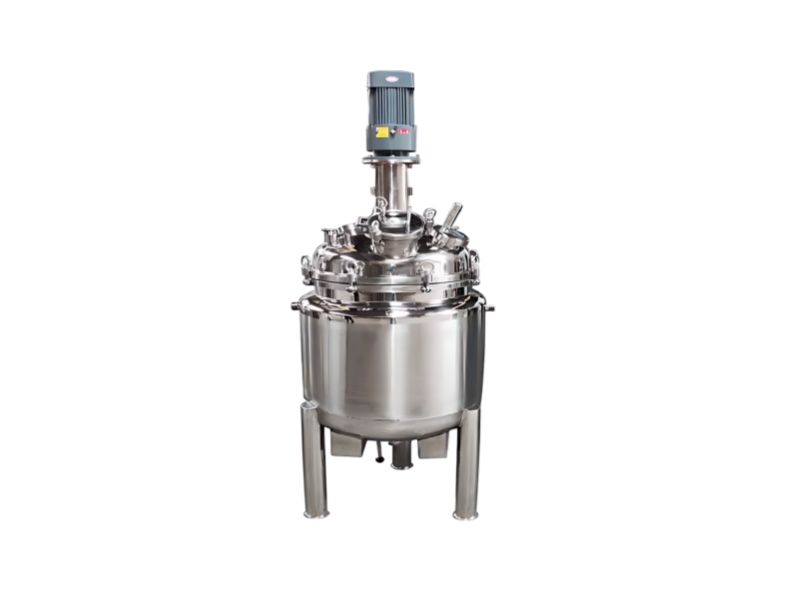
Based on the customer's formula, the raw materials are primarily aqueous, with minimal oil-phase components. Therefore, flavoring is produced simply through mixing and heating. The core design element is a heating mixing tank. Based on the customer's process requirements and production capacity targets, we recommended a fixed type vacuum heating mixing tank and implemented several customized designs specifically for the material characteristics of chicken base paste.
● Equipment Model: SLMT-650 Vacuum Heated Mixing Tank
● Loading Volume: 500L (Suitable for 500kg/batch)
● Quantity: 1 unit (Suitable for batch production to meet capacity requirements)
2.2 Core Structural Design
2.2.1 Tank Structure
● Cylinder Body: Vertical cylindrical structure, made of 304 stainless steel, with mirror-polished inner wall (Ra≤0.4μm) to reduce material residue.
● Bottom End: Elliptical end*design, which, compared to a flat bottom, facilitates the concentration of viscous sauces towards the center, making discharge easier.
● Jacketed Heating: A steam jacket is installed on the outside of the tank, allowing for steam heating or cooling water cooling. It provides a large heating area and uniform temperature.
● Insulation Design: Three-layer jacket, with the outermost layer being a heat insulation layer to prevent workers from being burned during operation.
2.2.2 Mixing System
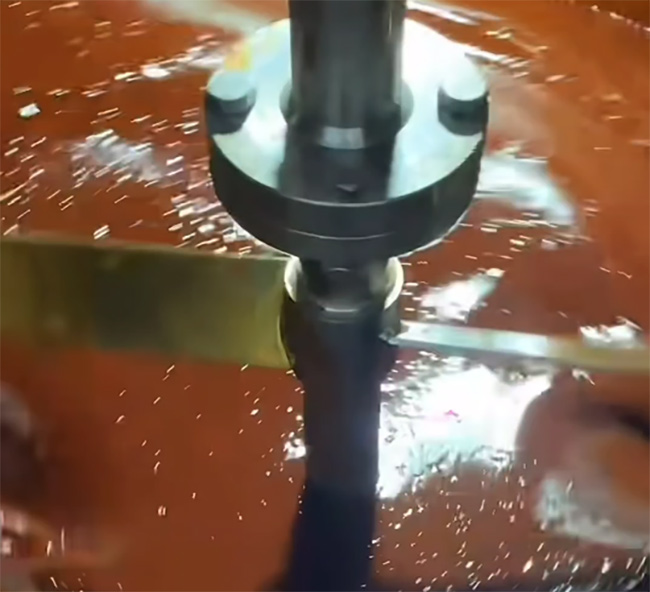
According to the design principles of chemical mixers, the type of impeller directly affects the flow pattern and mixing effect. Considering the medium viscosity of chicken flavoring paste, we configured an I shaped mixing paddle.
Design Features | Value of Chicken Flavoring |
Horizontal mixing paddle and approximately 45 degrees tilting | Axial flow is generated, which drives the material to circulate up and down. |
Speed adjustable by frequency conversion | 0-45 rpm, adaptable to different viscosity stages |
2.2.3 Vacuum System
● Vacuum Port: A DN50 vacuum port is provided on the top of the tank, which can be connected to a vacuum pump.
● Vacuum Degree: Reaches -0.09 MPa at room temperature; the vacuum degree decreases at high temperatures.
● Function: Conducting thermal reactions in a vacuum environment can:
● Prevent oxidation of oils and aroma components
● Remove air bubbles from materials, resulting in a finer product texture.
2.2.4 Discharge System
Bottom Manual Valve Discharge Design:
● Valve Location: Bottom of the tank
● Valve Type: Manual ball valve (sanitary grade)
● Operation Method: After opening the valve, the material flows out automatically under gravity (the viscosity of chicken flavor paste is not very high, so gravity flow can be used).
2.2.5 Cleaning and Auxiliary Configuration
Configuration | Function | Value of Chicken Base Paste |
Spray cleaning ball | Top-mounted for 360° spray cleaning | Connect the water pipe and start vacuum and negative pressure flushing. |
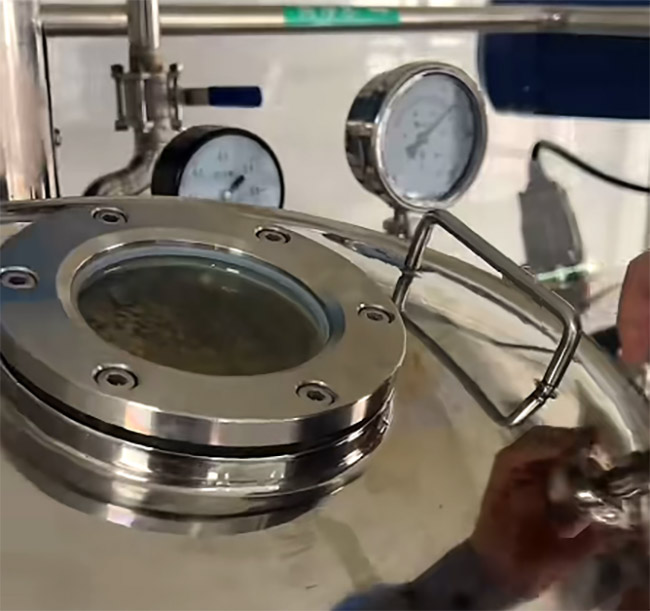
Observation port | Viewing glass, with LED light | Real-time monitoring of material status and reaction conditions. |
Feed inlet | Top quick-opening feeding port | Convenient for input of solid and liquid raw materials |
Vacuum port | Connect to vacuum system | Achieving vacuum reaction and degassing |
Temperature sensor | PT100 sensor | Precise temperature control ensures consistent reaction. |
2.3 Equipment in Use
The equipment is currently in operation for the formal production of chicken flavoring paste, and the customer is very satisfied with it. Below is a video of the equipment in use for reference:
2.4 Applicable Scenarios
This solution is particularly suitable for:
● Thermo-reactive paste flavoring manufacturers (chicken, beef, seafood, etc.)
● Heating and mixing of medium to low viscosity pastes (formulas mainly using aqueous raw materials, and the materials need to be in micro-particle form or hot-melt solid food raw materials)
● Products requiring vacuum degassing or vacuum reaction
● Food ingredient manufacturers with high batch consistency requirements
III. Call to Action
In this case, we designed the vacuum mixing tank with heating jacket for the customer to make chicken base paste. For different production need, the machine can be different. If you are also looking for suitable equipment for the production of thermo-reactive flavoring pastes such as chicken or beef flavoring paste, or need to expand production to meet market demand, we offer:
● Process Diagnosis: Optimizing reaction parameters based on your formula
● Equipment Selection: Recommending suitable volume based on capacity requirements
● Custom Design: Customizing mixing methods for special materials
Contact us to get your sauce production solution.