


 English
 French
The nutraceutical industry relies on accurate powder blending to produce products such as protein supplements, vitamin and mineral premixes, powdered drink mixes, and dietary supplement formulations. Unlike some conventional food powders, nutraceutical formulations may contain numerous ingredients in relatively small proportions. Achieving a uniform blend is therefore not simply a matter of mixing everything together.
Ingredients can differ considerably in particle size, bulk density, flowability, and moisture sensitivity. These differences influence how powders move inside a mixer and whether the final blend remains uniform during discharge and subsequent handling.
So, what are the best dry powder mixers for nutraceutical manufacturers? The answer depends on the formulation, production scale, required blend uniformity, and cleaning requirements. This guide compares four commonly considered mixer types and explains how to select a suitable configuration for different nutraceutical applications.
I. Why Nutraceutical Powder Blending Requires Special Attention
Nutraceutical formulations often combine major ingredients with small quantities of functional ingredients, such as vitamins, minerals, sweeteners, and botanical extracts. Even when a mixer produces a visually uniform batch, the actual distribution of low-dose ingredients may not be sufficiently consistent. Several material characteristics deserve attention.
Differences in particle size: Fine particles and coarse particles may move differently during mixing. Under certain conditions, smaller particles can migrate through spaces between larger particles, resulting in segregation.
Differences in bulk density: Ingredients with substantially different densities may respond differently to the movement inside a mixer. The formulation and mixing process should be evaluated together rather than assuming that longer mixing will solve every blending problem.
Flowability and cohesiveness: Free-flowing powders are generally easier to blend than materials that tend to form lumps or adhere to equipment surfaces. Hygroscopic ingredients may also require additional attention to environmental conditions and handling.
Risk of post-mixing segregation: Blend uniformity can change during discharge, conveying, storage, or transfer. A satisfactory mixing result does not automatically guarantee that the powder remains uniform throughout the entire production process.
For nutraceutical manufacturers, mixer selection should therefore consider both the blending process and what happens to the powder afterward.
II. Common Types of Dry Powder Mixers
Different mixer structures create different material movement patterns. The following equipment types are worth considering for nutraceutical powder production.
2.1 Ribbon Blender: A Versatile Choice for Routine Production
Ribbon blenders are widely used for blending free-flowing powders in food, chemical, and supplement manufacturing. The horizontal mixing chamber contains inner and outer helical ribbons that move materials in different directions, promoting circulation throughout the vessel. This structure is suitable for many routine nutraceutical formulations, including protein powder blends, powdered beverage mixes, and mineral-containing formulations.
1)Advantages:
Suitable for medium and large production batches.
Handles a broad range of free-flowing powder formulations.
Practical for continuous production scheduling with batch-based operation.
Such mixer can be configured with different feeding and discharge arrangements.
2)Points to consider:
Ribbon blenders are not automatically suitable for every formulation. Cohesive materials, highly sensitive ingredients, or blends with significant density differences may require additional process evaluation. Mixing time and ribbon speed should be established through testing rather than selected solely from general recommendations.
2.2 Paddle Mixer: For Formulations Requiring Gentle Mixing
Paddle mixers use paddles mounted on a rotating shaft to move and redistribute materials. Depending on the paddle arrangement and operating speed, they can provide a relatively gentle mixing action.
This type may be considered for nutraceutical formulations containing fragile particles or ingredients where excessive mechanical action is undesirable. Potential applications include specialty supplement blends and formulations containing ingredients with different physical characteristics.
1)Advantages:
Mixing action can be adapted through paddle arrangement and operating parameters.
Worth evaluating for formulations requiring controlled material movement.
Can be designed for different batch capacities and process requirements.
2)Points to consider:
A gentle mixing action does not necessarily mean better uniformity. The required mixing intensity depends on the formulation. Manufacturers should assess whether the selected paddle arrangement can distribute minor ingredients adequately without causing unnecessary particle damage or segregation.
2.3 V-Type Blender: Simple Structure and Gentle Tumbling
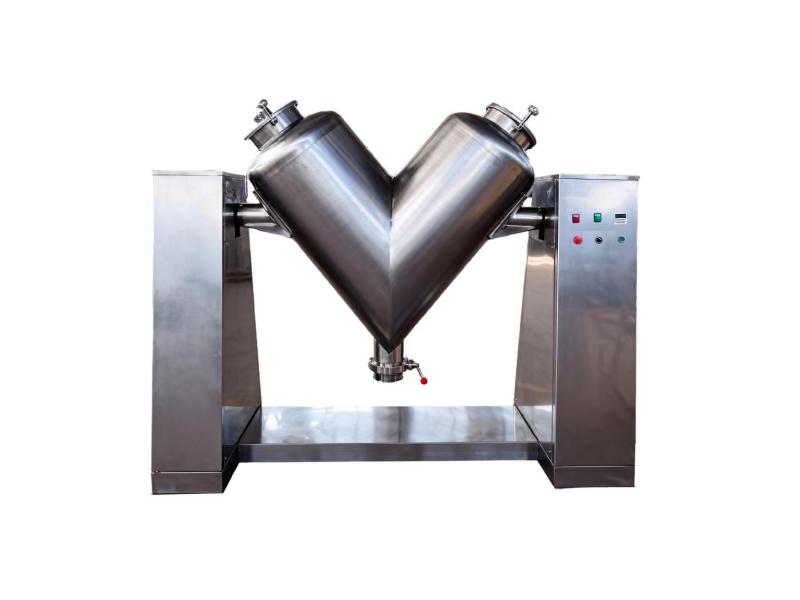
A standard V-type blender uses a rotating V-shaped vessel to create repeated splitting and recombination of powder during operation. Unlike ribbon and paddle mixers, the standard design does not contain an internal agitator. Material movement is mainly driven by gravity and vessel rotation. This relatively simple internal structure can be attractive when cleaning, inspection, and avoiding internal mechanical components are important considerations.
1)Advantages:
No standard internal agitator or mixing shaft.
Relatively simple internal construction.
Gentle tumbling action for suitable free-flowing powders.
Convenient access for internal inspection, depending on the equipment design.
2)Points to consider:
V-type blenders rely on the movement of the powder itself. They are not ideal for every cohesive or poorly flowing material. Formulations containing ingredients with substantially different particle sizes or densities should be evaluated carefully because segregation may occur.
2.4 Double Cone Blender: Another Option for Tumbling-Based Mixing
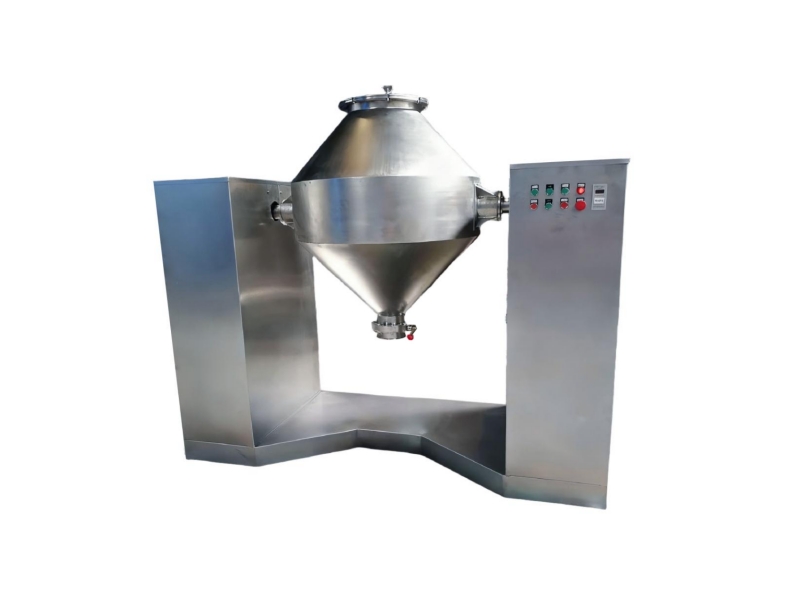
A standard double cone blender works on a similar principle to a V-type blender. The vessel rotates, allowing powders to tumble and redistribute through repeated changes in material position. Its standard configuration also has no internal agitator structure. This makes it a relatively straightforward option for suitable free-flowing powder formulations.
For nutraceutical manufacturers, the choice between a V-type and a double cone blender should not be based on the assumption that one is universally more effective. Vessel geometry, batch size, filling level, material characteristics, and required mixing uniformity all matter.
2.5 Customized Double Cone Blender with Internal Mixing Structure
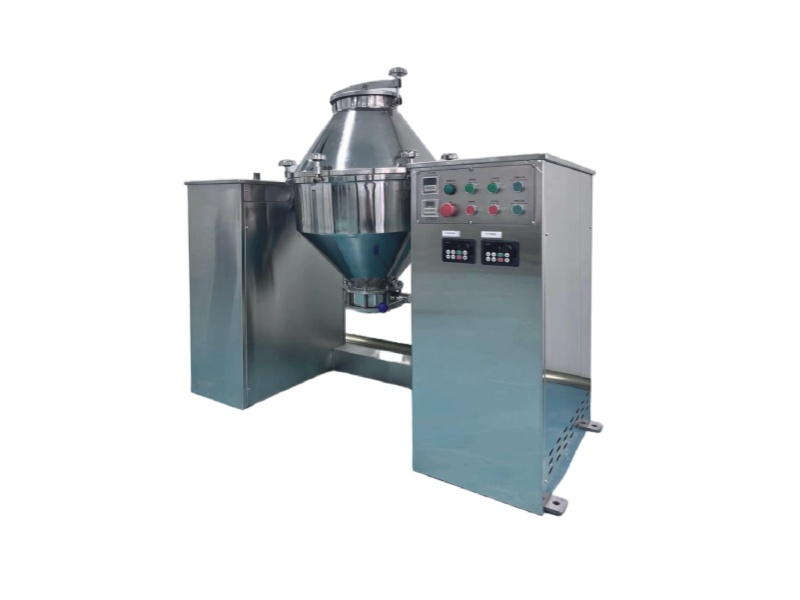
Some formulations may require more active material circulation than a standard tumbling design can provide. In such cases, a customized double cone blender can be considered with an additional internal forced-mixing structure, such as a ribbon-type assembly. This combines vessel rotation with internal mechanical agitation, creating additional movement within the powder bed.
This is a customized design rather than a standard feature of a double cone blender. It may be worth evaluating when a formulation is difficult to blend using conventional tumbling alone. However, the additional internal structure also introduces more components that need to be inspected and cleaned. Manufacturers should balance mixing performance against hygiene, maintenance, and cleaning requirements.
III. How to Select the Right Mixer for Your Formulation
Choosing a mixer should start with the characteristics of the actual ingredients, not simply the desired machine capacity.
3.1 Consider the Ingredient Ratio and Density Difference
A formulation containing one major carrier ingredient and several low-dose functional ingredients requires careful attention to ingredient distribution.
For example, a protein powder blend may contain a large proportion of protein base powder together with smaller quantities of vitamins, minerals, flavoring agents, and sweeteners. A preliminary blending step may help distribute low-dose ingredients before they are introduced into the main batch. This is particularly worth evaluating when the minor ingredients represent a very small percentage of the total formulation.
When bulk density differences are significant, manufacturers should assess the mixing behavior through trials. Depending on the materials, a customized forced-mixing structure may be considered, but it should not be treated as an automatic requirement.
3.2 Evaluate Particle Size and Flowability
Particle size distribution influences how ingredients move and interact during blending. If the formulation contains powders with very different particle sizes, segregation may occur during mixing or after discharge. In some applications, adjusting the raw material particle size before blending can be more effective than simply increasing mixing time.
For cohesive or moisture-sensitive powders, the manufacturer should also evaluate whether the mixer can handle the material without excessive buildup or lump formation.
3.3 Define the Required Blend Uniformity
A common mistake is to judge blending quality only by appearance. For nutraceutical products, especially those containing low-dose ingredients, manufacturers should establish an appropriate sampling and testing procedure. Samples taken from different locations or stages of a batch can help assess whether the mixing process achieves the required uniformity.
Over-mixing should also be avoided. Longer operation does not always improve blend quality. Under certain conditions, continued mixing may increase the possibility of segregation.
The appropriate mixing endpoint should be determined through formulation-specific trials and quality testing.
3.4 Match the Mixer to the Production Batch
Mixer capacity should be calculated based on the required batch weight and the bulk density of the formulation. A basic calculation is: Required powder volume = Batch weight ÷ Bulk density.
For example, a 300 kg batch with a bulk density of 0.5 kg/L occupies approximately 600 L of powder volume. However, this does not mean a 600 L mixer is sufficient. The total vessel volume and recommended working volume are different. The actual working capacity should be confirmed with the equipment manufacturer according to the mixing structure and material characteristics.
IV. Hygiene and Cleaning Considerations
Hygiene is an important part of nutraceutical equipment selection. Different products may contain different active ingredients, allergens, flavors, or botanical materials, making cleaning and changeover procedures particularly important.
A standard V-type or double cone blender has no internal agitator, which can simplify internal inspection and reduce the number of internal components requiring cleaning. Ribbon and paddle mixers contain shafts and mixing components inside the chamber. Their cleaning arrangements should therefore be evaluated carefully, particularly when frequent product changeovers are expected.
Regardless of mixer type, manufacturers should pay attention to:
• Product-contact material and corrosion resistance.
• Internal surface finish and accessible cleaning areas.
• Discharge valve design and potential powder retention.
• Seals, joints, and other areas where material may accumulate.
• Cleaning procedures and verification requirements.
Stainless steel 304 is commonly used for many food-processing applications. Stainless steel 316 may be considered where the formulation or cleaning environment requires greater corrosion resistance. The final material selection should be based on actual process conditions.
For manufacturers operating under U.S. dietary supplement regulations, 21 CFR Part 111 includes requirements concerning equipment design, maintenance, and cleaning. Equipment selection should support the manufacturer’s documented quality and sanitation procedures.
V. Conclusion
The best dry powder mixers for nutraceutical manufacturers are those that match the formulation’s physical properties, production requirements, and hygiene expectations.
Ribbon blenders are versatile options for many routine production applications, while paddle mixers may be worth considering when controlled or gentler material movement is needed. Standard V-type and double cone blenders offer simple tumbling-based mixing without internal agitators. Where additional circulation is required, a customized double cone design with an internal ribbon-type mixing structure can also be evaluated.
Before purchasing equipment, manufacturers should confirm the target batch size, ingredient characteristics, required blend uniformity, cleaning procedure, and discharge conditions. Testing the actual formulation is the most reliable way to determine whether a proposed mixer can meet production expectations.
Technical References
1. Côté, P., & Abatzoglou, N. (2006). Powder and other divided solids mixing: Scale-up and parametric study of a ribbon blender used in pharmaceutical powders mixing. Pharmaceutical Development and Technology, 11(1), 29–45. DOI: 10.1080/10837450500463778.
2. Venables, H. J., & Wells, J. I. (2001). Powder mixing. Drug Development and Industrial Pharmacy, 27(7), 599–612.
3. U.S. Food and Drug Administration. 21 CFR Part 111 – Current Good Manufacturing Practice in Manufacturing, Packaging, Labeling, or Holding Operations for Dietary Supplements.
4. U.S. Food and Drug Administration. Inspection Guide: Oral Solid Dosage Forms – Pre/Post Approval Issues, section on tumbler blenders.