


 English
 French
How do you adjust the grinding fineness of a colloid mill? In an adjustable colloid mill, the main control is the clearance between the rotor and the stator. Turning the adjustment handle changes the stator’s height, which increases or decreases the working gap and affects the resulting particle size and product texture.
For the colloid mill adjustment mechanism demonstrated in this guide, raising the stator increases the rotor-stator gap and generally produces a coarser output, while lowering the stator reduces the gap and generally produces a finer output. However, the correct setting depends on the material being processed and the desired result. A smaller gap does not automatically guarantee a specific mesh size or a smoother finished product. The most reliable approach is to understand the adjustment mechanism, make controlled changes, and verify the output through testing.

I. How Does Colloid Mill Mesh Size Adjustment Work
The grinding fineness of an adjustable colloid mill is primarily influenced by the working clearance between the rotor and the stator. This gap determines how the material passes through the grinding zone and experiences mechanical shear and friction.
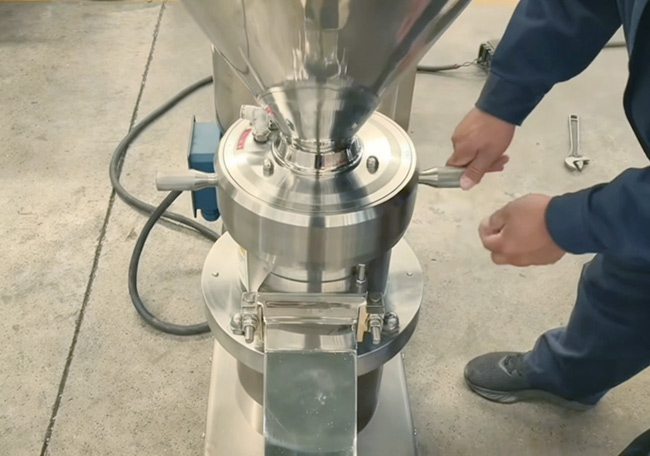
On the colloid mill adjustment mechanism covered in this guide, an external handle controls the stator’s vertical position. Raising or lowering the stator changes the clearance between the two grinding components.
The basic relationship is straightforward:
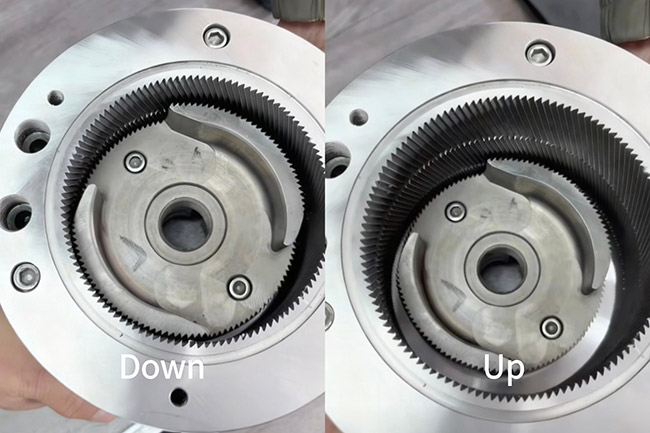
• Raise the stator: Increase the rotor-stator gap for a generally coarser output.
• Lower the stator: Decrease the rotor-stator gap for a generally finer output.
This relationship provides the starting point for adjusting the machine to suit different materials and processing requirements.
1.1 What Happens When the Stator Moves Up or Down
The rotor and stator work together to create the grinding zone. As material passes through this area, mechanical shear and friction help reduce particles and, depending on the application, disperse or emulsify the material.
When the stator is raised, the wider clearance generally reduces the intensity of the grinding action applied within the gap. The resulting product tends to be coarser. When the stator is lowered, the narrower clearance generally increases the grinding intensity. This can help produce a finer output, provided that the material and operating conditions are suitable.
The exact relationship between the adjustment position and the final product depends on the machine design, the material’s physical properties, and the operating conditions.
1.2 Why the Adjustment Gap Matters More Than the Mesh Number Alone
The term mesh size is often used when discussing grinding fineness, but it should not be treated as a direct measurement of the colloid mill’s adjustment position. A colloid mill’s handle changes the rotor-stator clearance. The resulting particle size or texture must then be evaluated using an appropriate measurement method or product acceptance standard.
This distinction is particularly important for wet-ground materials, pastes, and emulsions. Their final texture may depend on particle-size distribution, viscosity, oil or liquid content, and the characteristics of the formulation.
Therefore, use the adjustment handle to control the grinding conditions, then verify the actual product result rather than assuming that a particular handle position corresponds to a guaranteed mesh size.
II. How to Adjust a Colloid Mill Using the Adjustment Handle
For the adjustable colloid mill design covered in this guide, the handle changes the stator’s vertical position and therefore the working gap between the stator and the rotor. The following steps explain the adjustment principle. Because adjustment mechanisms and operating procedures vary between colloid mill models, always follow the instructions supplied for your specific machine.
Step 1: Identify the Adjustment Handle
Locate the external adjustment handle or handwheel used to change the grinding clearance.
This handle operates the adjustment mechanism that raises or lowers the stator. It is different from the main motor switch and should not be confused with other fastening or locking components.
Before making any adjustment, confirm how the handle and locking mechanism work on your specific model.
Step 2: Rotate the Handle to Change the Stator Height
Turning the handle moves the stator vertically through the machine’s adjustment mechanism.
For the mechanism shown in this guide:
• Turning the handle in the direction that raises the stator increases the gap.
• Turning the handle in the direction that lowers the stator decreases the gap.
The clockwise or counterclockwise direction depends on the adjustment mechanism and the viewing orientation. Therefore, confirm the direction shown on your machine. Following is a video to show you how to adjust the handle:
Step 3: Check the Resulting Gap
As the stator moves up or down, the clearance between the rotor and stator changes. A wider gap generally produces a coarser output, while a narrower gap generally produces a finer output.
The gap should remain within the adjustment range specified for the machine. Do not force the handle beyond its designed travel or assume that the smallest possible gap is always the correct operating position.
Step 4: Test the Material at the Selected Setting
After setting the gap according to the machine’s operating instructions, evaluate the actual product. Check whether the output meets the required particle size, smoothness, or consistency. If further refinement is needed, make a small adjustment within the permitted range and compare the results. This controlled approach is more reliable than making large adjustments without checking the resulting product.
III. What Is the Difference Between Raising and Lowering the Stator
The easiest way to understand colloid mill gap adjustment is to compare the two settings directly.
Adjustment | Stator Position | Rotor-Stator Gap | General Output Tendency |
Raise the stator | Higher | Larger | Coarser |
Lower the stator | Lower | Smaller | Finer |
The table summarizes the basic adjustment relationship for the mechanism described in this guide. It does not establish a universal mesh-size conversion because the resulting product depends on the machine and material.
3.1 When Should You Increase the Gap
A larger gap may be worth testing when the existing setting produces an unnecessarily fine product, when the process requires a coarser texture, or when the current operating conditions are unsuitable for the material.
The correct setting should still be determined by product quality and stable machine operation. Increasing the gap does not guarantee higher throughput in every application, because the actual production rate also depends on the material, feeding conditions, and processing requirements.
3.2 When Should You Decrease the Gap
A smaller gap may be worth testing when the product is too coarse and a finer result is required. However, reducing the clearance too aggressively can introduce problems. Depending on the machine and material, the process may become less stable, the product may heat up more, or the motor load may increase.
The rotor and stator must never be allowed to make unintended contact. Follow the manufacturer’s permitted adjustment range and operating procedure. The practical goal is to find a working gap that achieves the required product quality while maintaining stable operation.
IV. Does a Smaller Colloid Mill Gap Always Produce a Finer Product
Reducing the rotor-stator gap generally increases the intensity of the grinding action, but the final product is not determined by the gap alone. Material properties, machine design, feed conditions, and operating parameters also influence the result. This is why the same adjustment may produce different outcomes with different materials.
4.1 Material Characteristics Affect Grinding Results
Different materials respond differently to colloid milling. For example, an oil-rich nut material may form a thick paste, while a more fluid material may behave differently in the grinding zone. A change in viscosity or feeding behavior can affect how the material passes through the machine.
For this reason, the best gap for one product should not automatically be applied to another.
4.2 Gap Adjustment Is Not the Same as a Guaranteed Mesh Setting
A colloid mill does not necessarily provide a direct one-to-one relationship between the handle position and a particular mesh size. The gap influences the grinding action, but the resulting particle-size distribution must be evaluated separately.
For applications that require a specific particle-size specification, use an appropriate measurement method rather than relying solely on the handle position. For paste products, visual inspection and sensory evaluation may also be necessary because nominal particle size does not fully describe the final texture.
4.3 Finer Grinding May Require More Than One Pass
If a single pass does not achieve the required product fineness, a second grinding pass may be worth evaluating. For some applications, additional processing or a different equipment configuration may be necessary. The appropriate solution depends on the target texture, material properties, and required production capacity.
For example, in almond paste processing, the output may remain relatively thick and retain a fine-particle texture after the initial grinding stage. A second pass or suitable downstream homogenization may be considered if a smoother product is required, subject to equipment compatibility and testing. See our Processing Technology for Making Nut Butter for further information about nut paste processing considerations.
V. Important Safety Considerations During Gap Adjustment
Correct adjustment is essential not only for product quality but also for safe and reliable operation. The exact procedure depends on the colloid mill design. Some machines permit certain adjustments during operation, while others require shutdown before the gap is changed.
Always follow the operating manual for your specific model rather than applying a general instruction to every machine. Before adjusting the colloid mill:
• Confirm whether the machine must be stopped and isolated from its power supply before adjustment.
• Release locking components only as directed in the operating manual.
• Do not force the adjustment handle beyond the designed range.
• Prevent unintended contact between the rotor and stator.
• Retighten or secure the locking mechanism as specified by the manufacturer.
• If the machine produces abnormal noise, vibration, or signs of mechanical contact, stop and investigate according to the prescribed procedure.
• Never reach into the grinding chamber or attempt to inspect moving components while the machine is running.
These precautions help protect the grinding components and reduce the risk of damage caused by incorrect adjustment.
Conclusion: The Right Colloid Mill Gap Depends on Your Product
Adjusting colloid mill grinding fineness starts with understanding how the adjustment handle changes the stator's position relative to the rotor. For the mechanism demonstrated in this guide, raising the stator increases the gap and generally produces a coarser output, while lowering the stator decreases the gap and generally produces a finer output. However, the gap is only one factor affecting the final result. Material properties, operating conditions, and the target product specification must also be considered.
The most reliable approach is to follow the machine's adjustment instructions, make controlled changes within the permitted range, and evaluate the actual product after each adjustment.