


 English
 French
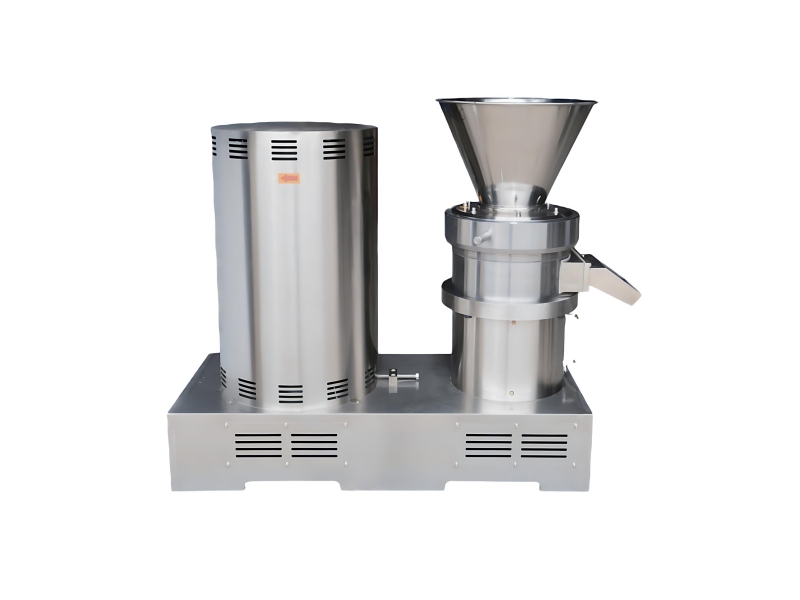
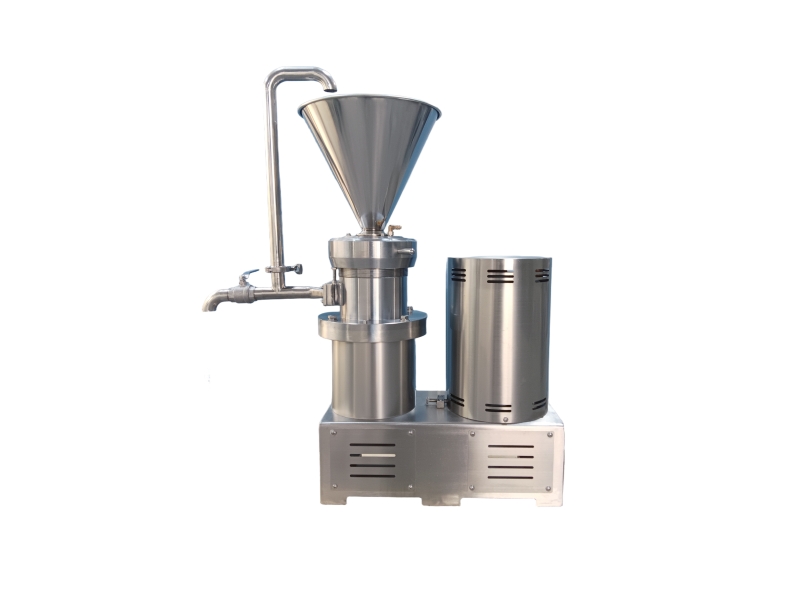
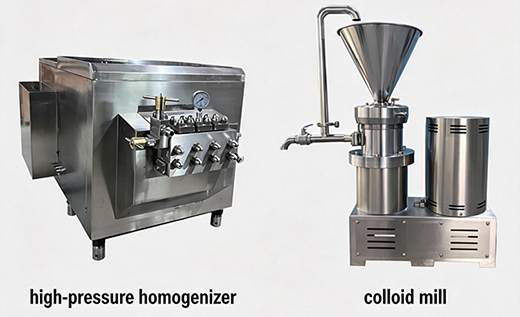
What is the relationship between colloid mill and high-pressure homogenizer? You can consider the two devices as homogenizing equipment, capable of refining materials to a certain degree. However, their working principle, feed requirement, homogenization effect, and application differ fundamentally. Simply put, colloid mills excel at "opening up" the homogenization process, while high-pressure homogenizers excel at "fine-tuning." In most scenarios requiring high fineness, they are used in conjunction with each other, rather than being substitutes.
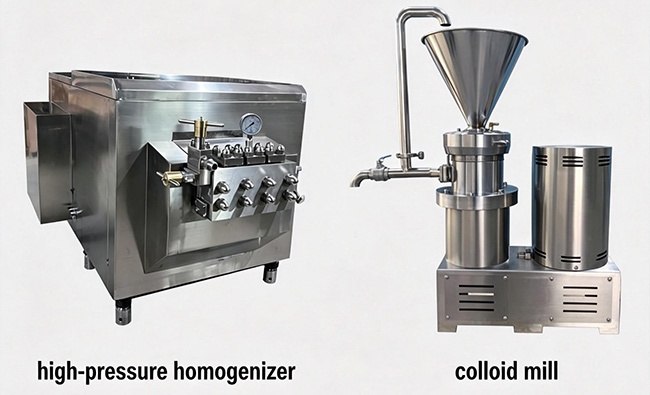
I. The Essential Difference of the Homogenization Principle
The working principle of colloid mill is similar to that of high-speed rotating grinding wheel - the material is forcibly dragged through a narrow gap and ground up. The working principle of a high-pressure homogenizer is similar to that of a high-pressure water jet impacting sediment–not grinding, but blasting and impacting. See the comparison table below for details:
Dimension | Colloid Mill | High-Pressure Homogenizer |
Core Force | Shear force | Cavity effect + collision + shear |
Energy Density | Medium | Extremely high (10⁹W/m² at the moment of cavitation collapse) |
Mechanical Contact | Material in contact with the stator and rotor | No fierce contact, only pass by |
Material Temperature Rise | High (frictional heat) | Low (primarily adiabatic compression) |
II. Differences in Feed Requirements
You can see the different feeding requirements in the following by the two type devices.
2.1 Colloid Mill: Accept Big Size Material
Colloid mills typically have a large feed inlet, allowing them to directly process coarsely crushed lumpy materials. For example:
● Whole peanuts, almonds (must be coarsely crushed first)
● Fresh chili peppers, garlic
● Cooked beans (must have a certain moisture content, not too dry)
This is because colloid mill is a grinding device; its design purpose is to reduce large particles to smaller ones.
2.2 High-Pressure Homogenizer: Only process fluids
The feed to a high-pressure homogenizer must be a flowable liquid or slurry. It cannot process:
● Whole nuts
● Large pieces of fruits and vegetables
● High-viscosity but non-flowable pastes
This is because the plunger pump in a high-pressure homogenizer relies on fluid intake and discharge. If the material cannot flow, the plunger pump will not be able to feed properly, and the equipment will run dry and be damaged.
Dimension | Colloid Mill | High-Pressure Homogenizer |
Material Form | Blocks, granules, and slurries, etc | Liquids |
Typical Material Feed Size | ≤20mm(depend on model) | ≤0.5mm(Preprocessing required) |
Feed Pump | No special requirements | Usually rotor pump or screw pump |
In short: a colloid mill can turn "lumps" into "sauce", while a high-pressure homogenizer can only make the "sauce" finer.
III. Differences in Homogenization Effects
The two devices also have differences in the homogenization performance, you can check the following analysis.
3.1 Fineness Limits of Colloid Mill
The minimum achievable particle size of a colloid mill is limited by the minimum mechanical clearance between the stator and rotor. Currently, the minimum clearance for industrial-grade colloid mills is approximately 0.1 mm (100 μm). Even when the clearance is pushed to its limit, due to factors such as rotor vibration and thermal expansion, the actual stable operating clearance is still around 100-150mesh(depending on material).
Typical Application Fineness:
● Regular Peanut Butter: 40-150 mesh
● Chili Sauce: 40-80 mesh
● Sesame Paste: 40-150 mesh
3.2 Fineness Limits of High-Pressure Homogenizer
High-pressure homogenizers have no mechanical contact parts; fineness depends only on pressure and material properties. The final mesh size is about 200-1000mesh, depending on the specific material.
Typical Application Fineness:
● Ultra Fine Peanut Butter: 200-500mesh
● Ultra Fine Sesame Paste: 120-500mesh
● Ultra Fine Protein Beverage: 200-500mesh
Why it can achieve even finer fineness: The shock waves generated by the cavitation effect can easily break down submicron-level aggregated particles, which is impossible with pure mechanical shearing.
IV. Complementary Relationships: Complements instead of Substitutes
If you have a colloid mill, do you still need a high-pressure homogenizer? And vice versa?
Scenario 1: Low Fineness Requirements (≤150 mesh)
If you are producing mass-market products, such as regular peanut butter (60-120 mesh) or chili sauce (40-100 mesh), a single colloid mill or two sets are sufficient.
Scenario 2: High Fineness Requirements (≥200 mesh)
If you want to enter the high-end market, such as ultra fine peanut butter (300 mesh) or export-grade sesame paste, a colloid mill + high-pressure homogenizer is the standard configuration.
Colloid mill is responsible for turning whole particles into a paste (from centimeter-scale to hundreds of micrometer-scale).
High-pressure homogenizer is responsible for breaking through fineness limits (from hundreds of micrometer-scale to micrometer-scale).
Why they are necessary:
● High-pressure homogenizers cannot handle large pieces of material.
● Colloid mills cannot achieve ultra fine processing requirements.
● The two are complementary, not competitive.
● Application case: In the case of Retrofit with High-Pressure Homogenizer for 300Mesh Peanut Butter Production, the two devices work together to make fine peanut butter.
Scenario 3: Fluids (such as milk or juice) as the Handling Product
If you are producing a liquid product, choose a high-pressure homogenizer directly; a colloid mill is not necessary.
V. Conclusion
Both colloid mill and high-pressure homogenizer are excellent homogenizing equipment, but they serve different stages of the process. The former transforms large materials into a paste, while the latter can refine the paste to an extremely fine texture. Furthermore, they are not interchangeable; each has its own unique processing characteristics, and in some situations, one may suffice. However, in others, both machines need to work together to elevate product quality to new heights.