


 English
 French
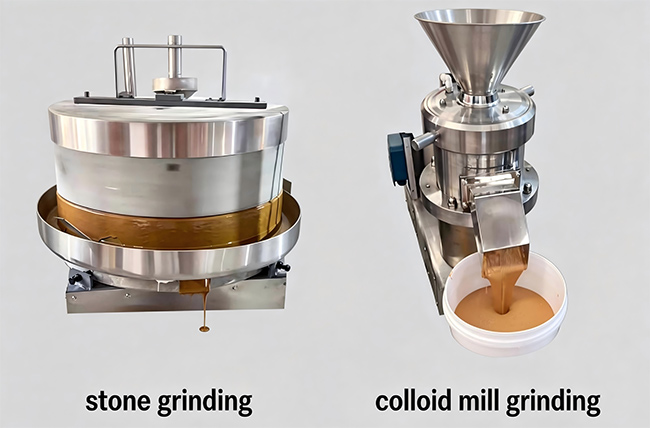
What are the differences between stone grinder and colloid mill in processing nut butter? In short, stone grinder represents low-speed, low-temperature, and traditional flavor, while colloid mill is the mainstay of high-efficiency, controllable, and industrialized production. Stone mills focus on flavor, while colloid mills prioritize efficiency.
Simply put: Choose a stone grinder for pursuing the ultimate natural flavor, and opt for a colloid mill for focusing on production capacity and cost-effectiveness. In the premium market, both can complement each other—first use the colloid mill for rough grinding to enhance efficiency, then employ the stone grinder for fine grinding to boost aroma. The following is a specific introduction to the differences between the two.

I. Differences in Working Principle
Following are the differences analysis of the two type machines:
1.1 Stone Mill: Traditional Wisdom of Gravity and Friction
The core components of the stone mill are a pair of natural granite stone grinding discs. The lower plate is fixed, and the upper plate rotates (usually 20-40rpm). The material enters from the center and enters between two plates under the action of gravity, relying on the friction, compression, and shear between the rough surface of the stone and the material to achieve grinding.
It can be understood as follows: the working principle of a stone mill is like crushing grains with two rough stones - slow, gentle, and natural.
1.2 Colloid Mill: Modern Engineering of High-Speed Shearing
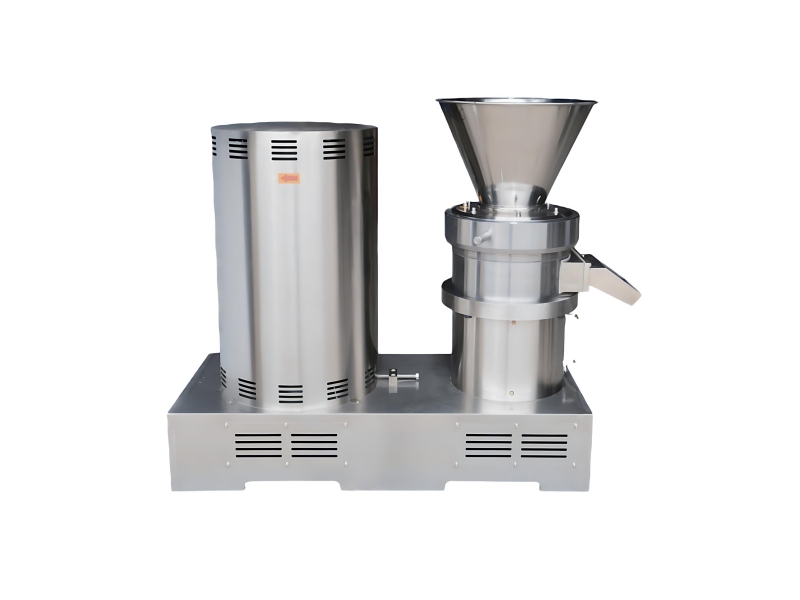
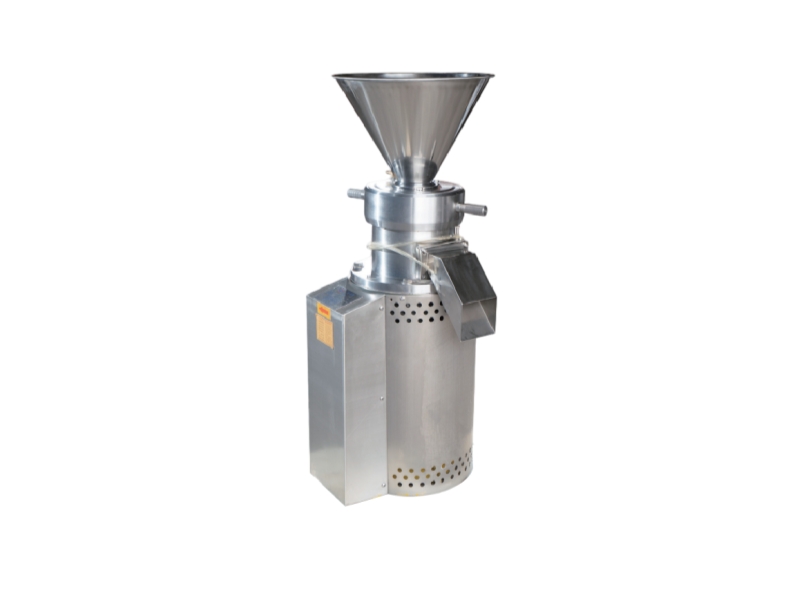
The core components of a colloid mill are the stator and rotor (usually made of stainless steel). The rotor rotates at high speed (2900rpm) while the stator remains stationary, maintaining a small gap (0.1-3mm) between the two. When the material passes through this gap, it is subjected to strong shear force, friction force, and high-frequency vibration.
It can be understood as follows: The working principle of a colloid mill is like a high-speed rotating grinding wheel sharpening - fast, powerful, and efficient.
Dimension | Stone Grinder | Colloid Mill |
Core Force | Friction, compression, shear | Shear |
Rotary Speed | 20-40rpm | 2900rpm |
Linear Speed | 2-5 m/s | 15-25 m/s |
Mill Temperature | <45℃ | 50-80℃(With cooling jacket design to lower) |
Milling Part Material | Savageness granite | Stainless steel, alloy, diamond |
To quickly see the working difference, you can watch working videos of the two type devices below:
II. The Difference in Thermal Management
Why is grinding temperature so important for nut sauce? How do the two devices perform? Temperature is a key factor determining the flavor of nut sauce.
2.1 The Effect of Temperature on Nut Butter
1)Oil oxidation: Nut butter has a high oil content (45-65%), and unsaturated fatty acids are temperature sensitive. Research has shown that for every 10 ° C increase in grinding temperature, the rate of oil oxidation increases by 2.3 times.
2)Volatile flavor compounds: The aroma components of nuts are mostly low boiling point substances, and high temperatures can cause volatilization loss.
3)Excessive Maillard reaction: Excessive reaction can produce a burnt bitter taste, masking the natural flavor of nuts.
2.2 The Thermal Management Advantages of Stone Grinding
1)Low speed (20-40rpm) generates less frictional heat
2)Natural stone has low thermal conductivity and is not prone to heat accumulation
3)Discharge temperature: usually controlled at 40-45 ° C
2.3 The Thermal Management Challenge of Colloid Mill
1)High speed (2900rpm) generates a large amount of frictional heat
2)Must be forcibly cooled: requires water-cooled jacket to control temperature
3)Discharge temperature: with water cooling, it can be controlled at 50-60 ° C, and without water cooling, it can reach above 80 ° C
Dimension | Stone Grinder | Colloid Mill |
Discharge Temperature | About 40-45° C | About 50-60°C(with cooling water) |
Oil Oxidation Risk | Low | Medium |
Flavor Retention | Good | Common |
III. Differences in Product Texture
What are the differences in texture between nut butter produced by stone milling and colloid mill milling?
3.1 Stone Milling: Grainy Texture or Smooth Paste After Long Time Repeated Grinding
The grinding zone of a stone mill is wider (usually 5-20mm), and the material stays between the grinding discs for a longer time (several seconds to tens of seconds). This results in:
1)Wider Particle Size Distribution: Containing both fine powder and tiny particles
2)Richer than 10 Layers of Texture: A subtle grainy texture can be felt, considered the source of the "handmade" feel
3)Moderate Spreadability: The granular structure provides a certain degree of support.
4)Long Time Grinding for Smooth Paste: For short time or one time grinding, the nut butter is grainy. Long time or repeated grinding are required to get fine nut butter.
3.2 Colloid Milling: Fine Nut Butter in One Time
The grinding zone of a colloid mill is extremely narrow (0.1-3mm), and the material passes through for a very short time (<1 second). This results in:
1)Narrower Particle Size Distribution: Highly uniform particle size
2)Selectable Texture: Grainy or smooth (The coarseness can be adjusted by adjusting the handle; generally, it is set to the finest setting by default.)
3)Excellent Spreadability: Smooth and easy to spread, with good extensibility.
Dimension | Stone Grinder | Colloid Mill |
Particle Size Distribution | Wide (various thicknesses) | Narrow (uniform height) |
Taste Characteristics | Layered, with a "handmade" feel | Available smooth and grainy textures |
Spreadability | Moderate | Good |
Consumer Perception | Traditional, natural | Delicate, exquisite |
IV. Differences in Application Scenarios
What products are stone mills and colloid mills suitable for respectively?
4.1 Stone Grinder Applicability
1)High-end cold-ground nut butters: Preserves natural flavor and supports premium pricing.
2)Traditional flavor products: Such as stone-ground sesame paste and traditional peanut butter.
3)Organic/natural positioning: No high-temperature processing, aligns with the clean label trend.
4.2 Colloid Mill Applicability
1)Mass-market products: Prioritize production capacity and cost efficiency.
2)Smooth texture: 80-150 mesh ultra fine peanut butter and sesame paste.
3)Large-scale continuous production: Single-machine capacity can reach 500-5000 kg/hour.
V. The Difference Between Efficiency and Cost
Dimension | Stone Grinder | Colloid Mill |
Single Unit Capacity | Low to Medium(about 5-500kg/h) | Low to High(20-5000 kg/h) |
Energy Consumption | High | Medium |
Production Area Requirements | High(usually larger space required) | Low |
Maintenance Cost | High delivery cost and replacement cost (Big size stone) | Cheap delivery cost and easy to replace |
Purchase Cost | Low to High | Low to High |
The above summarizes the differences between stone grinder and colloid mill in nut processing. Our company primarily provides colloid mill as nut butter grinder. Please feel free to contact us if you have any needs.
References:
[1] Chen, H., et al. (2022). Oxidation kinetics of unsaturated fatty acids in nut butter during processing. Food Research International, 151, 110865.
[2] European Nut Butter Association. (2023). Traditional vs. Modern Milling Techniques: A Comparative Study. ENA Technical Report 2023-07.